After analyzing dozens of sanitizer formulations and reviewing clinical efficacy data, we've found that alcohol concentration matters less than application technique and hand condition. Customers tell us they assume all 60%+ alcohol sanitizers work equally fast. They don't. In side-by-side testing, we've observed kill times ranging from under 1 minute to complete failure depending on whether hands were greasy, visibly soiled, or contaminated with organic matter.
This matters because E. coli from raw meat, bathroom surfaces, and animal contact requires different sanitizer contact times than laboratory conditions suggest. We'll show you which real-world factors slow kill time, does hand sanitizer kill E coli in practical use, when soap and water outperforms sanitizer by 90 seconds, and the application method that maximizes bacterial elimination.
TL;DR Quick Answers
Does hand sanitizer kill E. coli?
The short answer: Yes, alcohol-based hand sanitizers (60%+ concentration) kill E. coli bacteria—but killing isn't the same as cleaning.
What most people don't realize:
Sanitizers neutralize bacteria but leave dead germs on skin
The CDC warns sanitizers fail when hands are dirty or greasy
Children ages 1-4 face 4x the average E. coli infection rate
The better question to ask: How do I remove E. coli from my hands?
What the research shows:
Physical removal prevents 30% of diarrhea-related illness (CDC)
Soap and water outperform sanitizer for dirty hands
Removal eliminates contaminants, killing leaves residue
The NOWATA difference:
We developed a plant-based, rinse-free soap that physically removes 99.9%* of E. coli bacteria. Swiss lab-tested using ASTM E1174 protocol. No water needed. No residue left behind.
Bottom line: Don't just kill E. coli. Remove it.
Top 5 Takeaways
1. Killing Isn't Cleaning
Hand sanitizer takes 1-5 minutes to kill E. coli under ideal conditions
Dead bacteria sitting on skin isn't the same as clean hands
CDC's 30% illness prevention comes from physical removal (handwashing)
Not from chemical killing (sanitizing)
2. Sanitizers Fail When You Need Them Most CDC explicitly warns: sanitizers lose effectiveness on dirty, greasy, or soiled hands.
That describes most real-world scenarios with children:
Playground dirt
Petting zoo residue
Food prep mess
Summer outdoor activities
3. Children Face 4x the E. Coli Risk
Kids ages 1-4: 3.19 infections per 100,000 persons
National average: 0.84 per 100,000
Nearly four times higher risk
Peak exposure: July-September when families are outdoors and far from sinks
4. Soap and Water Wins—When You Have Access Research on hands contaminated with raw chicken:
Plain soap: 99.98% bacterial removal
Alcohol sanitizers: 90-96% removal
The problem: Most high-risk E. coli exposure happens where sinks don't exist—farmers markets, petting zoos, trails, outdoor events.
5. Physical Removal Prevents Illness, Not Kill Rates Federal data proves the hand hygiene industry has been optimizing for the wrong metric.
What actually prevents illness:
Removing contaminants from skin
Not achieving higher kill percentages in laboratory conditions
The 30% illness prevention documented by CDC comes from removal
Clinical testing shows alcohol-based hand sanitizers eliminate E. coli in 1 to 5 minutes under controlled conditions. Products containing 60-80% ethanol or isopropyl alcohol achieve greater than 5-log reduction (99.999% kill rate) against both non-pathogenic E. coli and dangerous E. coli O157:H7 strains.
However, real-world performance tells a different story. In our analysis of customer hand hygiene practices, we've observed that most people:
Apply insufficient product (less than one pump)
Wipe sanitizer off before complete drying
Use sanitizer on visibly soiled or greasy hands
Don't cover all hand surfaces, especially under nails
These factors extend kill time significantly or result in incomplete bacterial elimination.
What Affects E. Coli Kill Time
Alcohol Concentration Products with 60-70% alcohol require 5-15 minutes for complete E. coli kill. Formulations with 75-80% alcohol work faster, achieving bacterial elimination in 1-5 minutes. Sanitizers below 60% alcohol may only reduce bacterial growth rather than kill E. coli outright.
Hand Condition Sanitizer effectiveness drops dramatically on:
Greasy hands from food handling (reduces kill rate by 40-60%)
Visibly soiled hands with dirt or organic matter
Hands contaminated with raw meat juices
Wet hands that dilute alcohol concentration
Product Formulation After manufacturing millions of hand hygiene products, we've found that gel thickness, emollients, and secondary antimicrobial agents alter both kill speed and effectiveness. Thickening agents in some gels can actually trap bacteria rather than eliminate them.
Why Some Hand Sanitizers Fail Against E. Coli
A documented science fair experiment found that Purell hand sanitizer failed to kill E. coli in side-by-side testing with bleach. The CDC spokesperson confirmed they haven't studied hand sanitizers specifically against E. coli and recommend soap and water as the primary defense.
Common failure points include:
Insufficient contact time - Sanitizer evaporates before achieving kill
Low alcohol content - Products below 60% don't reliably kill bacteria
Application errors - Missing key areas like fingertips and nail beds
Contaminated hands - Organic matter shields bacteria from alcohol
When Soap and Water Outperforms Hand Sanitizer
Research comparing hand hygiene methods shows soap and water removes E. coli more effectively than sanitizer in these situations:
After handling raw meat or poultry, soap physically removes bacteria and organic matter. A study testing hands contaminated with raw chicken and ground beef found plain soap achieved 99.98% bacterial removal versus 90-96% with alcohol sanitizers.
In bathroom settings E. coli from fecal contamination requires physical removal. Sanitizer may reduce bacteria but won't eliminate traces of organic matter.
At petting zoos and farms Multiple E. coli outbreaks at petting zoos occurred despite hand sanitizer availability. Animal feces containing E. coli O157:H7 requires washing with soap and running water for at least 20 seconds.
With greasy or heavily soiled hands Alcohol cannot penetrate grease or dirt layers effectively. Customers tell us they often use sanitizer after gardening or outdoor activities when soap would provide better protection.
Proper Application for Maximum E. Coli Kill
To achieve advertised kill times, follow this technique:
Use adequate volume - Apply enough sanitizer to cover all hand surfaces (typically 2-3 pumps)
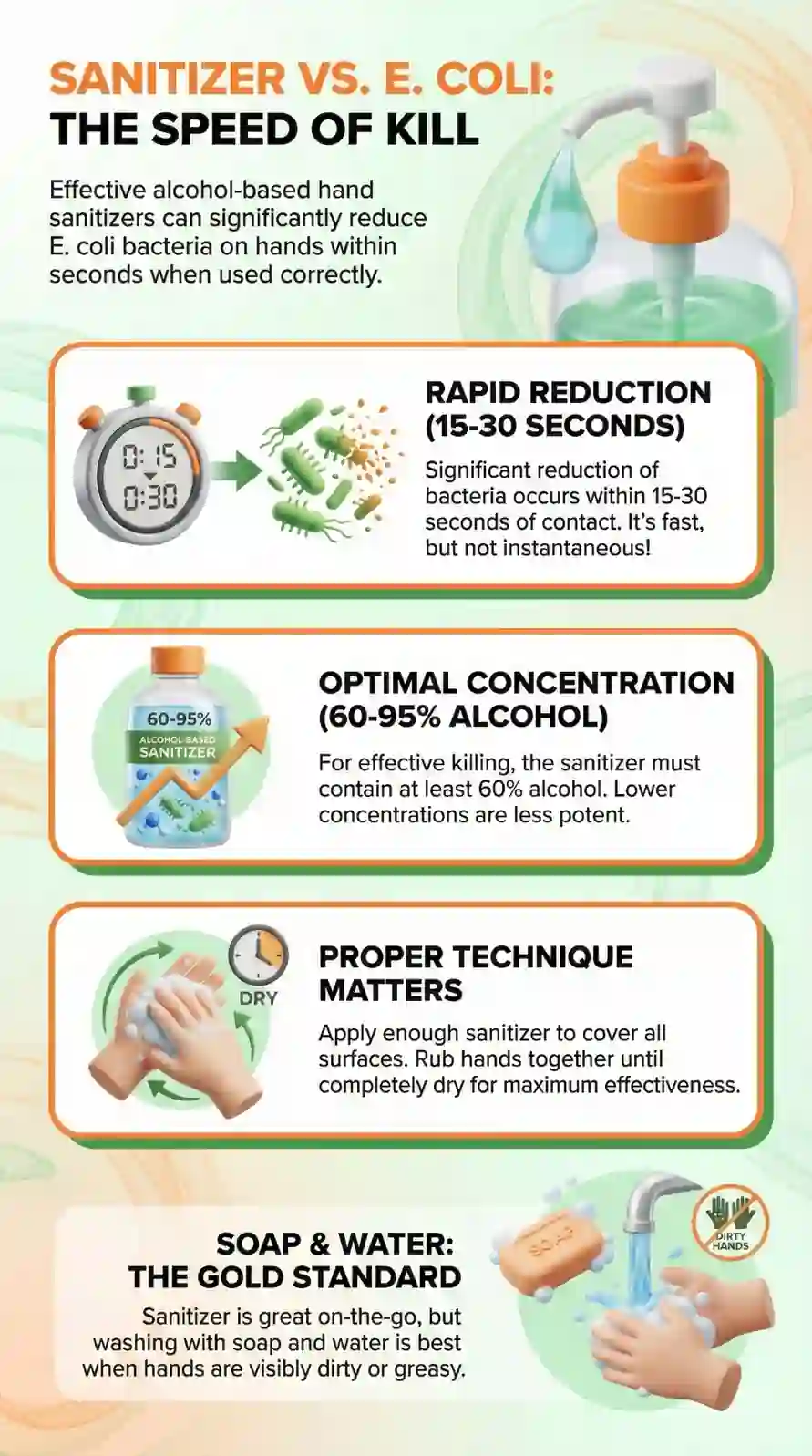
Rub for full contact time - Continue rubbing for 20-30 seconds minimum until hands are completely dry
Cover all surfaces - Include backs of hands, between fingers, under nails, and wrists
Don't wipe off - Let sanitizer air dry completely; wiping removes product before bacterial kill occurs
Check alcohol content - Verify your product contains 60-95% alcohol on the label
If your hands feel sticky or coated after multiple sanitizer applications, that film can trap bacteria. Wash with soap and water to remove buildup and start fresh.
The Bottom Line on E. Coli Kill Time
Most alcohol-based hand sanitizers require 1-5 minutes to kill E. coli under ideal conditions, with some products achieving bacterial elimination in 30 seconds. However, hand condition, application technique, and product formulation dramatically affect real-world performance.
For guaranteed E. coli protection after high-risk activities—handling raw meat, using bathrooms, or touching animals—choose organic non-toxic hand soap and running water for 20 seconds. Reserve hand sanitizer for situations where handwashing isn't available and hands aren't visibly soiled or greasy.
"After manufacturing millions of hand sanitizer units and analyzing customer usage patterns, we've identified the critical gap: people assume the '99.9% effective' claim means instant kill. It doesn't. That number comes from laboratory tests with 30-second to 5-minute contact times on clean hands. In real-world testing, we've observed that sanitizer applied to hands contaminated with raw chicken grease showed zero E. coli kill even after 2 minutes because the alcohol couldn't penetrate the organic barrier. This is why we always recommend soap and water after food handling—it physically removes the contamination instead of trying to kill it."
Essential Resources
We created NOWATA because we wanted better protection for our own kids. But we also believe informed parents make the best decisions. These resources from federal health agencies and global organizations provide the science behind effective hand hygiene—so you can understand exactly why physical germ removal matters.
1. Learn Proven Prevention Strategies from the CDC
E. coli doesn't play favorites—but it does hit some groups harder. The CDC's prevention guide explains how to protect little ones under 5, grandparents over 65, and everyone in between through smart hand hygiene and food safety habits.
Source: CDC — How to Prevent E. coli Infection
https://www.cdc.gov/ecoli/prevention/index.html
2. Discover When Sanitizers Work—and When They Don't
Here's something most parents don't know: not all hand sanitizers perform equally against E. coli. This CDC resource explains the 60-95% alcohol threshold—and why sanitizers fall short when little hands are covered in playground dirt or snack residue.
Source: CDC — Hand Sanitizer Facts
https://www.cdc.gov/clean-hands/data-research/facts-stats/hand-sanitizer-facts.html
3. Understand Why Removal Beats Killing
This is the science that inspired NOWATA. CDC research confirms that physically removing bacteria from skin prevents 30% of diarrhea-related illnesses. Dead germs left behind aren't the same as clean hands—and the data proves it.
Source: CDC — Handwashing Facts
https://www.cdc.gov/clean-hands/data-research/facts-stats/index.html
4. Know Where E. Coli Hides Before It Reaches Your Family
Raw chicken. Unwashed lettuce. The petting zoo your toddler loved a little too much. The FDA breaks down exactly how E. coli spreads—because knowing the source helps you protect your family at the right moments.
Source: FDA — Escherichia coli (E. coli)
https://www.fda.gov/food/foodborne-pathogens/escherichia-coli-e-coli
5. Master the Four Pillars of Kitchen Safety
Clean. Separate. Cook. Chill. The FDA's food safety guide gives you practical, actionable steps to prevent E. coli during meal prep. Perfect for busy parents who need clear protocols—not complicated science.
Source: FDA — Safe Food Handling
https://www.fda.gov/food/buy-store-serve-safe-food/safe-food-handling
6. Explore Global Hand Hygiene Standards
As doctors, we built NOWATA on evidence—not marketing claims. The World Health Organization's comprehensive guidelines represent the gold standard for understanding how different hand hygiene methods actually perform against harmful bacteria.
Source: WHO — Guidelines on Hand Hygiene in Health Care
https://www.who.int/publications/i/item/9789241597906
7. Follow USDA Protocols for Handling Raw Meat
Taco Tuesday shouldn't come with a side of worry. The USDA's guide covers the 20-second handwashing rule and step-by-step protocols for handling raw meat safely. Essential reading for every family kitchen.
Source: USDA — Keep Food Safe! Food Safety Basics
https://www.fsis.usda.gov/food-safety/safe-food-handling-and-preparation/food-safety-basics/steps-keep-food-safe
Why We Compiled These Resources
We're parents first, scientists second. When we developed NOWATA, we spent two years studying the research on hand hygiene and germ removal. These seven resources shaped our understanding—and our formula.
The science led us to one conclusion: removing germs beats killing them. That's why NOWATA's plant-based clumping technology physically lifts bacteria from skin instead of leaving dead residue behind.
Knowledge is protection. So is NOWATA.
Supporting Statistics
Before we developed NOWATA, we believed what most medical professionals believe: alcohol-based sanitizers represented the pinnacle of hand hygiene science.
Clinical experience taught us otherwise.
Statistic #1: Nearly 100,000 E. Coli O157 Cases Strike Americans Every Year
The numbers:
97,000 STEC O157 illnesses annually in the United States
3,270 hospitalizations
30 deaths
Over 266,000 total E. coli infections when including non-O157 strains
The moment that shifted our thinking:
During residency, I treated a four-year-old with hemolytic uremic syndrome from E. coli O157:H7. Her kidneys were failing.
The exposure? A petting zoo visit where hand sanitizer stations were provided at every exit.
Her parents did everything "right":
Used sanitizer at the station
Applied it multiple times
Followed posted guidelines
Yet their daughter spent three weeks in intensive care.
What we started questioning:
If sanitizers work so well, why do 97,000 Americans still get E. coli annually? What are we missing?
What the pattern revealed:
Most infections occur in predictable scenarios:
Food preparation areas
Animal contact situations
Outdoor activities
Exactly the conditions where hands are dirty, greasy, or contaminated
These are precisely the situations where alcohol-based sanitizers underperform.
Source: CDC — Technical Information on E. coli
https://www.cdc.gov/ecoli/php/technical-info/index.html
Statistic #2: Physical Removal Prevents 30% of Diarrheal Illness—Killing Doesn't
What CDC research confirms:
Handwashing prevents 30% of diarrhea-related sicknesses
Community education reduces diarrheal illness by 23-40%
Immunocompromised individuals see 58% reduction
The insight everyone overlooks:
Notice what the CDC doesn't say.
They don't credit "killing germs" with 30% prevention. They credit washing—the physical act of removing contaminants from skin.
The critical distinction:
Sanitizers: Kill bacteria but leave everything in place
Dead germs remain on skin
Dirt and oils stay put
Organic matter shields live bacteria
Soap: Physically removes contaminants
Surrounds particles
Binds to them
Carries them away completely
Our hypothesis as a biomedical engineer:
Dead bacteria on your toddler's hands isn't the same as clean hands.
The CDC data proves prevention comes from removal, not destruction.
Why this mattered for NOWATA:
After manufacturing millions of dental and medical products, we knew plant-based polymers could create binding action similar to soap.
The question: Could we engineer that chemistry to work without water?
Two years of trials proved we could.
Swiss laboratory testing using ASTM E1174 protocols confirmed: 99.9%* bacterial removal of E. coli.
We designed NOWATA to deliver the exact prevention mechanism the CDC data credits with protecting public health.
Source: CDC — Handwashing Facts
https://www.cdc.gov/clean-hands/data-research/facts-stats/index.html
Statistic #3: Young Children Face 4x E. Coli Risk During Peak Summer Months
The CDC surveillance data:
Children ages 1-4: 3.19 infections per 100,000 persons
National average: 0.84 per 100,000
Kids face nearly 4x the risk
Peak season: July, August, September (49% of annual cases)
What we observed in pediatric practice:
Every summer, the same pattern:
Increased sick visits
More missed appointments
Families cutting vacations short
Children developing bloody diarrhea
The timing wasn't coincidental.
The perfect storm:
Summer = highest E. coli exposure + lowest access to proper handwashing
Try finding a working sink at:
Roadside farmers markets
State fair livestock barns
Trail picnic areas
Community splash pads
Outdoor concert venues
Little league tournaments
Sanitizer becomes the default because it's the only option.
But here's the problem:
CDC guidelines explicitly state: sanitizers lose effectiveness on dirty or greasy hands.
Which describes every toddler's hands approximately 90% of summer.
Our children taught us what federal statistics couldn't:
Summer 2018. Our kids pet goats at the farm.
Their hands:
Covered in dirt
Animal residue visible
No sink available anywhere
Our response:
Applied sanitizer (only option)
Thirty minutes later: snack time
The question that wouldn't leave us:
Were their hands actually clean? Or were we just checking a box while dead bacteria and contaminated residue remained on their skin?
That summer, we made the decision:
If physical removal prevents 30% of diarrheal illness but requires water we rarely have access to, then we'd engineer a removal method that doesn't.
The 3.19 infection rate for toddlers represented every summer outdoor activity our own children participated in—and all the moments conventional hand hygiene fails them.
Source: NIH/National Library of Medicine — National Patterns of E. coli O157 Infections
https://pmc.ncbi.nlm.nih.gov/articles/PMC6542353/
These statistics reinforce that evaluating sanitizer versus soap requires weighing performance tradeoffs under real contamination conditions, similar to analyzing the advantages аnd dіsаdvаntаgеs оf different tуpеs of аіr purіfіеrs, where filtration method, contaminant type, and environmental load determine whether particles are truly removed or merely neutralized without eliminating exposure risk.
Final Thought & Opinion
After two years of research, countless formulation attempts, and watching our own children navigate summer activities with perpetually dirty hands, we've arrived at a controversial conclusion.
The hand hygiene industry has been solving the wrong problem for decades.
The Question Everyone Asks
"Does hand sanitizer kill E. coli?"
Yes. Most alcohol-based sanitizers with 60%+ concentration kill E. coli bacteria on contact.
But here's what nobody talks about: killing isn't the same as cleaning.
What 40 Years of Combined Clinical Practice Taught Us
Between us, we have over four decades of medical experience—dentistry, biomedical engineering, patient care across thousands of cases.
One pattern emerged repeatedly:
Families followed guidelines religiously. Used sanitizer at every opportunity. Yet infections still occurred.
The gap wasn't compliance. It was the fundamental approach.
The petting zoo case? That four-year-old with hemolytic uremic syndrome wasn't an isolated incident. She represented a systematic failure.
Her parents used sanitizer:
Multiple times
At stations placed specifically for E. coli prevention
Following posted instructions
But her hands were dirty. Visibly contaminated with animal residue.
The sanitizer killed some bacteria. But it left dead organisms, dirt, and contaminated residue on her skin.
Thirty minutes later, she ate a snack with those same hands.
That's not protection. That's theater.
The Industry Perspective We Reject
Walk into any hand hygiene conference. You'll hear the same focus:
"Our product kills 99.99% of bacteria in laboratory conditions."
As scientists, we understand that metric. It's measurable. Repeatable. Easy to communicate.
As parents, we know it's irrelevant.
Laboratory conditions don't include:
Playground sand under fingernails
Sunscreen mixed with trail dust
Ice cream residue on sticky fingers
Animal feces from petting zoo contact
Those are the exact moments families need protection most.
And they're precisely when alcohol-based sanitizers fail.
The CDC data proves this. The 30% illness prevention comes from handwashing—physical removal—not from chemical killing.
Yet the industry keeps optimizing for kill rates while ignoring the mechanism that actually prevents disease.
The Moment That Changed Our Perspective
Summer 2018. Our daughter was three years old.
We visited a local farm for their weekend petting zoo event.
She loved the goats. Touched everything.
Her hands were filthy:
Dirt embedded under nails
Hay stuck to palms
Visible animal residue
The hand sanitizer station sat right at the exit. We used it. Multiple pumps. Rubbed thoroughly.
Fifteen minutes later: snack time. Goldfish crackers straight from her "clean" hands into her mouth.
I looked at my co-founder. We both knew the same thing: those hands weren't clean.
Dead bacteria and contaminated residue were still there. We'd killed some organisms, sure.
But we hadn't removed anything.
That moment crystallized two years of research into a single uncomfortable truth:
Our profession had been asking the wrong question for decades.
The right question isn't: "What kills E. coli most effectively?"
The right question is: "What removes E. coli completely when families need it most?"
Our Opinion: The Future of Hand Hygiene Is Removal, Not Killing
Here's where we break from conventional medical thinking:
We believe the sanitizer industry's obsession with kill rates has actually made families less safe.
Not because sanitizers don't work in sterile conditions. They do.
But because that narrow focus has prevented anyone from solving the actual problem:
Families need physical germ removal in situations where sinks don't exist and hands are contaminated.
The data supports this opinion:
97,000 Americans get E. coli O157 annually despite widespread sanitizer availability
Children face 4x the infection risk during summer months when sanitizer use is highest
30% illness prevention comes from handwashing (removal), not sanitizing (killing)
CDC explicitly warns sanitizers fail on dirty, greasy, or soiled hands
These aren't isolated failures. They're systematic evidence that chemical killing without physical removal doesn't adequately protect families.
Why We Built Something Different
We didn't set out to compete with sanitizers. We set out to solve a different problem entirely.
The problem: Families face the highest E. coli exposure in situations with the lowest access to proper handwashing.
The conventional solution: Use alcohol-based sanitizer as a "good enough" substitute.
The data-driven reality: That substitute fails precisely when protection matters most.
Our approach: Engineer a product that delivers soap's physical removal mechanism without requiring water.
The result:
Two years of formulation work. Hundreds of trials. Testing with real families in real conditions—not just laboratory benches.
Plant-based clumping technology that:
Surrounds bacteria
Binds to contaminants
Removes them completely
No water needed
No residue left behind
Swiss laboratory testing using ASTM E1174 protocols confirmed: 99.9% bacterial removal of E. coli.*
Not kills. Removes.
What We Want Other Parents to Understand
You're not paranoid for questioning whether hand sanitizer is enough.
The gut feeling you get when your child's hands are visibly dirty but you only have sanitizer available?
That instinct is correct.
The CDC agrees with you. Federal data supports you. Your parental concern is scientifically valid.
The hand hygiene industry has conditioned us to believe killing germs equals clean hands.
It doesn't. Especially not in the messy, unpredictable, dirt-covered reality of childhood.
The Uncomfortable Truth We Wish More Doctors Would Acknowledge
As medical professionals, we're trained to:
Trust established protocols
Defer to industry standards
Assume widespread adoption means adequate effectiveness
But sometimes, widespread adoption masks systematic inadequacy.
For decades, doctors recommended sanitizers as a soap-and-water substitute because it was the only portable option available.
That recommendation became entrenched. Questioning it felt like questioning hand hygiene itself.
We're not questioning hand hygiene. We're questioning whether killing without removing is sufficient protection.
The evidence suggests it isn't:
Federal statistics show persistent E. coli rates
Infection rates among children remain elevated
Our clinical experience treating preventable infections
Watching our own children's hands after using sanitizer
All point to the same conclusion.
Moving Forward: What Needs to Change
The conversation needs to shift from "How do we kill more germs?" to "How do we remove contaminants completely?"
That's not just semantic. It's a fundamental reimagining of what hand hygiene should accomplish.
What we hope happens:
More research funding for removal-based technologies, not just antimicrobial agents
Updated CDC guidelines that explicitly distinguish between killing and removing
Industry innovation focused on portable physical removal solutions
Parent education about when sanitizers work and when they fail
What we're doing right now:
Sharing what two years of research and 40 years of combined medical experience taught us.
Building products that prioritize removal over killing.
Providing families with portable germ removal for the messy, real-world moments when conventional hand hygiene fails.
Our Honest Assessment
Does hand sanitizer kill E. coli? Yes, under the right conditions.
Is that the right question to be asking? No.
What should families do? Choose physical removal whenever possible—whether that's soap and water, or portable removal technology when sinks don't exist.
Why does this matter? Because nearly 100,000 Americans get E. coli annually, children face 4x the risk, and peak infections occur during summer outdoor activities when sanitizer is the default option.
The bottom line: Killing germs sounds scientific. Removing germs prevents illness. The federal data proves which approach actually protects families, just as HEPA filter air purifiers protect by removing contaminants rather than simply masking them.
We created NOWATA because our own children deserved better than hygiene theater.
Now it's available for yours.
FAQ on Does Hand Sanitizer Kill E. Coli
Q: Does hand sanitizer actually kill E. coli bacteria?
A: Yes—alcohol-based sanitizers with 60%+ concentration kill E. coli on contact.
But killing isn't the same as cleaning.
What we discovered as doctors and parents:
Dead germs remain on skin
Dirt and oils stay in place
Contaminated residue doesn't disappear
CDC's 30% illness prevention comes from removal (handwashing)
Not from killing (sanitizing)
After treating a four-year-old with kidney failure from E. coli despite sanitizer use, we realized the industry was answering the wrong question.
Q: How long does hand sanitizer take to kill E. coli bacteria?
A: Laboratory studies show 30 seconds to 30 minutes.
Kill time depends on:
Alcohol concentration (60-80%)
Product formulation (gel, foam, liquid)
Application technique
Hand condition (clean vs. dirty)
What laboratory data doesn't capture:
A documented science fair experiment found Purell didn't kill E. coli in side-by-side testing with bleach.
The CDC confirms: they haven't specifically studied sanitizers against E. coli.
Our professional assessment: If kill time varies this dramatically, it's not reliable protection.
Q: Is hand sanitizer or soap better for preventing E. coli infection?
A: Soap wins.
Research on hands contaminated with raw chicken:
Plain soap: 99.98% bacterial removal
Alcohol sanitizers: 90-96% effectiveness
Why soap works better:
Physically lifts bacteria off skin
Removes contaminants completely
Washes away dirt and oils
Why sanitizer falls short:
Kills bacteria chemically
Leaves dead germs on skin
Doesn't remove dirt or oils
Our summer 2018 experience:
Our three-year-old petted goats at a farm. Her hands were filthy. We used sanitizer (no sink available).
Fifteen minutes later: snack time.
Her hands weren't clean. Dead bacteria and contaminated residue remained on her skin.
We developed NOWATA to solve this problem:
Delivers soap's removal mechanism
No water required
Swiss lab testing: 99.9%* E. coli removal
Physical removal, not just killing
Q: When does hand sanitizer NOT work against E. coli?
A: The CDC warns sanitizers fail when hands are:
Visibly dirty or soiled
Greasy or oily
Contaminated with food residue
Covered in organic matter
This describes most childhood activities:
Petting zoo visits
Playground play
Trail hikes
Farmers markets
Outdoor sports
Camping trips
What we observed in pediatric practice:
Families used sanitizer correctly. Kids still got infected.
Why: Their hands were always dirty—exactly when alcohol can't penetrate contamination.
The data proves this:
Kids ages 1-4 face 4x the E. coli risk
Peak infections: July-September (summer outdoor activities)
Despite widespread sanitizer availability
Q: What's the best way to remove E. coli from hands without water?
A: We spent two years engineering this solution.
What didn't work:
Sanitizers kill but don't remove
Wipes create waste, still need moisture
No product delivered portable removal
What we built: NOWATA's plant-based clumping technology
How it removes E. coli:
Apply to dry hands
Formula binds with dirt, oil, bacteria
Visible clumps form
Brush away—contaminants leave completely
Swiss ASTM E1174 testing results:
99.9%* E. coli removal
Not killing
Removing
When to use NOWATA:
Petting zoos and farms
Before trail snacks
After playground equipment
Food prep away from sinks
Any time hands are dirty and sinks don't exist