Getting rid of an old mattress can feel deceptively simple—until you start looking into the rules and costs involved. Unlike regular household trash, mattresses are treated as bulky, regulated items in many cities, which means the price to dispose of one legally isn’t always obvious upfront. Depending on where you live, the condition of the mattress, and the disposal method you choose, costs can range from nothing at all to a significant out-of-pocket expense. If you’re searching for how to dispose of a mattress legally and what it truly costs, this guide walks through the pricing realities, explains why some options are more expensive than others, and helps you choose a compliant solution without overpaying.
Quick Answers
How to Dispose of Mattress
Disposing of a mattress legally means using an approved option that aligns with local rules. The most reliable choices include mattress recycling programs, scheduled municipal bulk pickup, or professional removal services. Leaving a mattress curbside without approval or attempting to dismantle it often results in fines, rejected disposal, or extra costs.
Top Takeaways
- Mattress disposal costs vary by method and locationPricing depends on recycling access, city rules, and service availability.
- Free options exist—but are limitedSome recycling programs and municipal pickups cost little or nothing if requirements are met.
- Professional removal costs more but reduces riskPaid services cover labor, hauling, and compliance, avoiding fines or rejected drop-offs.
- Improper disposal often costs the mostFines, citations, or repeat handling quickly exceed legal disposal costs.
- Knowing your options upfront saves moneyChoosing the right method the first time prevents unexpected expenses.
Why Mattress Disposal Costs More Than Expected
Mattresses are bulky, labor-intensive, and regulated differently than normal household trash, much like other large household items that affect indoor environments such as air purifiers. Many waste services charge extra because mattresses don’t compact, require special handling, and take up disproportionate landfill space. In areas with recycling mandates, disposal fees may be built into product stewardship programs, while other regions rely on private services that pass handling costs to the homeowner.
Cost Option #1: Mattress Recycling Programs
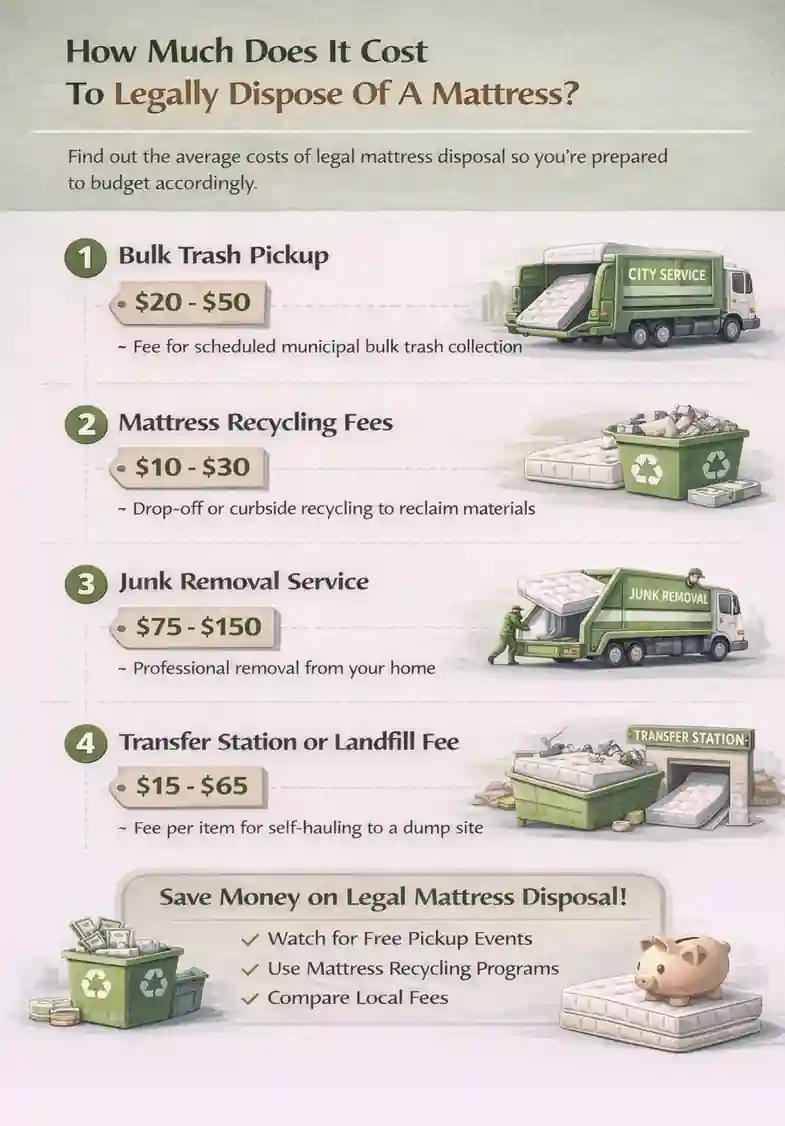
Recycling is often the most affordable legal option. In states with mattress recycling laws, drop-off fees are minimal or already included in a recycling surcharge paid at purchase. Costs typically range from free to $30, depending on location. Availability varies, and transportation is usually the homeowner’s responsibility.
Cost Option #2: Professional Mattress Removal Services
Professional removal is the most predictable but highest-cost option. Pricing generally ranges from $75 to $150, depending on mattress size, access, and local disposal requirements. The cost reflects labor, protective equipment, transport, and compliant disposal—making it ideal for heavy, damaged, or difficult-to-move mattresses.
Cost Option #3: Donation (When Accepted)
Donation is usually free, but only if the mattress meets strict acceptance standards. Many charities refuse used mattresses due to sanitation regulations. When rejected, homeowners often incur additional costs arranging another disposal method, making donation an uncertain option financially.
Costly Options to Avoid
Leaving a mattress curbside without approval
Illegal dumping or abandoning mattresses
Attempting DIY dismantling without proper facilities
These choices frequently result in fines, citations, or repeat disposal fees, often exceeding the cost of legal removal.
Choosing the Most Cost-Effective Disposal Option
The cheapest option isn’t always the least expensive long-term. Recycling and approved municipal programs offer the lowest upfront cost when available. Professional removal costs more initially but eliminates risk, labor, and compliance issues, as duct cleaning also does when handled properly. The most expensive outcome almost always comes from doing it incorrectly first.
“When people ask about mattress disposal cost, what they’re really asking is how to avoid paying twice. The lowest-cost option is the one that gets it handled correctly the first time—without fines, injuries, or rejections.”
Essential Resources
Federal Waste & Disposal Guidance
U.S. Environmental Protection Agency (EPA) – Household Waste & Recycling
Explains how bulky items like mattresses fit into federal waste reduction and recycling guidance, with links to local programs.
https://www.epa.gov/recycle
Explains how bulky items like mattresses fit into federal waste reduction and recycling guidance, with links to local programs.
https://www.epa.gov/recycle
Local Government Bulk Pickup Rules
USA.gov – Find Your Local Waste Services
Helps users locate city and county waste departments that set bulk pickup rules, fees, and scheduling requirements.
https://www.usa.gov/local-governments
Helps users locate city and county waste departments that set bulk pickup rules, fees, and scheduling requirements.
https://www.usa.gov/local-governments
Mattress Recycling Laws by State
Product Stewardship Institute – Mattress Programs
Details which states require mattress recycling fees, how programs are funded, and what residents should expect to pay.
https://productstewardship.us/products/mattresses/
Details which states require mattress recycling fees, how programs are funded, and what residents should expect to pay.
https://productstewardship.us/products/mattresses/
Environmental Impact of Mattress Disposal
Earth911 – Mattress Recycling & Disposal
Breaks down environmental considerations, recycling availability, and why some disposal methods cost more than others.
https://earth911.com/recycling-guide/how-to-recycle-mattresses/
Breaks down environmental considerations, recycling availability, and why some disposal methods cost more than others.
https://earth911.com/recycling-guide/how-to-recycle-mattresses/
Donation Rules & Rejection Criteria
Goodwill Industries – Donation Guidelines
Outlines why many nonprofits refuse used mattresses and how failed donations often lead to unexpected disposal costs.
https://www.goodwill.org/donate/donation-guidelines/
Outlines why many nonprofits refuse used mattresses and how failed donations often lead to unexpected disposal costs.
https://www.goodwill.org/donate/donation-guidelines/
Consumer Cost Comparisons
Consumer Reports – Large Item Disposal Advice
Provides consumer-focused insights on disposal costs, tradeoffs, and when paying for removal makes financial sense.
https://www.consumerreports.org/home-garden/
Provides consumer-focused insights on disposal costs, tradeoffs, and when paying for removal makes financial sense.
https://www.consumerreports.org/home-garden/
Municipal Fee Examples
NYC Department of Sanitation – Mattress Disposal Rules
Shows how major cities regulate mattress disposal, including wrapping requirements, fines, and compliance costs.
https://www.nyc.gov/site/dsny/collection/get-rid-of/large-items.page
These resources explain how federal guidance, local rules, recycling laws, and disposal fees shape mattress removal decisions, helping homeowners plan compliant disposal while considering dryer vent cleaning services as part of overall household maintenance and cost planning.
Shows how major cities regulate mattress disposal, including wrapping requirements, fines, and compliance costs.
https://www.nyc.gov/site/dsny/collection/get-rid-of/large-items.page
Supporting Statistics
Mattresses are a major source of bulky waste in the U.S.
The Mattress Recycling Council reports that state recycling programs have diverted over 15 million mattresses from landfills, highlighting how frequently mattresses enter regulated waste streams.
https://mattressrecyclingcouncil.org/
Mattresses significantly increase landfill and disposal costs.
According to the U.S. Environmental Protection Agency (EPA), bulky items like mattresses take up far more space than typical household waste and are costly to manage, which is why many landfills charge special handling or tipping fees.
https://www.epa.gov/smm/sustainable-materials-management-non-hazardous-materials-and-waste-management-hierarchy
Recycling laws sharply reduce illegal dumping.
Research from the Product Stewardship Institute shows that states with mattress recycling programs report higher compliance rates and fewer illegally dumped mattresses, lowering cleanup and enforcement costs for municipalities.
https://productstewardship.us/products/mattresses/
Local governments spend millions addressing illegal mattress dumping.
Municipal reports summarized by CalRecycle (California Department of Resources Recycling and Recovery) show that mattresses are among the most commonly collected illegally dumped items, driving up public cleanup expenses.
https://calrecycle.ca.gov/products/mattress/
Why this matters:
These statistics explain why mattress disposal often comes with fees. Regulations, recycling programs, and enforcement costs exist because mattresses are expensive for cities to manage when disposed of improperly—making legal disposal the more predictable and cost-effective option.
Mattresses are a major source of bulky waste in the U.S.
The Mattress Recycling Council reports that state recycling programs have diverted over 15 million mattresses from landfills, highlighting how frequently mattresses enter regulated waste streams.
https://mattressrecyclingcouncil.org/
Mattresses significantly increase landfill and disposal costs.
According to the U.S. Environmental Protection Agency (EPA), bulky items like mattresses take up far more space than typical household waste and are costly to manage, which is why many landfills charge special handling or tipping fees.
https://www.epa.gov/smm/sustainable-materials-management-non-hazardous-materials-and-waste-management-hierarchy
Recycling laws sharply reduce illegal dumping.
Research from the Product Stewardship Institute shows that states with mattress recycling programs report higher compliance rates and fewer illegally dumped mattresses, lowering cleanup and enforcement costs for municipalities.
https://productstewardship.us/products/mattresses/
Local governments spend millions addressing illegal mattress dumping.
Municipal reports summarized by CalRecycle (California Department of Resources Recycling and Recovery) show that mattresses are among the most commonly collected illegally dumped items, driving up public cleanup expenses.
https://calrecycle.ca.gov/products/mattress/
Final Thought & Opinion
The true cost of mattress disposal goes beyond the price tag—it comes down to whether the job is done correctly the first time.
Key insights from real disposal scenarios:
“Free” options often come with strict rules and limited availability
Rejected pickups and failed donations create repeat handling costs
Improper disposal frequently leads to fines or citations
What experience consistently shows:
The cheapest option upfront isn’t always the least expensive overall
Professional removal reduces uncertainty, labor, and compliance risk
Matching the disposal method to the mattress condition prevents delays
Bottom line:
The smartest mattress disposal choice is the one that ensures legal removal in a single step, and for many situations that means using a properly sized dumpster rental. Paying slightly more upfront often saves time, effort, and money by avoiding rejections, penalties, and repeat disposal attempts.
“Free” options often come with strict rules and limited availability
Rejected pickups and failed donations create repeat handling costs
Improper disposal frequently leads to fines or citations
The cheapest option upfront isn’t always the least expensive overall
Professional removal reduces uncertainty, labor, and compliance risk
Matching the disposal method to the mattress condition prevents delays
FAQ on How to Dispose of Mattress
Q: How much does it usually cost to dispose of a mattress?
A:
$0–$30 through recycling programs
$75–$150 for professional removal
Costs vary by location and condition
Q: Are there free mattress disposal options?
A:
Some recycling programs
Limited municipal bulk pickups
Donation only if accepted
Q: Why do disposal costs vary so much?
A:
Local regulations
Recycling availability
Labor and transport requirements
Q: Is illegal dumping cheaper?
A:
No
Fines often exceed legal disposal costs
Q: What’s the most cost-effective option overall?
A:
The option that works the first time
Avoids fines, injuries, and repeat handling
A:
$0–$30 through recycling programs
$75–$150 for professional removal
Costs vary by location and condition
A:
Some recycling programs
Limited municipal bulk pickups
Donation only if accepted
A:
Local regulations
Recycling availability
Labor and transport requirements
A:
No
Fines often exceed legal disposal costs
A:
The option that works the first time
Avoids fines, injuries, and repeat handling