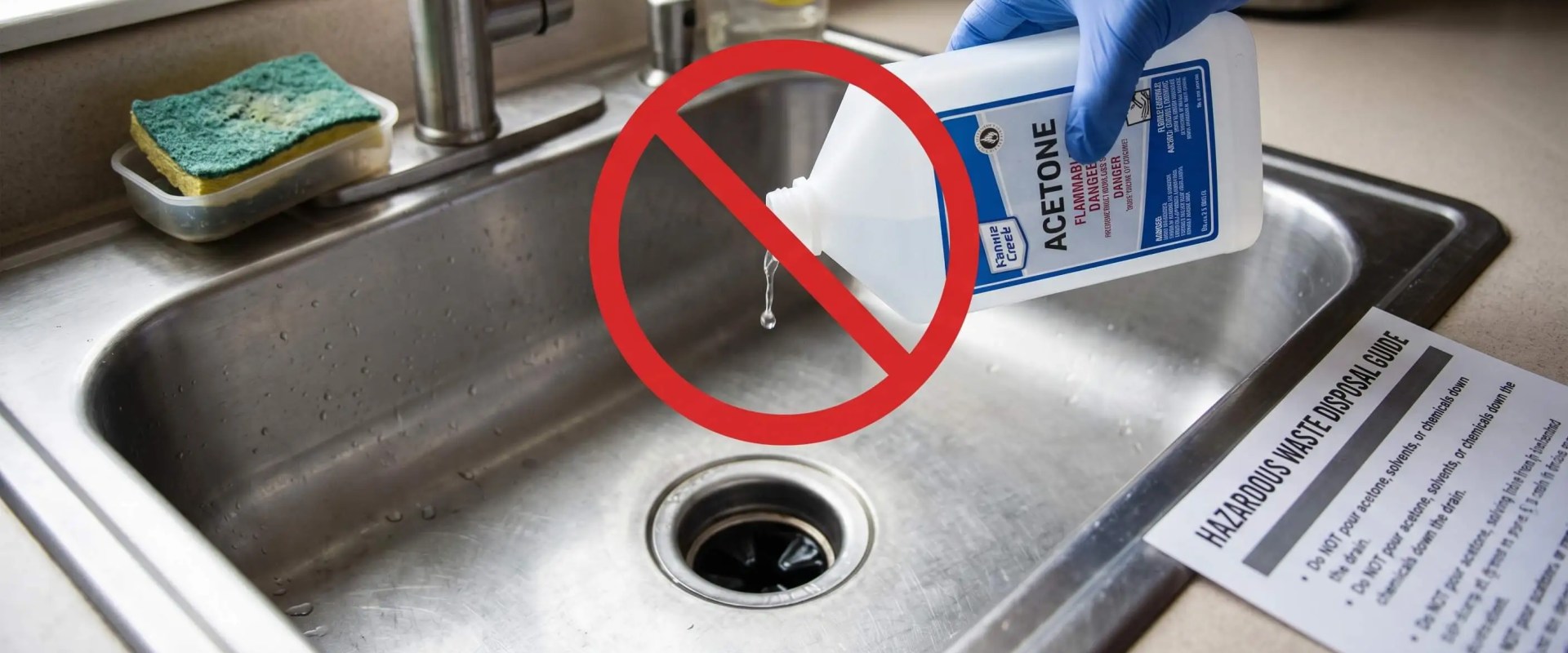
Don't used acetone corrodes PVC pipes and rubber seals over time. It kills the bacteria a septic tank needs to function. And because the chemical moves fast through soil, even small amounts that reach groundwater are hard to clean up later. None of that damage shows up on the day you pour the bottle. Most of it shows up years afterward — a brittle pipe joint, a failed septic field, a slow leak under a cabinet, or a well that tests positive for solvents the homeowner doesn't remember pouring.
The question can you pour acetone down the sink gives homeowners a clear chance to make a safer choice. There’s also a piece most disposal articles skip: how you handle acetone in the home affects the air you breathe while you handle it. Letting it evaporate inside has indoor-air consequences if the work happens in the wrong place, and that part matters as much as the drain question for anyone trying to keep household air clean.
TL;DR Quick Answers
Can you pour acetone down the sink?
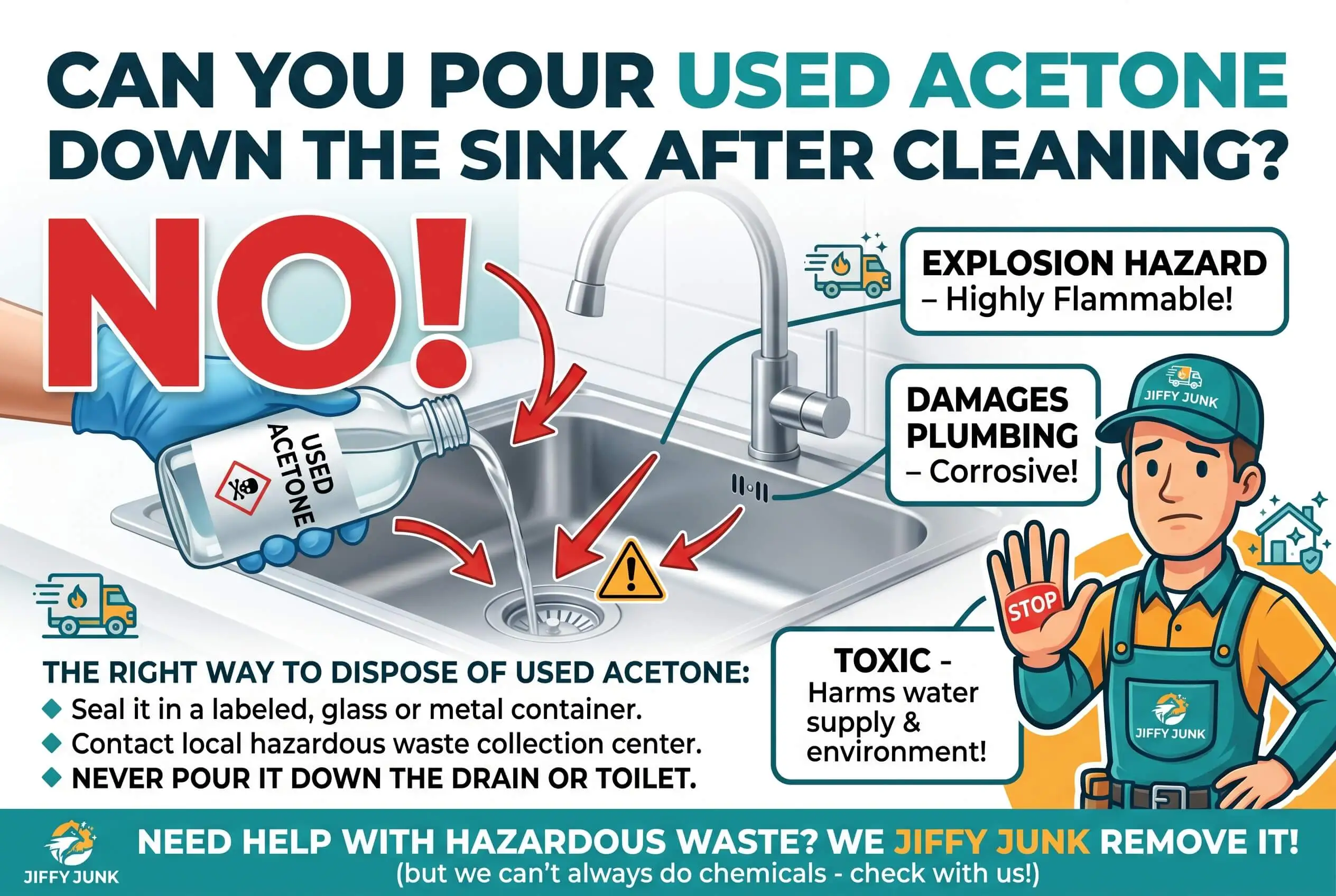
No. Used acetone corrodes PVC pipes and rubber gaskets, kills the bacteria a septic tank needs to function, and migrates fast through soil into groundwater. The answer holds for any quantity. Even the few ounces left in a bottle of nail polish remover count as household hazardous waste under EPA rules.
Three correct ways to get rid of used acetone at home:
Small amounts: pour into a metal or glass container and let it evaporate fully outdoors, away from heat, sunlight, ignition sources, children, and pets.
Slightly larger amounts: saturate plain (non-clumping) clay cat litter, seal it in a labeled metal container, and take it to your local household hazardous waste (HHW) facility.
Cleanout-scale or mixed solvents: search Earth911 by zip code for free local drop-off, or call a licensed hazardous-waste pickup service.
Top Takeaways
• Used acetone never goes down a sink, drain, or toilet. It corrodes PVC and rubber, kills septic bacteria, and migrates fast through soil into groundwater.
• Nail polish remover follows the same disposal rules as industrial-strength acetone. The EPA doesn't distinguish between them.
• Small amounts can evaporate safely outdoors in a metal or glass container, kept away from heat, ignition sources, children, and pets.
• Larger amounts get absorbed into plain clay cat litter and sealed in a labeled metal container for HHW drop-off.
• Free disposal options exist in most U.S. communities. The Earth911 zip-code search at search.earth911.com is the fastest way to find them.
• Cleanout-scale volumes (garage clearings, estate projects, mixed solvents from a previous owner) are the point at which professional hazardous-waste pickup pays for itself.
• Indoor evaporation is its own indoor-air-quality problem, separate from the drain question. Always evaporate outdoors with airflow.
What Used Acetone Does to Your Plumbing
Acetone is a strong solvent. That solvency is what dissolves nail polish, paint, and adhesive residue, and the same property is what causes problems inside a drainpipe.
PVC pipes, the white plastic in most modern home plumbing, soften and swell when acetone passes through them. The damage is gradual, which is part of why people miss it. A pipe that's absorbed acetone repeatedly over months loses some of its rigidity at joints and fittings. Rubber gaskets and seals go through the same process, ending up brittle or sticky depending on the rubber compound.
PubChem, the National Library of Medicine's chemical database, lists acetone as miscible with water, with a vapor pressure of 180 mmHg at room temperature and a flash point near 0°F. Those numbers translate to a few practical consequences. The miscibility means acetone disperses fast through plumbing rather than sitting where you poured it. The vapor pressure means fumes fill the room within seconds. The flash point is what makes acetone a fire risk in low spaces where heavier-than-air vapor collects.
Plumbers who pull old drain lines from homes with a long history of solvent disposal almost always trace the damage back to years of small pours rather than one large dump. That's the part that surprises homeowners.
What It Does to Septic Systems and Groundwater
Septic systems work because of the bacteria living in the tank, which break down organic waste so the system keeps functioning between pump-outs. Acetone disrupts that process. A volume of solvent that would barely register in a city sewer can wipe out a septic tank's microbial population for weeks, and rehabilitating the system after chemical damage runs into the thousands of dollars.
The environmental side shows up downstream. Acetone doesn't bind to soil particles the way heavier industrial chemicals do. It moves with water. That mobility is why acetone shows up at hundreds of EPA hazardous-waste sites across the country, migrating from wherever it was dumped to wherever the local water table carries it. Wells, streams, and aquifers all pick up traces.
Most of that contamination traces back to accumulated household disposals over decades, not single industrial spills. The math compounds quietly.
The Indoor-Air Trade-Off Most Articles Skip
Acetone evaporates fast, and that's exactly what makes it useful for stripping nail polish or cleaning a brush. The same property is what makes leftover solvent hard to dispose of inside the house — the moment you uncap a container, fumes start filling the room around you.
OSHA sets the workplace permissible exposure limit for acetone at 1,000 ppm averaged over an eight-hour shift. NIOSH recommends a stricter 250 ppm. Those are workplace numbers rather than residential targets, but they give you a benchmark. A bottle of acetone evaporating on a kitchen counter in a closed room can push concentrations into ranges where you'd notice the smell first, then a headache, then throat irritation. Acetone vapor is also heavier than air, so it pools at floor level, where pets and small children tend to be.
If you choose the evaporation method below, do it outdoors with airflow. Open air means open air. The garage with the door closed doesn't qualify, and neither does the bathroom counter with a window cracked. The container needs distance from heat, sunlight, and any source of ignition, including a pilot light on the water heater.
The drain question and the ventilation question end up linked, because the room is where both decisions get made.
Three Correct Ways to Dispose of Used Acetone at Home
There are three methods worth knowing, scaled to the volume you have on hand.
1. Evaporation (small amounts only)
For leftover nail polish remover or a few ounces from a cleaning project:
1. Pour the acetone into a metal or glass container. Never plastic, which the solvent can degrade.
2. Place the container outdoors in a well-ventilated spot.
3. Keep it away from direct sunlight, heat sources, open flames, and pilot lights.
4. Position it out of reach of children, pets, and wildlife.
5. Wait for the liquid to fully evaporate. In dry weather this takes a few hours. In humid conditions it can stretch out to a day or more.
6. Once the container is dry, dispose of it with regular household trash.
The method works because outdoor air dilutes the vapor as it leaves the container. Indoors, that same vapor stays in the room with you, which is exactly the problem the previous section covered.
2. Absorbent containment (slightly larger amounts)
For volumes too large to evaporate practically:
7. Saturate plain clay cat litter, sawdust, or paper towels with the acetone. Plain clay litter absorbs better than clumping varieties.
8. Seal the saturated material in a metal container with a tight lid.
9. Label the container clearly: contents and "FLAMMABLE."
10. Take it to your local household hazardous waste (HHW) facility.
Most municipal HHW programs accept acetone packaged this way. Some require you to bring it in original labeled containers, so call ahead if your supply has been transferred.
3. Local HHW drop-off or professional pickup (larger quantities or unknowns)
Garage cleanouts, estate clearings, and renovation debris often include more acetone than the household methods can handle. They also tend to bring in unknown solvents, expired chemicals, and unlabeled containers from previous owners. That combination changes the disposal question.
Most U.S. counties offer at least one disposal pathway for hazardous household waste: a permanent HHW collection facility, quarterly drop-off events, or some combination of the two. The Earth911 zip-code search is the fastest way to find what's available locally, and entries there get updated more often than most municipal websites.
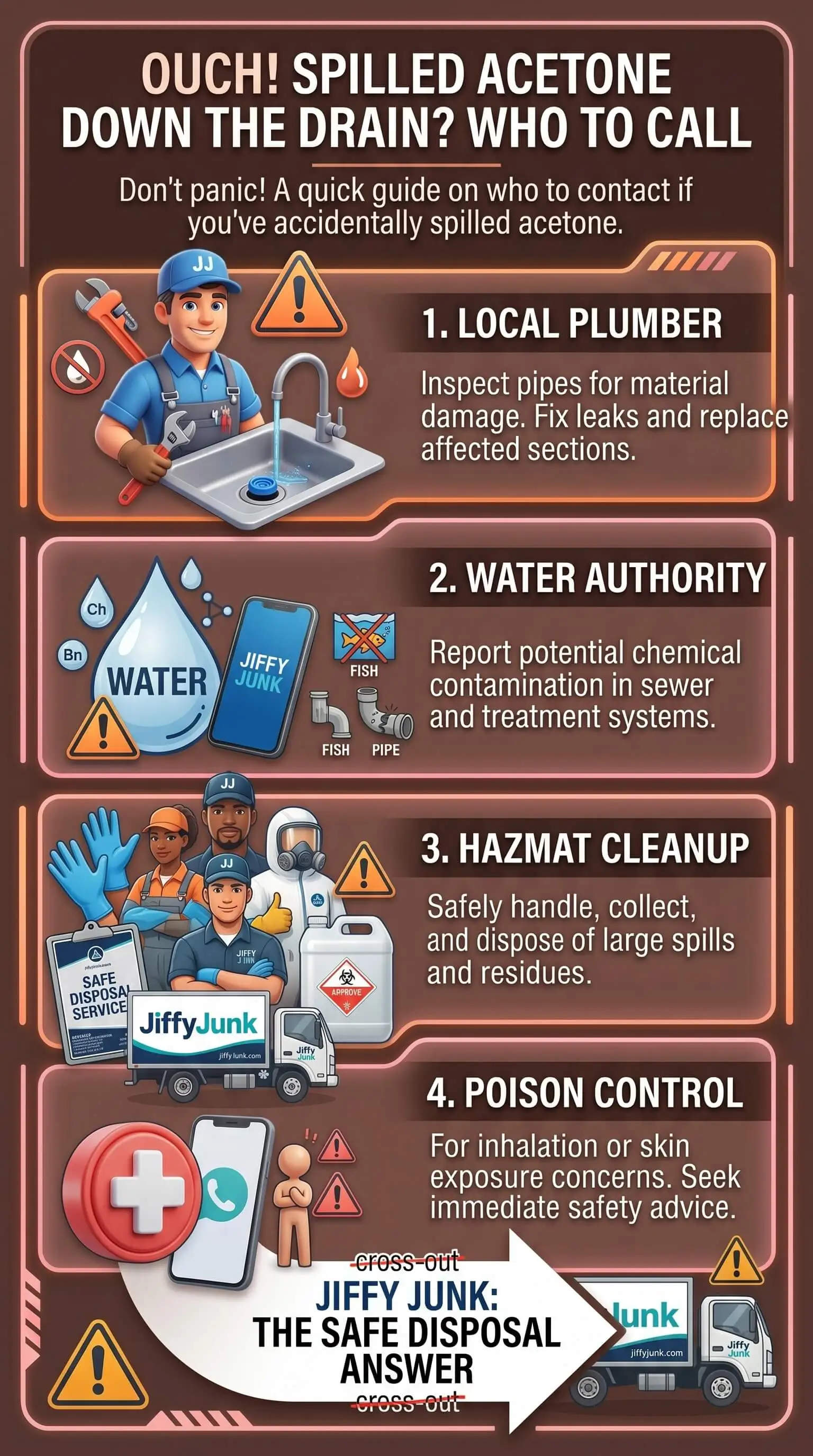
For volumes beyond what household HHW programs accept, or when the load includes mixed and unidentified chemicals, professional hazardous-waste pickup handles transport, identification, and licensed disposal. Companies like Jiffy Junk publish detailed walkthroughs of how to safely dispose and get rid of acetone at home for cleanout-scale projects, including the regulatory pieces most homeowners don't anticipate: state hazardous-materials transport rules, container requirements, household-versus-commercial volume caps, and the few subtleties around mixed-solvent batches.
Volume and certainty are what change the calculation. With one bottle of nail polish remover, the home methods cover the job. With a shed full of mystery jars from the previous owner, the math flips toward professional pickup.
What About Nail Polish Remover?
Nail polish remover and the "industrial" acetone in a hardware-store paint thinner are the same chemical at different concentrations. The bottle in your bathroom and the can in your garage follow identical EPA disposal rules, both count as household hazardous waste, and both go through the same evaporate, absorb, or HHW-drop-off methods.
The most common error people make with nail polish remover is the assumption that a small amount is fine to rinse down the bathroom sink. It isn't, for the reasons covered above. The volume per disposal is small enough that nothing obvious goes wrong on the day, which is exactly why the cumulative version of the problem stays invisible until a joint actually fails.
“What I've noticed in the homes I've written about for this site is that the air-quality cost of household chemicals stays invisible until it doesn't. A bottle of acetone evaporating on a kitchen counter doesn't trigger any kind of alarm — acetone fumes don't ring a bell the way smoke does. By the time someone notices the headache or the throat irritation, the room has been in workplace-exposure territory for a while. To my way of thinking, the disposal question and the indoor-air question end up being the same question, because the room is where you're standing when you handle the bottle.”
7 Essential Resources
If you want to verify any of the guidance above against primary sources, or you have a situation that needs more than a general guide, these are the seven references worth bookmarking.
1. Find a Free Drop-Off Near You — Earth911 Recycling Search
Earth911's recycling search lets you enter a zip code and pull up a list of nearby hazardous-waste collection facilities, including the ones that accept acetone. The database includes municipal sites, retail take-back programs, and one-day collection events. We point readers here first because it updates faster than most county websites.
2. Why Acetone Is Hazardous Waste — EPA Household Hazardous Waste Guide
The EPA's household hazardous waste page sets the federal framing for what counts as HHW and how it should be handled. The guide explains why common products like nail polish remover and paint thinner aren't supposed to go in regular trash or down the drain, and it lists the categories of household chemicals that local programs typically accept.
https://www.epa.gov/hw/household-hazardous-waste-hhw
3. Health and Exposure Profile — ATSDR Toxicological Profile for Acetone
The Agency for Toxic Substances and Disease Registry maintains the federal government's reference document on acetone exposure. It covers inhalation, skin contact, ingestion, and the full picture of what the chemical does to the body at various exposure levels. If you want the underlying health science behind the disposal rules, this is the source.
https://wwwn.cdc.gov/TSP/ToxProfiles/ToxProfiles.aspx?id=5&tid=1
4. Workplace Exposure Limits — OSHA Acetone Chemical Database
OSHA's chemical-data page for acetone lists the legal workplace exposure limits, the IDLH threshold, and recommended ventilation practices. The 1,000 ppm permissible exposure limit isn't a residential target, but it gives you a useful ceiling for thinking about ventilation when you handle acetone at home.
https://www.osha.gov/chemicaldata/476
5. Spill and Fire Response — NOAA CAMEO Chemicals
The CAMEO Chemicals database from NOAA's Office of Response and Restoration provides emergency-response information for acetone. The page covers fire-suppression methods if a spill ignites, recommended distances, and protective equipment. Worth bookmarking for anyone running a home workshop.
https://cameochemicals.noaa.gov/chemical/8
6. Chemical Properties and Environmental Behavior — PubChem
PubChem, run by the National Library of Medicine, hosts the canonical compound record for acetone. It covers the physical chemistry that explains why acetone behaves the way it does in plumbing and groundwater: vapor pressure, water miscibility, soil mobility, and environmental fate.
https://pubchem.ncbi.nlm.nih.gov/compound/180
7. Licensed Hazardous-Waste Facilities — EPA Hazardous Waste Facility Locator
When you have more acetone than a household HHW drop-off can take, the EPA's facility locator points you to permitted treatment, storage, and disposal sites. This is the right tool after a workshop cleanout, an estate clearing, or any project where the volume crosses out of the household-quantity range.
https://www.epa.gov/hwpermitting/how-do-i-find-hazardous-waste-management-facilities-my-area
3 Statistics
A few numbers help the household-scale decision feel less abstract. These are the ones we keep coming back to when readers ask why a single bottle matters.
1. Acetone Shows Up at Hundreds of Federal Hazardous-Waste Sites
The ATSDR Toxicological Profile for Acetone documents acetone presence at more than 650 sites on the EPA's National Priorities List. That's roughly one in three of the country's most-contaminated cleanup sites. The pattern matters because most of those listings didn't trace back to a single industrial accident. They came from decades of small disposals that accumulated in soil and groundwater. The reason acetone keeps showing up on contamination lists is sheer prevalence. The chemical sits under bathroom sinks, in workshop cabinets, and at the back of craft drawers in millions of homes, where even air purifiers cannot solve the larger disposal problem, and small amounts from each of those locations add up across decades.
Source: ATSDR Toxicological Profile for Acetone — https://www.atsdr.cdc.gov/toxprofiles/tp21-c5.pdf
2. Roughly 85% of Major Superfund Cleanups Involve Groundwater Contamination
EPA Superfund program data shows that roughly 85% of large federal cleanup sites require groundwater remediation. The mechanism is the same one that makes acetone disposal matter at the household scale: solvents that don't bind to soil particles travel with water, often farther and faster than the original disposal site suggests. Wells go bad, streams pick up traces, and cleanup work that runs into the millions per site usually traces back to disposal decisions that cost nothing in the first place.
Source: EPA, How Superfund Addresses Groundwater Contamination — https://www.epa.gov/superfund/how-superfund-addresses-groundwater-contamination
3. More Than 1.5 Million Tons of Hazardous Waste Get Recycled Each Year in the U.S.
EPA hazardous-waste reporting documents over a million and a half tons of hazardous waste reaching licensed facilities each year for recovery and reuse rather than landfill disposal. Acetone is one of the solvents that routinely gets reclaimed and reprocessed for industrial use. That changes how the household disposal question reads. The container of used acetone you bring to an HHW drop-off doesn't end its life in a landfill. Most of what reaches licensed facilities feeds back into a recycling stream that keeps the chemical out of soil, water, and the next leachate plume.
Source: EPA, Hazardous Waste Recycling — https://www.epa.gov/hw/hazardous-waste-recycling
Final Thoughts and Opinion
The recurring theme in covering household hazardous waste is how few of these problems get caused by people doing something dramatic. The drain damage, the failed septic field, the well that tests positive for solvent traces, the slow leak under a kitchen cabinet — almost all of it traces back to thousands of small decisions across years. A bottle here, a rinse there, multiplied across hundreds of households on the same water table. The cumulative version of the problem rarely shows up on the day it was caused.
What I keep coming back to, writing for an indoor-air-quality site, is the second piece. Most acetone disposal articles stop at "don't pour it down the drain." Fewer of them mention that the next-most-common mistake is letting it evaporate inside the house, in the same room you're sitting in. That's an indoor-air problem before it's a hazardous-waste problem. It's the angle the regulatory pages don't cover, because regulatory pages are written for workplaces, not living rooms.
If I could change one thing about how households approach this question, it would be the assumption that "small amount" equals "no consequence." A few ounces of acetone evaporating in a closed bathroom is enough to push the room into the territory OSHA writes industrial warnings about. Each individual disposal involves a small dose. Repeated over months, especially for whoever does the disposing, the cumulative dose is something else.
The fix is genuinely cheap. Earth911 finds a free drop-off site for most U.S. zip codes in about five minutes. Awareness has been the bottleneck. Access has been there for years.
Frequently Asked Questions
Can I pour acetone down the sink or toilet?
No. Acetone corrodes PVC pipes and the rubber gaskets at pipe joints. In septic systems, it wipes out the bacteria the tank needs to function and can cause system failure that costs thousands of dollars to repair. And because acetone moves quickly through soil, anything that reaches groundwater is often impossible to clean up afterward. None of those outcomes show up on the day you pour the bottle. They show up years later, which is part of why the practice keeps repeating.
What's the safest way to dispose of small amounts at home?
Pour the acetone into a metal or glass container, never plastic, which the solvent can degrade. Place the container outdoors, out of reach of children, pets, and wildlife. Keep it away from heat sources, sunlight, and any ignition sources, including pilot lights. Wait for full evaporation, which takes a few hours in dry weather and longer in humidity. Once the container is dry, throw it out with regular household trash.
Is nail polish remover the same as industrial acetone for disposal purposes?
Yes. The EPA classifies both as household hazardous waste and applies the same rules to both. The bottle in your bathroom is a more dilute version of the same chemical sold by the gallon at a hardware store. The disposal methods (evaporate, absorb, or take it to HHW drop-off) work identically for both.
Does acetone really damage pipes if I only pour a little?
Yes, cumulatively. A single small disposal won't cause visible damage. Repeated small disposals over months and years degrade PVC and rubber components silently. The damage tends to surface when a joint fails or a pipe starts leaking, often years after the disposal pattern began. Plumbers who pull old drain lines from homes with a long history of solvent disposal report visibly softened plastic and brittle gaskets.
Where can I take used acetone for free?
Most U.S. counties have at least one free disposal pathway. Search Earth911 (search.earth911.com) by zip code for permanent HHW facilities, quarterly drop-off events, or retail take-back programs in your area. If you live in a larger metropolitan area, a permanent year-round facility is likely within driving distance. In rural counties, quarterly or annual collection days are more common, so calendar them as soon as the schedule posts.
Is letting acetone evaporate indoors safe?
No. Indoor evaporation pushes vapor concentrations into ranges where you'll start to notice the smell, then headache, then throat irritation. The OSHA workplace permissible exposure limit is 1,000 ppm averaged over an eight-hour shift, and acetone vapor is heavier than air, so it pools at floor level. Evaporate outdoors with airflow, away from people and pets, every time.
What if I have a workshop or estate cleanout volume?
Skip the household methods. Most municipal HHW facilities cap residential drop-offs (commonly at five gallons per household per year), and transporting larger volumes can trigger state hazardous-materials regulations. Professional hazardous-waste pickup handles the identification, transport, and disposal logistics, including for unlabeled containers and mixed solvents from previous owners.
Ready to Handle Used Acetone the Right Way?
For one bottle, the outdoor evaporation method handles the job in an afternoon. For anything bigger (a workshop's worth, an estate clearing, or mixed solvents from a previous owner), skip the DIY route and route the load through a licensed hauler. Search Earth911 by zip code for free local drop-off, or contact a professional hazardous-waste pickup service when the volume crosses out of the household range.