The fix is straightforward. A few targeted steps before pickup day eliminates the friction entirely. This guide focuses on fridge pick up, removal, haul away, and disposal, covering what our crews actually need on arrival and what consistently slows jobs down when it's missing so your process goes smoothly, stays compliant, and doesn't cost you extra time or money.
TL;DR Quick Answers
Fridge Pick Up, Removal, Haul Away, and Disposal
Getting rid of an old refrigerator involves more than a curbside dropoff. Here's what matters most:
What to know before pickup:
Disconnect and defrost 24 to 48 hours before the crew arrives
Empty the unit completely and drain the drip pan
Clear a direct path from the appliance to the exit
Confirm your hauler is EPA-certified for refrigerant handling
Your main removal options:
Utility rebate programs — pay you $25 to $75 for working units
Retailer haul away — available with a new appliance purchase
Municipal bulk pickup — varies by location and requires advance scheduling
Professional junk removal — fastest option, handles all compliance for you
What happens after haul away:
Refrigerants are recovered by certified technicians
Recoverable materials are recycled — steel, aluminum, copper, and glass
Working units go to donation partners when possible
Bottom line: Refrigerators contain EPA-regulated refrigerants. Improper disposal carries real liability. The fastest, most compliant path forward is a single call to a certified removal service.
Top Takeaways
Prep work determines how fast your pickup goes.
Disconnect and defrost 24 to 48 hours before arrival
Empty the appliance completely and drain the drip pan
Clear a direct path to the exit before the crew arrives
Refrigerant compliance is a legal requirement.
Older fridges contain EPA-regulated refrigerants under Section 608
Your removal provider must be certified to handle them
If they aren't, liability follows the appliance — not the hauler
The cheapest option often costs more in the long run.
Uncertified haulers cut corners on refrigerant recovery
Illegal dumping and vented refrigerants are still common outcomes
Verify certification before you book
Access is the most overlooked part of the job.
Measure doorways and clear hallways before pickup day
Flag tight spaces when you schedule
Blocked pathways are the single most common cause of delays our crews encounter
One call handles everything with the right provider.
Disconnection, heavy lifting, compliance, and eco-responsible disposal
No surprises, no hidden fees
Jiffy Junk's White Glove Treatment covers every step
Step 1: Disconnect and Defrost Before Pickup Day
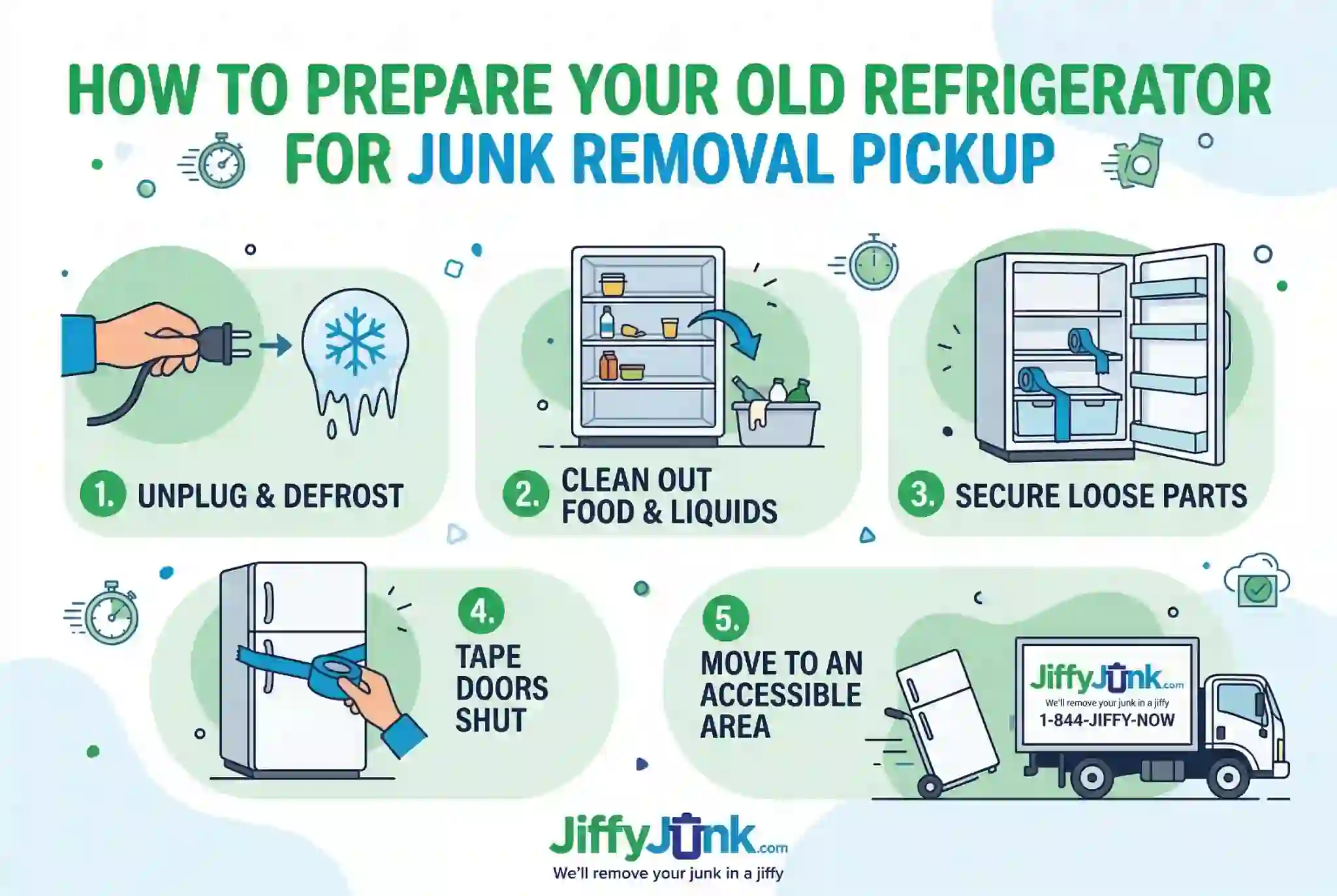
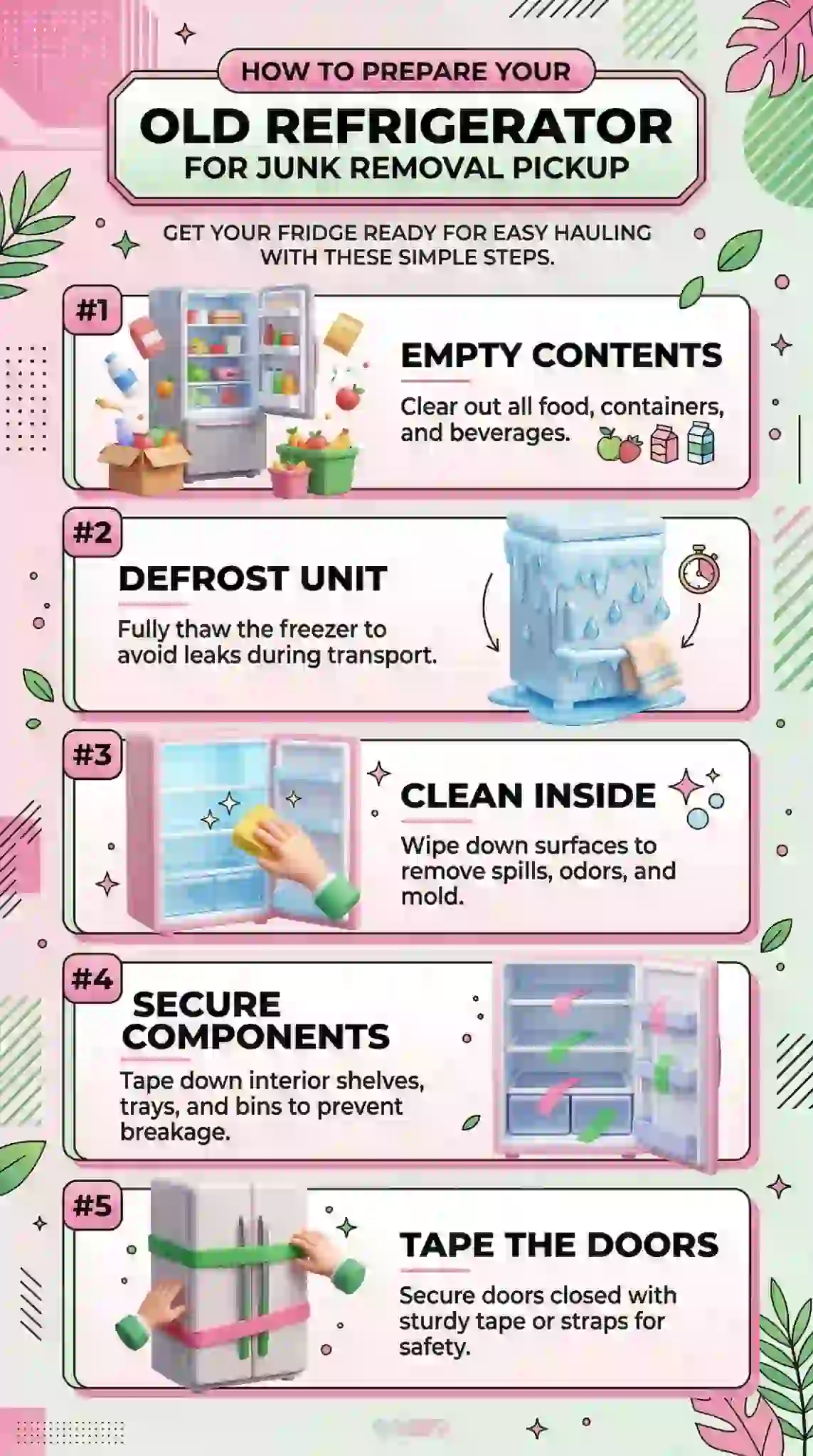
Cut power to the refrigerator at least 24 to 48 hours before your scheduled pickup. This gives the freezer compartment enough time to fully defrost, which prevents water from leaking onto floors or into the removal truck during transport. Once defrosted, wipe down the interior and empty the drip pan — a full drip pan is one of the most common causes of last-minute delays our crews encounter on arrival.
Step 2: Remove All Food, Shelves, and Loose Items
Clear everything out of the refrigerator before the team arrives. Remove all food, beverages, and any detachable shelves, drawers, or bins. Loose items shift during transport and can damage the unit or create safety hazards for the crew. If shelves are broken or cracked, bag them separately and let the team know ahead of time.
Step 3: Understand Refrigerant Compliance Requirements
Older refrigerators contain refrigerants — typically Freon in units manufactured before 2010 — that require EPA-compliant handling and disposal. You are not responsible for extracting the refrigerant yourself, but you should confirm that your junk removal provider is certified to handle it. At Jiffy Junk, every appliance removal involving refrigerants is handled by trained technicians in full compliance with EPA Section 608 regulations. This protects you from potential liability and ensures the appliance is disposed of responsibly.
Step 4: Clear a Direct Path from the Appliance to the Exit
One of the most consistent friction points our crews encounter is access. Measure doorways, hallways, and stairwells along the removal path before pickup day. Move furniture, rugs, or any obstacles that could block the route, especially items typically handled through curbside furniture pick up. If the refrigerator is in a tight space — a garage corner, a basement, or a narrow kitchen layout — flag that when you book so the crew arrives with the right equipment and enough hands for the job.
Step 5: Know What to Expect on Pickup Day
On arrival, the Jiffy Junk team will assess the appliance, confirm the removal path, and handle all the heavy lifting. You won't need to assist with moving the unit. Having the refrigerator defrosted, emptied, and accessible when the crew arrives keeps the job on schedule and avoids additional service fees. Most standard refrigerator removals are completed in under 30 minutes when the prep steps above are followed.
"In our experience, the refrigerator removals that run longest aren't the heaviest ones or the hardest to reach — they're the ones that weren't prepped. A freezer that's still running, a drip pan that hasn't been emptied, a hallway packed with boxes — these are the things that turn a 20-minute job into an hour-long ordeal. We've done this thousands of times, and the difference between a smooth pickup and a complicated one almost always comes down to what happened before we arrived. Give us a clear path, a defrosted unit, and an empty appliance, and we'll handle everything else."
Essential Resources
We know you want to handle this the right way. Whether you're trying to understand the regulations, find a rebate program, or locate a certified recycler near you, these seven resources give you the information you need to make a smart, confident decision before your fridge leaves the house.
EPA Section 608: Know What Federal Law Actually Requires Before Pickup Day Refrigerators contain EPA-regulated refrigerants — and federal law requires certified technicians to recover them before disposal. This official EPA resource explains exactly what Section 608 mandates, so you understand your obligations and can verify that whoever hauls your fridge is handling it correctly. https://www.epa.gov/section608
EPA Responsible Appliance Disposal Program: Make Sure Your Recycler Is Doing It Right Not all recyclers are created equal. The EPA's RAD Program identifies utilities, retailers, and removal companies committed to responsible appliance disposal — recovering refrigerants, recycling materials, and properly managing hazardous components. If you want to confirm your hauler's practices go beyond the bare minimum, start here. https://www.epa.gov/rad
Energy Star Rebate and Recycling Finder: You May Get Paid to Recycle Your Old Fridge Here's something most people don't know until it's too late: many utility companies will actually pay you $25 to $75 to pick up a working refrigerator as part of energy efficiency programs. This DOE search tool finds certified programs near you. It takes two minutes and could save you the cost of removal entirely. https://www.energystar.gov/rebate-finder
Steel Recycling Institute: What Your Old Fridge Is Actually Worth as Scrap That old refrigerator isn't just dead weight — it contains recoverable steel, aluminum, and copper. This resource breaks down material recovery rates and makes the case for recycling over landfill disposal. Customers who understand this are the ones who ask the right questions about where their appliance ends up after pickup. https://www.steelsustainability.org
Call2Recycle: Find a Certified Refrigerant Disposal Facility by ZIP Code If you're exploring local options beyond professional removal, this nonprofit-run directory connects you with certified collection facilities equipped to handle refrigerant-containing appliances. Search by ZIP code for compliant options in your area — and confirm they hold proper EPA certification before you commit. https://www.call2recycle.org
Earth911: The Fastest Way to Find Appliance Recyclers Near You Earth911 searches over 100,000 locations nationwide to surface appliance recyclers, municipal programs, and drop-off points close to your ZIP code. It's one of the most practical starting points we point customers toward when they want to compare their local options before booking a pickup. https://earth911.com
Consumer Reports: An Unbiased Look at Every Fridge Disposal Option on the Table Retailer take-back programs, utility rebates, donation, junk removal services, scrap value — Consumer Reports breaks down every option side by side with no agenda. If you want an editorially independent read before making your final call, this is the resource that gives it to you straight. https://www.consumerreports.org
These essential resources help you approach junk removal with confidence—giving you the information needed to choose the right provider, ensure compliant disposal, and take advantage of cost-saving programs before your refrigerator is picked up.
Supporting Statistics
These numbers come from federal data — but after removing thousands of refrigerators from homes across the country, we've seen exactly what they look like on the ground.
11 to 13 Million Refrigerators Reach End-of-Life Every Year in the U.S.
The EPA estimates 11 to 13 million refrigerated appliances are disposed of annually. We see it in our own call volume — refrigerator removal is consistently one of our most requested services.
What the statistic doesn't show:
Appliances left curbside without scheduled pickup are frequently mishandled
Uncertified haulers still vent refrigerants illegally
Recyclable materials get sent to landfills more often than they should
That's why every Jiffy Junk appliance removal goes through a certified recycling partner — no exceptions.
Source: U.S. Environmental Protection Agency https://www.epa.gov/section608/appliance-disposal
Refrigerators Over 15 Years Old Cost Homeowners $95 or More Every Year Just to Run
ENERGY STAR data shows older units consume roughly 20 percent more energy than current models. That gap adds up quietly — and it's the number that most often convinces customers to finally let go of the garage fridge they've kept "just in case," similar to how upgrading to modern air purifiers improves efficiency and performance over time.
What the data shows:
15-plus-year-old units cost $95 or more annually just to operate
Older models use approximately 20 percent more energy than current ENERGY STAR units
Replacing every outdated U.S. refrigerator would save $330 million in annual energy costs
That same replacement would prevent 5.5 billion pounds of greenhouse gas emissions
It's not just taking up space. It's pulled from the electric bill every single month.
Source: U.S. Department of Energy / ENERGY STAR https://www.energystar.gov/products/refrigerators
Responsible Recycling Has Already Diverted 1.5 Billion Pounds of Materials from Landfills
The EPA's Responsible Appliance Disposal Program has processed more than 9 million refrigerated appliances since 2006. The results validate what our crews see on every job.
RAD Program results to date:
1.5 billion pounds of metals, plastics, and materials recovered
543,000-plus hazardous components safely managed
Emissions avoided equivalent to powering 5 million homes annually
What this means on a Jiffy Junk job:
Steel, aluminum, copper, and glass get reclaimed
Refrigerants are recovered by certified technicians
Working units go to donation partners when possible
Every step is accounted for — because our customers ask, and we're always glad to answer
Source: U.S. Environmental Protection Agency https://www.epa.gov/rad
Final Thought & Opinion
Getting a refrigerator ready for pickup sounds minor. In practice, it's the step that determines whether your removal wraps up in 20 minutes or turns into an all-day ordeal.
What This Page Covered
Five prep steps make the difference:
Disconnect and fully defrost 24 to 48 hours before pickup
Empty the appliance completely, including the drip pan
Clear a direct, unobstructed path to the exit
Understand that refrigerant compliance is a legal requirement, not a suggestion
Confirm your removal provider is certified to handle it
Most people don't know any of these steps until something goes wrong on pickup day.
Our Honest Take After Thousands of Refrigerator Removals
The jobs that run longest are never the heaviest units or the hardest locations. They're the ones where the appliance wasn't ready.
What we see most often on delayed pickups:
Freezer still running at full temperature on arrival
Drip pan sitting in a standing puddle of water
Hallways and pathways blocked with furniture or boxes
These aren't unusual situations. They're the norm when customers don't know what to prepare for.
The Compliance Side Surprises Most People
The physical prep is straightforward. The regulatory side catches people off guard.
What homeowners need to know:
Refrigerants in older units are federally regulated under EPA Section 608
The crew removing your appliance must be certified to handle them
If they aren't, liability doesn't stay with the hauler — it follows the appliance
We've seen customers choose the cheapest option available during a garage cleanout and discover later their unit was dumped illegally or refrigerants were vented without recovery. That outcome is avoidable every single time.
What Proper Prep Actually Accomplishes
Three things happen when preparation is done right:
Faster job — no delays, no add-on fees, no rescheduling
Full EPA compliance — zero liability exposure for the homeowner
Cleaner handoff — the crew handles the heavy lifting, you reclaim the space
The Bottom Line
Prep work isn't extra effort. It's what makes professional removal worth booking in the first place. When you're ready to move forward, Jiffy Junk's White Glove Treatment handles everything from disconnection to eco-responsible disposal — no heavy lifting, no refrigerant headaches, no surprises on the bill. Just reclaimed space where that old unit used to be.
FAQ on Fridge Pick Up, Removal, Haul Away, and Disposal
Q: How do I prepare my refrigerator for junk removal pickup?
A: The jobs that run smoothest share one thing in common — the appliance was ready when we arrived.
Do these things 24 to 48 hours before pickup:
Disconnect power and begin defrosting
Empty all food, shelves, and removable components
Drain the drip pan completely
Clear a direct path from the fridge to the nearest exit
Do these things and most removals wrap up in under 30 minutes. Skip them and the same job can take three times as long.
Q: Can I leave my old refrigerator at the curb for regular trash pickup?
A: In most cases, no. This is one of the most common misconceptions we encounter — and one of the most costly.
What most people don't know:
Most municipal waste services won't accept fridges without proof of prior refrigerant removal
Appliances left curbside without a confirmed pickup can sit for days uncollected
Improper curbside disposal can result in fines and liability exposure
Check with your local Department of Public Works before moving anything. Better yet, book a certified removal service that handles compliance for you.
Q: How much does refrigerator removal and haul away typically cost?
A: It depends on the method — but here's what we've seen across thousands of jobs:
Utility rebate programs — pay you $25 to $75 for working units
Retailer haul away — $25 to $50 with a new appliance purchase
Municipal bulk pickup — free to $50 or more depending on location
Professional removal — varies based on accessibility, location, and volume
Two things we've learned in the field:
Bundling the fridge with other items almost always delivers better overall value
Upfront pricing eliminates surprises — the number we quote is the number you pay
Q: Does my old refrigerator contain hazardous materials that require special handling?
A: Yes — every refrigerator does. This is the area where DIY disposal most often goes wrong.
What's inside your refrigerator:
Freon or alternative refrigerants regulated under EPA Section 608
Mercury switches in older models
PCB capacitors requiring certified extraction
Compressor oils that need proper handling
What this means for you:
You don't need to handle any of it yourself
You do need to confirm your hauler is EPA-certified before booking
Assuming compliance without verifying it is the mistake we see most often
Ask before you book. Every time.
Q: What happens to my refrigerator after it is hauled away?
A: What happens depends entirely on who handles the job. More customers ask this question now than ever — and we're always glad to answer it.
What the process looks like on every Jiffy Junk removal:
EPA-certified technicians recover all refrigerants on site
Hazardous components are safely extracted and properly managed
Steel, aluminum, copper, glass, and plastic are separated for recycling
Working units in good condition go directly to donation partners
What the data shows:
Responsible recycling diverts up to 85 percent of a refrigerator's total weight from landfills
Not all haulers follow this process
Illegal dumping and refrigerant venting still occur when certification isn't verified
We work exclusively with certified recycling partners on every job — and we'll always answer when customers ask where their appliance ended up.