The 12-yard size still makes sense for plenty of projects. Single-room renovations, garage cleanouts, and moderate landscaping work all fit comfortably within both the volume and the weight limits. The trouble starts when density-heavy materials enter the equation. Concrete, brick, tile, asphalt, soil, and roofing shingles each weigh enough that the truck hits its allowance well before the container fills.
What follows highlights the practical value of the 12 yard dumpster size, including what fits, what won’t, what it costs, and how choosing the right container can help you avoid the overage fee that turns a $400 rental into a $700 one.
TL;DR Quick Answers
12 yard dumpster size
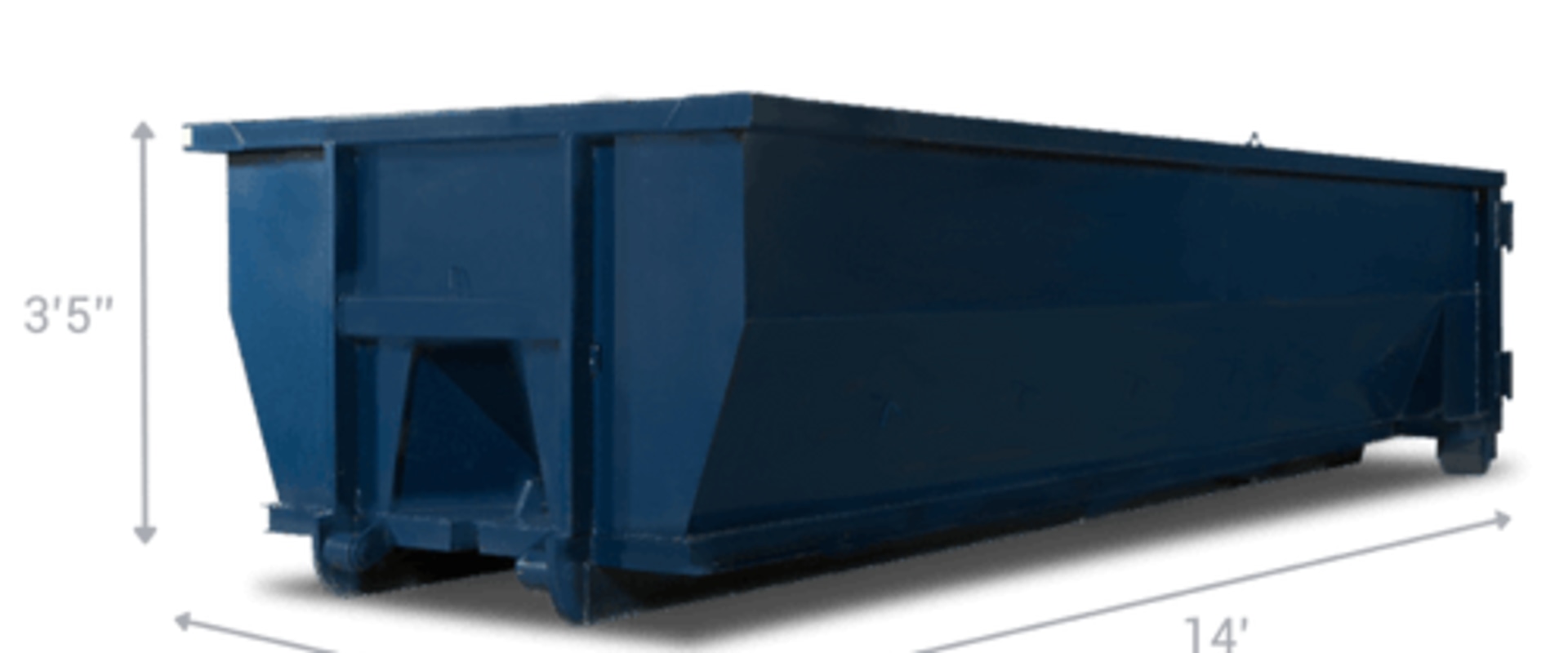
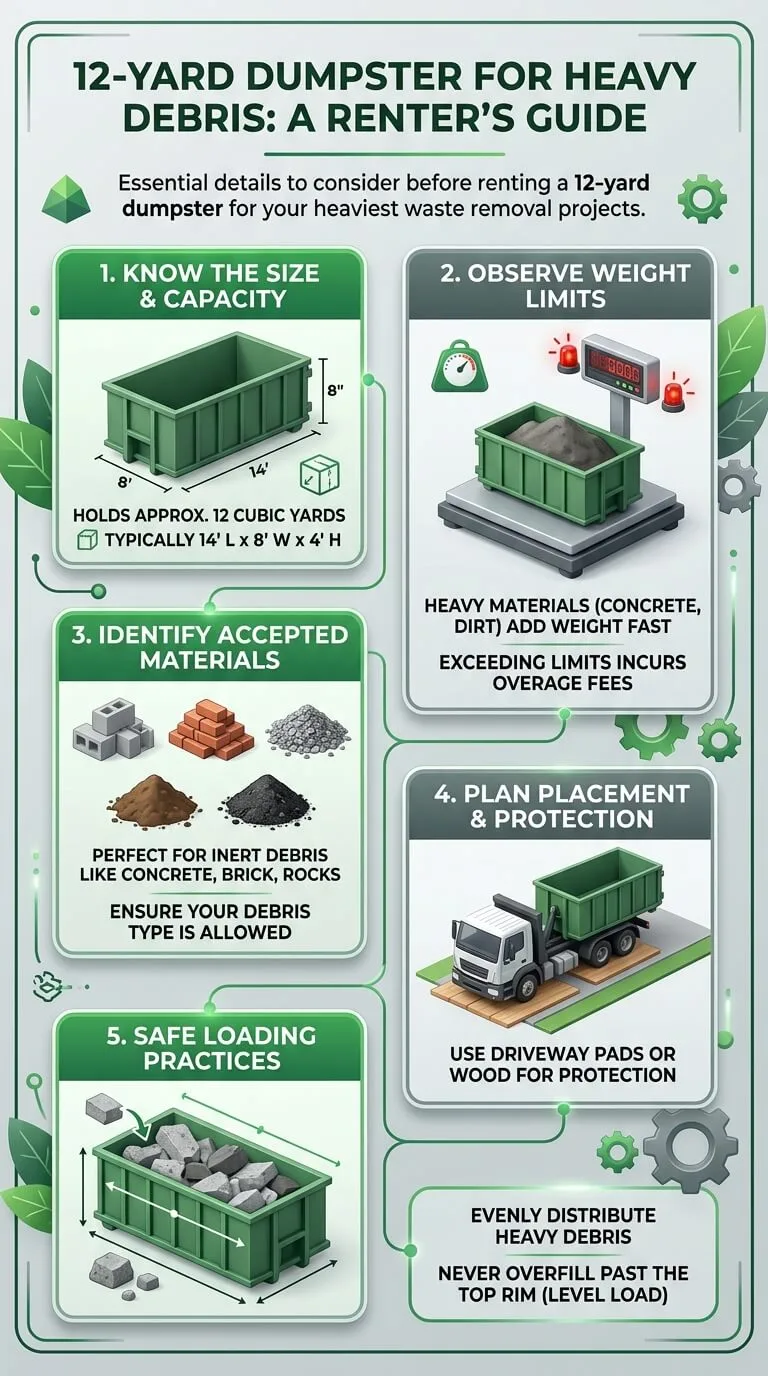
A 12 yard dumpster measures roughly 14 feet long, 7.5 feet wide, and 4 feet tall, with a footprint about the size of one parking space. Volume capacity is 12 cubic yards, equal to four or five pickup truck loads. Most providers cap the included weight at 2 to 4 tons (4,000 to 8,000 pounds), with overage fees of $50 to $100 per additional ton beyond that allowance.
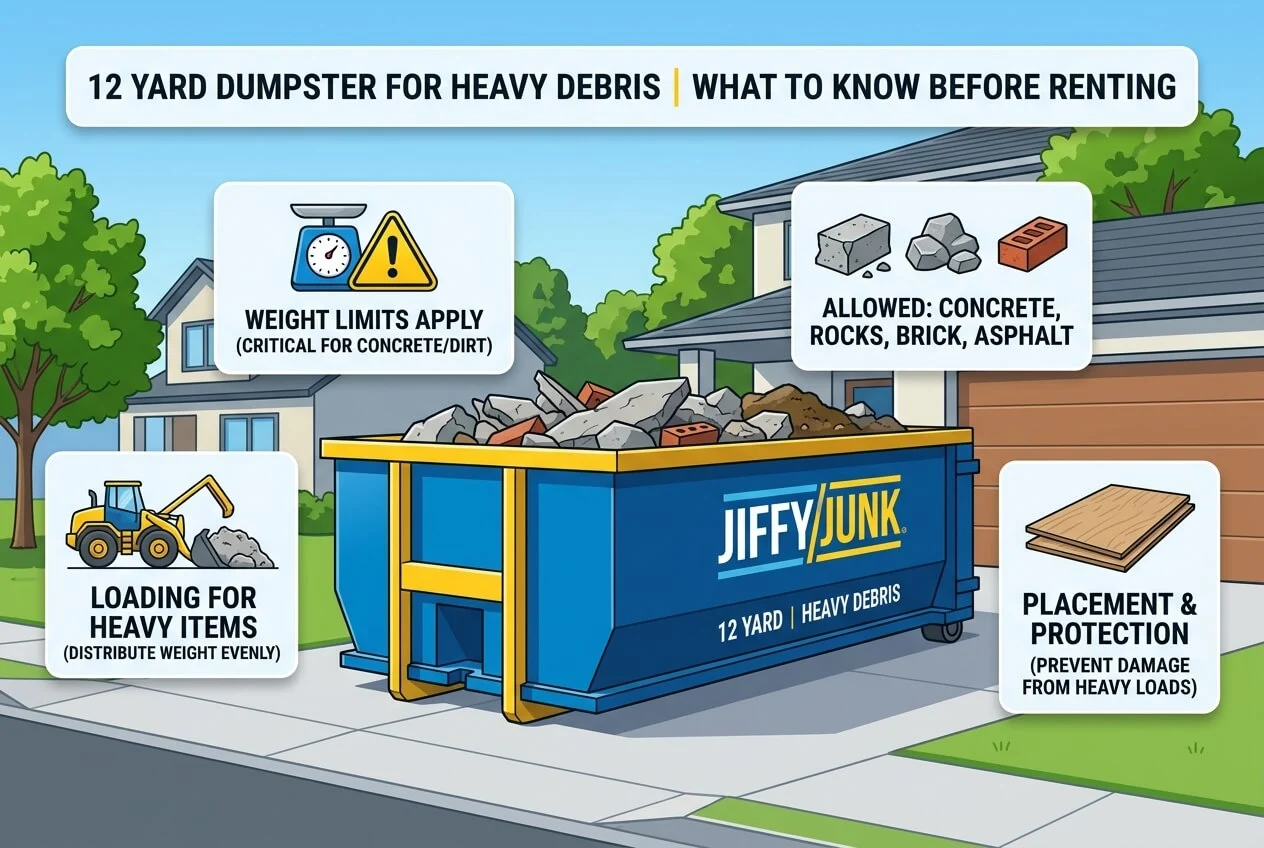
For long term roll off rentals involving heavy debris like concrete, brick, tile, or dirt, the weight cap fills before the volume does. Plan on roughly 2 cubic yards of concrete or 2 to 3 cubic yards of soil before you hit the limit.
12 yard dumpster specs at a glance:
Length: 14 feet
Width: 7.5 feet
Height: 4 feet
Volume: 12 cubic yards (4–5 pickup truck loads)
Weight allowance: 2 to 4 tons typical (4,000–8,000 lbs)
Footprint: About one parking space
Typical rental cost: $350 to $550 for a 7-day rental
Best for: Single-room renovations, garage cleanouts, moderate landscaping
Top Takeaways
Rent by weight, not volume. The 12 yard dumpster’s 2–4 ton weight limit fills before its 12 yard volume on heavy debris.
Concrete fills the weight cap at ~2 cubic yards. One cubic yard of concrete weighs roughly 4,000 lbs , so two cubic yards exhausts a 4-ton allowance.
Soil capacity is 2 to 3 cubic yards. Dry topsoil weighs less. Saturated soil weighs more. Plan for moisture.
Overage fees run $50 to $100 per ton. A single overage can erase the cost advantage of renting smaller.
Size up when in doubt. A 20 yard rental almost always beats a 12 yard plus an overage plus a second pickup.
Get an all-inclusive quote in writing. Weight allowance, overage rate, delivery and pickup, and any extra fees should appear on one page.
Check donation and recycling options first. Habitat ReStores and local C&D recyclers can divert weight (and reduce cost) before debris ever reaches the dumpster.
What Counts as “Heavy Debris”?
Heavy debris is about density, not size. A pickup bed full of pine framing weighs a fraction of a pickup bed full of concrete, even though both take up the same visual space. The materials that consistently push a 12 yard dumpster against its weight cap pack thousands of pounds into every cubic yard:
Concrete: ~4,000 lbs per cubic yard
Brick and masonry: ~3,000 lbs per cubic yard
Asphalt: ~2,700 lbs per cubic yard
Tile and stone: ~2,500 lbs per cubic yard
Soil and dirt: ~2,200 lbs per cubic yard, more when wet
Roofing shingles: ~250 lbs per bundle, with three bundles per roofing square
By comparison, the same volume of drywall, cardboard, or wood framing weighs anywhere from a quarter to a tenth as much. Knowing how dense materials behave inside a standard roll-off dumpster is what separates a clean rental from an expensive one.
12 Yard Dumpster Size and Weight Limits at a Glance
A 12 yard dumpster typically measures 14 feet long, 7.5 feet wide, and 4 feet tall. The footprint matches a single parking space, and the four-foot sidewall fits most residential driveways with clearance to spare. Volume capacity is 12 cubic yards, equal to roughly 4 to 5 pickup truck loads.
Weight limits are where heavy-debris projects live or die. Most providers cap a 12 yard rental at 2 to 4 tons (4,000 to 8,000 pounds) included in the base rate. Overage fees run $50 to $100 per additional ton beyond that allowance. Rental cost typically runs $350 to $550 for a seven-day rental, with regional disposal fees and the included weight allowance driving most of the price variance.
For a complete breakdown of measurements, capacity, and rental cost ranges across providers and regions, see this guide on 12 yard dumpster size, dimensions, and rental cost.
Dimensions: 14 ft L × 7.5 ft W × 4 ft H
Volume capacity: 12 cubic yards (~4–5 pickup loads)
Weight limit: 2–4 tons (4,000–8,000 lbs typical)
Footprint: About 1 standard parking space
Best heavy-debris uses: Single-room tile demo, small concrete pad, moderate dirt
Typical rental cost: $350–$550 for 7-day rental
Can a 12 Yard Dumpster Handle Concrete, Brick, and Tile?
Yes, with one important constraint: the weight limit caps you long before the volume does. Run the math. One cubic yard of concrete weighs roughly 4,000 pounds . A 12 yard dumpster with a 4-ton (8,000 lb) allowance fills up by weight at about 2 cubic yards of concrete. That leaves 10 cubic yards of unused space sitting empty above the load.
For pure demo loads, many haulers either require or strongly recommend a dedicated “clean fill” dumpster that takes concrete only, with no mixed debris. For residential projects that mix heavy and light debris, the smart approach loads heavy material first along the floor of the container, then tops with lighter debris up to the fill line. That sequence protects the container floor, distributes weight evenly for safe transport, and uses the full volume without exceeding the weight cap.
How Much Dirt or Soil Fits Before Hitting the Limit?
Plan on 2 to 3 cubic yards of soil before the weight cap kicks in, depending on moisture content. Dry topsoil weighs about 2,000 lbs per cubic yard . Saturated soil after rain can clear 3,000 lbs . For larger landscaping projects, split the haul across two pickups or upgrade to a 20 yard container.
One restriction worth flagging: many haulers only accept “clean fill” dirt that contains no rocks, roots, or trash mixed in. If your soil contains debris, expect haulers to bill at standard waste-disposal rates instead of the lower clean-fill rate.
When to Size Up From a 12 Yard
Move up to a 20 yard container if any of the following apply:
You’re hauling more than 2 cubic yards of pure concrete, brick, or stone.
Your project spans more than one room or work zone.
You’re tearing off a full roof, since shingle weight adds up faster than most homeowners expect.
You’re removing an entire patio, walkway, or driveway.
You can’t accurately estimate volume. Size up when in doubt.
The cost logic is simple. An empty dumpster costs the same to haul as a full one, so a single 20 yard rental almost always beats a 12 yard plus an overage fee plus a second pickup.
“After working through hundreds of heavy-debris rentals, the same pattern shows up over and over. Homeowners size their dumpster by volume when they should be sizing by weight. A 12 yard container looks generous when you’re staring at a tile floor or a brick chimney, but the math gets unforgiving fast. One cubic yard of concrete weighs two tons. Two cubic yards weighs four tons, which hits the upper limit for most rentals. Once renters see those numbers spelled out before delivery day, the decision changes — and the overage fees stop happening.”
7 Essential Resources
Successful heavy-debris rentals usually start with a little homework on what’s allowed, what’s recyclable, and what requires special handling. These seven resources are worth bookmarking before delivery day.
1. What Is a Roll-Off Dumpster?
This overview covers the standard reference for dumpster types, sizes, and the differences between front-load, rear-load, and roll-off containers.
Source: Wikipedia
URL: https://en.wikipedia.org/wiki/Dumpster
2. EPA Sustainable Management of Construction & Demolition Materials
The EPA’s central hub covers what counts as C&D debris, how to reduce it, and where the biggest recovery opportunities sit. Worth reviewing before any renovation.
Source: U.S. Environmental Protection Agency
URL: https://www.epa.gov/smm/sustainable-management-construction-and-demolition-materials
3. EPA C&D Debris Material-Specific Data
Detailed breakdowns of how concrete, asphalt, drywall, brick, wood, and shingles flow through the U.S. waste stream, including recovery rates, landfill volumes, and trends since 1990.
Source: U.S. Environmental Protection Agency
4. Habitat for Humanity ReStore Donations
Before tossing fixtures, cabinets, doors, or appliances into a dumpster, check whether your local ReStore accepts them. Most offer free pickup for usable building materials and provide tax-deductible receipts.
Source: Habitat for Humanity
URL: https://www.habitat.org/restores/donate-goods
5. OSHA Standard 1926.252: Disposal of Waste Materials
This federal safety standard governs debris disposal on construction sites, covering chute requirements, drop-zone barricades, and removal protocols. Required reading for contractors and useful for serious DIY projects.
Source: Occupational Safety and Health Administration
URL: https://www.osha.gov/laws-regs/regulations/standardnumber/1926/1926.252
6. EPA Household Hazardous Waste & Demolition Guidance
Renovation projects routinely uncover paints, solvents, and pre-1978 materials that may contain lead or asbestos. This guide covers safe handling and disposal, none of which belongs in a standard rental dumpster.
Source: U.S. Environmental Protection Agency
URL: https://www.epa.gov/large-scale-residential-demolition/household-hazardous-waste-and-demolition
7. CalRecycle Construction & Demolition Recycling
This state-level model for finding C&D recycling processors works as a template for researching local infrastructure, even outside California. The site lists facility directories and cost-saving recycling options.
Source: California Department of Resources Recycling and Recovery
URL: https://calrecycle.ca.gov/condemo/
3 Statistics
The numbers behind heavy-debris disposal explain why getting the rental right matters for your wallet and for the wider waste stream.
1. 600 Million Tons of C&D Debris Generated Annually
The EPA estimates that 600 million tons of construction and demolition debris went into the U.S. waste stream in 2018. That figure exceeds the volume of municipal solid waste produced that same year by more than two times. Renovation, demolition, and remodeling projects produce the bulk of it, making proper cleanup important for a cleaner worksite and healthier indoor environments where air purifiers can also support better air quality during and after the project.
Source: U.S. Environmental Protection Agency
2. 76% Recovery Rate for C&D Materials
Of those 600 million tons, roughly 455 million tons went toward recovery, recycling, or beneficial reuse. Another 145 million tons went to landfills. The 76% recovery rate happens when materials get sorted properly at the source.
Source: U.S. Environmental Protection Agency
URL: https://www.epa.gov/smm/sustainable-management-construction-and-demolition-materials
3. C&D Recycling Supports 175,000 American Jobs
The EPA’s Recycling Economic Information report found that recycling and reuse of construction and demolition materials supports approximately 175,000 jobs across processing facilities, nonprofits, and logistics operations nationwide.
Source: U.S. Environmental Protection Agency
URL: https://www.epa.gov/smm/recycling-economic-information-rei-report
Final Thoughts and Opinion
Heavy debris is the single most common reason a 12 yard dumpster rental goes sideways. The container itself works well for mid-sized residential projects: single-room renovations, garage cleanouts, moderate landscaping. Mixed debris keeps the average density reasonable in those cases. Density-heavy demo work is where the 12-yard falls down. Pure concrete, full roofs, large soil hauls all push past the weight cap before the volume even fills. In those scenarios, you’ll pay twice over: once for the rental and once for the overage fee that a 20 yard container would have avoided in a single trip.
If we had to summarize the entire decision in one sentence: rent by weight, not by volume. Estimate the heaviest material in your project, multiply by the cubic yardage you expect, and compare that number against the weight allowance. If you’re at or above the cap, size up.
The other lesson worth internalizing about dumpster rental prices: getting an all-inclusive quote in writing before delivery gives you clarity, confidence, and better control over your budget. Weight allowance, overage rate, delivery and pickup fees, prohibited-item charges, and any rental period extensions should all show up on a single page with one number at the bottom. A provider who can’t produce that document is sending a signal worth listening to.
Frequently Asked Questions
What is the weight limit on a 12 yard dumpster?
Most rental providers cap a 12 yard dumpster at 2 to 4 tons (4,000 to 8,000 pounds), with overage fees of $50 to $100 per additional ton. The exact limit varies by provider and region, so confirm in writing before delivery.
Can I put concrete in a 12 yard dumpster?
Yes, but plan around the weight limit instead of the volume. One cubic yard of concrete weighs roughly 4,000 pounds , which means a 4-ton allowance maxes out at about 2 cubic yards. For larger concrete jobs, ask about a dedicated “clean fill” container that allows higher concrete-only weight.
How much does a 12 yard dumpster of dirt weigh?
A fully loaded 12 yard container of dry topsoil would weigh about 24,000 lbs (12 tons) , far above any standard weight limit. In practice, expect to fit 2 to 3 cubic yards of soil before you hit the weight cap.
Is a 12 yard dumpster big enough for a tile removal project?
For a single-room tile removal, yes. Most bathroom or kitchen tile floors fit comfortably within both the volume and weight allowance. For multi-room removals or full patio teardowns, size up to a 20 yard container.
How much does it cost to rent a 12 yard dumpster for heavy debris?
Expect $350 to $550 for a 7-day rental in most markets, before any weight overage. Heavy-debris rentals frequently incur additional charges, so request an all-inclusive quote with overage rates spelled out before booking.
Do I need a permit for a 12 yard dumpster on my driveway?
Usually no. Placement on private property typically does not require a permit. Most municipalities require a permit when the dumpster sits on a street, sidewalk, or alley, or when local ordinances or HOA rules apply. Confirm with your municipality before delivery.
Ready to Book Your Rental?
Got a heavy-debris project on the calendar? Run the numbers on weight first, before booking. Estimate the heaviest material, multiply by your expected cubic yardage, and compare that figure against the rental’s weight allowance. If you’re close to the cap, ask your provider what a 20 yard rental would cost. In most cases it’s cheaper than a 12 yard plus an average. And get the full quote in writing every time.
For more on debris removal, junk hauling, and household disposal, browse the rest of our home and disposal guides.