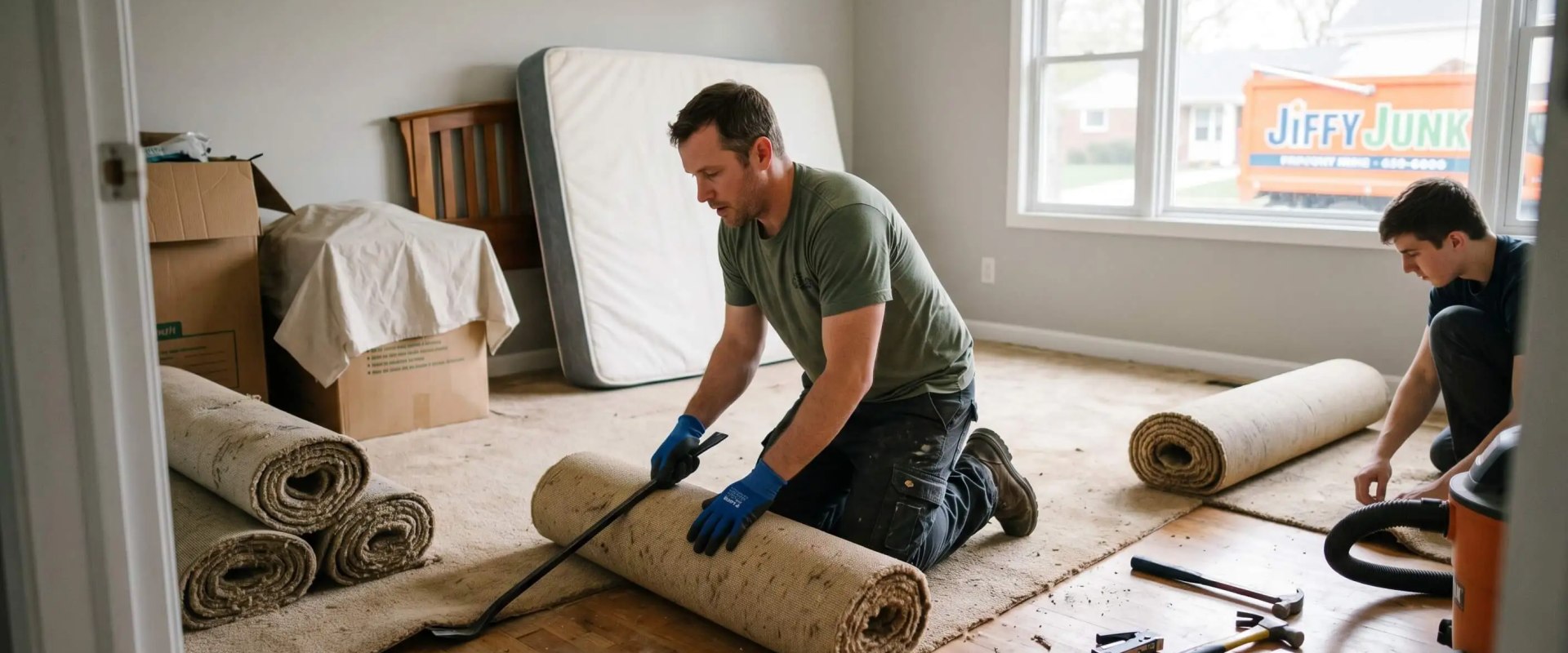
Bed bug carpet removal services cost about $1.50 to $4.50 per square foot in 2026, which works out to $300 to $700 for a single bedroom or $1,200 to $3,500 for a whole home. The dollar range looks wide because the actual variables (pad condition, tack strip damage, hazardous disposal fees, region) are wide. Get those itemized in writing before you sign anything, and the final invoice usually matches the quote.
Below: what you should expect to pay in 2026, what drives the price up or down, when removal makes more financial sense than treatment, and the questions that separate a legitimate professional from a problem you'll be paying to fix twice.
TL;DR Quick Answers
carpet removal services cost
Carpet removal services cost $1 to $2.50 per square foot for clean carpet, and $1.50 to $4.50 per square foot when the carpet is contaminated by bed bugs or similar hazards. Typical job pricing:
Single bedroom (~120 sq ft): $300–$700
Master bedroom (~200 sq ft): $500–$1,100
Living room (~300 sq ft): $700–$1,500
Whole home (~1,500 sq ft): $1,800–$3,000
Whole home (~2,500 sq ft): $2,800–$5,500
Urban markets (Los Angeles, NYC, Bay Area) run 20–35% above these ranges. Same-day or emergency service adds $200 to $500. Hazardous-disposal fees and regional labor rates account for most of the cost variation between quotes. Get three written, line-item quotes that explicitly name pad and tack strip removal before signing anything.
Top Takeaways
Bed bug carpet removal services cost $1.50 to $4.50 per square foot on average. Expect $300 to $700 for a single bedroom, and $1,200 to $3,500 for a whole home.
The carpet pad and tack strips are where most cost overruns come from. Get them addressed in writing before work starts.
DIY removal is rarely a good idea in apartments, condos, or any setting where cross-contamination to other units or vehicles is possible.
Removal beats treatment when eggs are visible in the fiber, when treatment has failed twice, when the carpet is 8+ years old, or when the pad is involved.
Hazardous disposal fees and regional labor rates drive most of the variation between quotes. Same-day service can add another $200 to $500 on top.
Always get three written, line-item quotes and verify licensing and insurance before signing anything.
Curbside disposal is rarely legal for known-infested carpet. Sealed transport and approved-facility disposal are usually required.
What You'll Pay To Remove Bed Bug-Infested Carpet
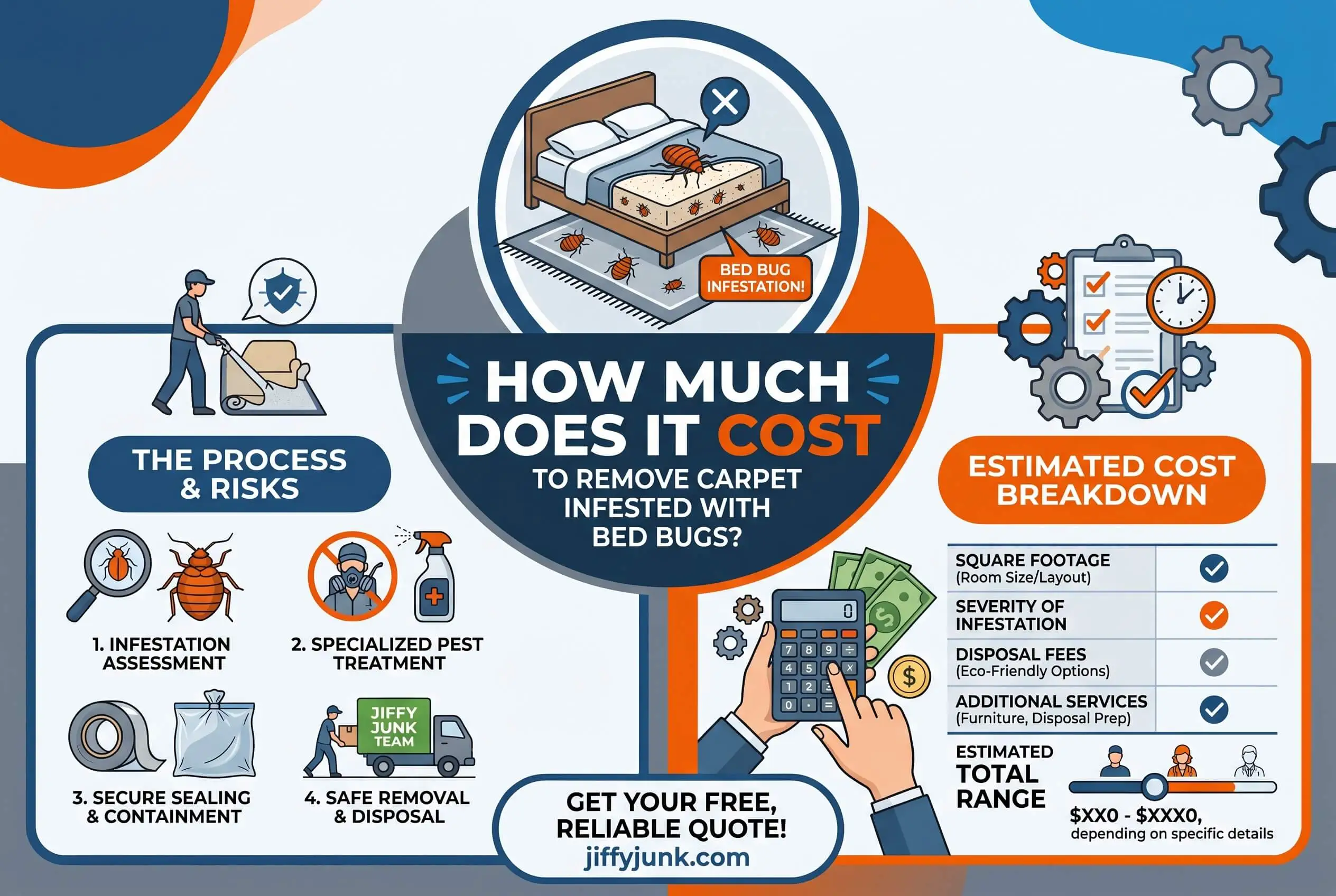
Contaminated carpet roughly doubles the per-square-foot rate of a clean removal. The premium pays for sealed transport, PPE, the hazardous-disposal surcharge at the landfill, and the extra labor needed to keep the infestation from spreading on the way out the door. Across the job sizes we see most often, the breakdown looks like this:
Single bedroom (~120 sq ft): $300–$700. Pad and tack strip removal usually included.
Master bedroom (~200 sq ft): $500–$1,100. Add $100–$200 if the subfloor needs treatment.
Living room (~300 sq ft): $700–$1,500. Larger pieces may require two crew members.
Whole home (~1,500 sq ft): $1,800–$3,000. Often eligible for a bundled-service discount.
Whole home (~2,500 sq ft): $2,800–$5,500. Multiple disposal trips. Same-day is rarely available.
The bands above reflect 2026 national averages. Major urban markets (Los Angeles, New York City, the Bay Area) routinely run 20–35% higher than the high end of each band. Rural and lower-cost regions sometimes come in below the floor. Same-day or emergency service tacks on another $200 to $500.
What Drives The Price Up Or Down
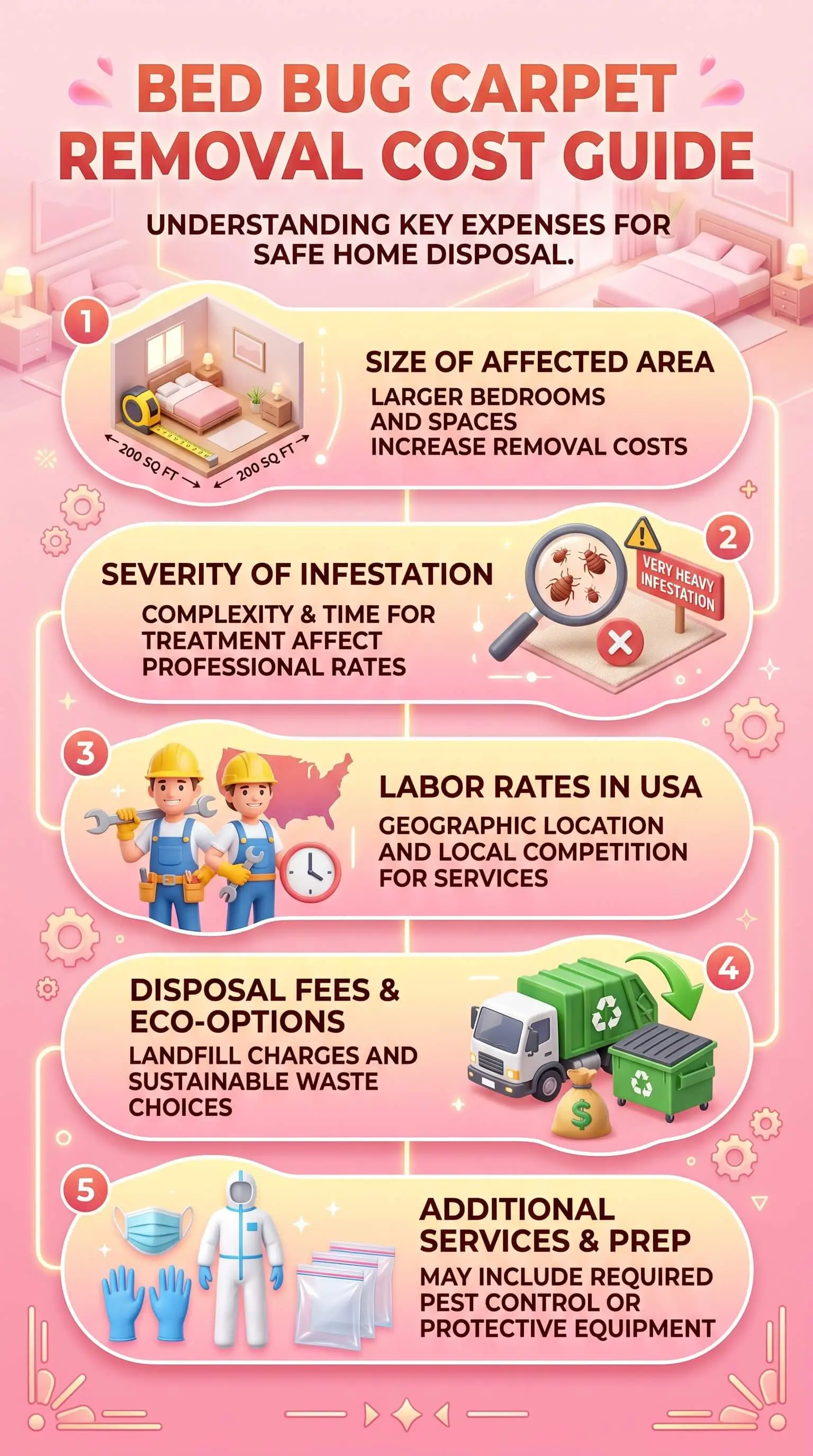
Five variables explain almost every dollar of variation in carpet removal services cost:
Square footage and minimum service charges. Most companies have a $200–$400 minimum, so a 100 sq ft job rarely costs one-tenth of a 1,000 sq ft job.
How deep the infestation runs. If bed bugs have moved into the carpet pad and the wooden tack strips along the wall, the haul weight roughly doubles, and so does the labor.
Hazardous disposal fees. Many landfills charge a tipping surcharge for sealed, infested material. That surcharge often runs $50 to $150 per load on top of standard fees.
Region and labor rates. The same job in Manhattan vs. central Pennsylvania can swing $400 or more.
Whether furniture and pad replacement are bundled in. Some quotes roll haul-away of contaminated bedroom furniture into the price. Others bill it separately.
It also helps to understand how carpet is constructed. Modern carpet sits in layers (face fibers on top, primary backing, latex adhesive, secondary backing), and bed bugs and their eggs can hide in all of them, particularly in the wooden tack strips that line the perimeter of every wall-to-wall installation. That layering is exactly why surface treatments so often miss infestations, and why pulling the whole thing becomes the durable fix once bugs reach the substructure.
Why You Can't Just Throw Bed Bug-Infested Carpet On The Curb
Here's where homeowners trip up. Most U.S. municipalities won't accept untagged carpet known to contain bed bugs at the curb, and several cities require it to be cut into strips, sealed in heavy plastic, and labeled before haul-out. The EPA goes further: it recommends marking or destroying infested furniture so a neighbor can't drag it home and start the cycle over.
Skipping those sealing and labeling protocols puts more than a fine at risk. The realistic outcome is reseeding your own garage, your car, the building stairwell (which is how single-unit infestations turn into building-wide ones), or your next-door neighbor's apartment. That's the failure mode professional removal is built around preventing.
DIY Versus Hiring A Pro
DIY looks cheaper on paper. A driveway dumpster runs $300 to $500 for a week. Add disposal fees, PPE, heavy plastic, and your time, and the all-in DIY tab usually lands between $400 and $800. Stacked against a $1,500 professional bedroom job, that's real savings on the surface.
The savings tend to evaporate fast. Cross-contamination during haul-out is the variable most homeowners underestimate. Rolled-up carpet sheds bugs and eggs onto every surface it touches, and a single missed egg cluster can reseed an entire room inside three weeks.
For most residential cases, working with a professional carpet removal service that specifically handles infested materials is the lower-risk path. Reputable operators will itemize disposal fees, hauling, pad replacement, and tack strip removal in writing before they start work. The final number ends up matching the actual final invoice, which is exactly what you want.
If you rent, or if you live in a multi-unit building, DIY is almost never the right call. Shared walls multiply the contamination risk, and most leases assign liability for any spread to whoever caused it.
When Removal Beats Treatment
Removal isn't always necessary. The EPA actively pushes back on throwing out items that can be effectively treated, citing the expense, the stress, and the risk of spreading the problem somewhere else. From what we've seen, removal makes the strongest economic case in four situations:
Visible eggs or shed casings are present in the carpet fiber, not just on top of it.
The infestation has returned after two or more rounds of professional treatment.
The carpet is older than 8–10 years and would need replacement soon anyway.
The infestation has reached the carpet pad or tack strips. At that point, removal is usually cheaper than the multi-treatment cycle required to fully clear it.
For light, recent infestations on newer carpet, professional steam treatment combined with chemical follow-up is often the smarter financial move.
“The single biggest cost driver I see homeowners miss is the carpet pad. People budget for the carpet, do the square-footage math, and feel ready to sign. Then the pad pulls up and there's a second layer of active infestation underneath. Add the tack strips at the perimeter, and the disposal weight doubles, and you're getting a revised invoice midway through the job. Two things prevent that from happening to you. Get the inspection done before the quote rather than during the haul, and insist on a written line-item that names pad and tack strip explicitly. That one sentence in a contract is worth several hundred dollars on a typical bedroom job. It forces the company to commit to the real scope, not the sales-friendly version of it.”
7 Essential Resources
Before you sign anything, cross-check quotes and protocols against the public sources industry professionals actually use. Each of the seven below is current, free, and worth bookmarking.
EPA Bed Bug Information Hub — epa.gov/bedbugs. The Environmental Protection Agency's main resource on identification, treatment, and product safety. Use it to fact-check anything a contractor tells you about pesticide application or heat treatment.
EPA Top Ten Tips For Bed Bug Control — epa.gov/bedbugs/top-ten-tips-prevent-or-control-bed-bugs. A practical, plain-language checklist covering when to call a professional and why throwing everything out is usually the wrong move.
EPA Do-It-Yourself Bed Bug Control Guide — epa.gov/bedbugs/do-it-yourself-bed-bug-control. The step-by-step protocol for inspection, sealing, and treatment if you're considering handling part of the work yourself.
CDC Bed Bug Overview — cdc.gov/bed-bugs/about/index.html. The Centers for Disease Control reference on bed bug biology, bites, and health impacts. Useful for renters who need to document an infestation in writing for a landlord.
Joint CDC/EPA Statement On Bed Bug Control — stacks.cdc.gov/view/cdc/21750. The official joint policy document on recommended public-health responses to bed bug infestations.
Cornell University Integrated Pest Management — cals.cornell.edu/integrated-pest-management/outreach-education/whats-bugging-you/bed-bugs. University-grade research and management guidance, including treatment protocols for large rugs and wall-to-wall carpet as part of a structural plan.
NPMA PestWorld Bed Bug Facts — pestworld.org/all-things-bed-bugs/bed-bug-facts-statistics/. The National Pest Management Association's industry survey data on infestation rates, common locations, and seasonal patterns. The most credible third-party prevalence numbers we've found.
3 Statistics
If you're wondering whether your situation is unusual, the data says no. Bed bug infestations are widespread, expensive, and frequently misidentified before anyone gets to the right diagnosis.
97% of pest control professionals treated bed bugs in the past year. According to the National Pest Management Association's Bugs Without Borders survey, that figure has stayed steady year over year, and it's a major jump from the 25% reported in 2000. (Source: NPMA / PestWorld)
Bed bug treatment averages $4 to $7.50 per square foot. Whole-home jobs land in the $1,000 to $4,000 band, severe infestations can hit $6,200, and full-building fumigation has been documented above $50,000 in extreme cases. (Source: Angi 2026 cost data)
84% of pest professionals were called about a different pest before they identified bed bugs as the actual cause. Most of those misidentifications were fleas (71%) or cockroaches (28%), which means a lot of homeowners pay for the wrong treatment first and inflate their total resolution cost. (Source: NPMA Bugs Without Borders survey)
Final Thoughts And Opinion
After years of covering air quality, junk removal, mold, and pest remediation, our take on the bed bug carpet decision is plain. Sticker price alone is bad framing. The right framing is the cost of getting the decision wrong, which usually shows up six weeks later as a re-treatment invoice.
A $400 DIY removal that reseeds the infestation three weeks later turns into a $2,500 decision once re-treatment, lost sleep, and a second round of disposal land on the bill. A $1,800 professional removal that actually solves the problem buys the outcome you wanted, not just the labor.
One piece of advice for first-time readers: get three written quotes, demand line-item pricing that names pad and tack strip explicitly, verify licensing and insurance, consider how the removal fits with your air purifier and overall indoor air quality plan, and treat any bid 30%+ below the others as a red flag. The cheapest bid in this category is almost always the most expensive bid in disguise.
Frequently Asked Questions
Do you have to throw out carpet with bed bugs?
Not always. The EPA actually recommends against throwing out items that can be effectively treated, since disposal is expensive and risks spreading the problem. For light infestations on newer carpet, professional steam and chemical treatment usually does the job. Heavy or repeat infestations are different. If eggs are visible in the fiber or the pad is involved, removal becomes the more durable answer.
Can bed bugs live in carpet padding?
Yes. Carpet pad is a common harborage site, along with the wooden tack strips around the room's perimeter. Both should be inspected and, if infested, removed and replaced. This is the most commonly missed cost driver when homeowners get a quote based on the visible carpet alone.
How much does professional carpet removal cost on average?
Clean carpet runs $1 to $2.50 per square foot. Infested carpet runs $1.50 to $4.50 per square foot, because of hazardous-disposal fees, sealed transport, PPE, and the labor needed to prevent spread. A typical bedroom is $300 to $700. A typical whole home is $1,200 to $3,500.
Will removing the carpet eliminate bed bugs completely?
Not on its own. Bed bugs also harbor in baseboards, electrical outlets, furniture, and wall voids. Removal eliminates one major harborage site and is often paired with a professional pest treatment of the empty room and adjoining spaces. Plan on coordinating both services for the best results.
Does homeowners insurance cover bed bug carpet removal?
Almost never. Bed bug infestations are typically classified as a maintenance issue rather than a covered peril, and most standard homeowners and renters insurance policies explicitly exclude pest damage. Check your individual policy, but assume out-of-pocket unless your declarations page says otherwise.
How long does bed bug carpet removal take?
A single bedroom takes most professional crews 2 to 4 hours, including pad and tack strip removal. A whole home runs 6 to 10 hours and may require two trips to the disposal facility. Same-day service is sometimes available at a $200 to $500 premium.
Can I do carpet removal myself with active bed bugs?
It's legal in most places, but it's risky. The big issue is cross-contamination during haul-out. That can hit your vehicle, your garage, or shared building areas. If you have a single-family home with a private driveway and you're confident in your ability to seal and transport the carpet without contact with other living spaces, DIY can work. In any apartment, condo, or shared-wall setting, hire a pro.
Should I replace the carpet pad too?
Yes. The pad is where bed bugs and their eggs frequently shelter, and replacing it is inexpensive ($0.30 to $0.80 per square foot) compared to the cost of leaving an active infestation in place beneath new flooring.
Ready To Get Bed Bug-Infested Carpet Out Of Your Home?
If you've decided removal is the right call, the next step is a written, all-inclusive quote from a licensed and insured provider that handles infested materials specifically. Click here to compare professional carpet removal services cost and see what a clean line-item quote actually looks like, including pad removal, tack strip handling, sealed transport, and approved-facility disposal.
If this guide helped, drop a comment with your own experience, share it with someone dealing with the same situation, or subscribe for more home and disposal cost coverage. We update this article when the underlying cost data shifts, so check back if you're researching a job a few months out.