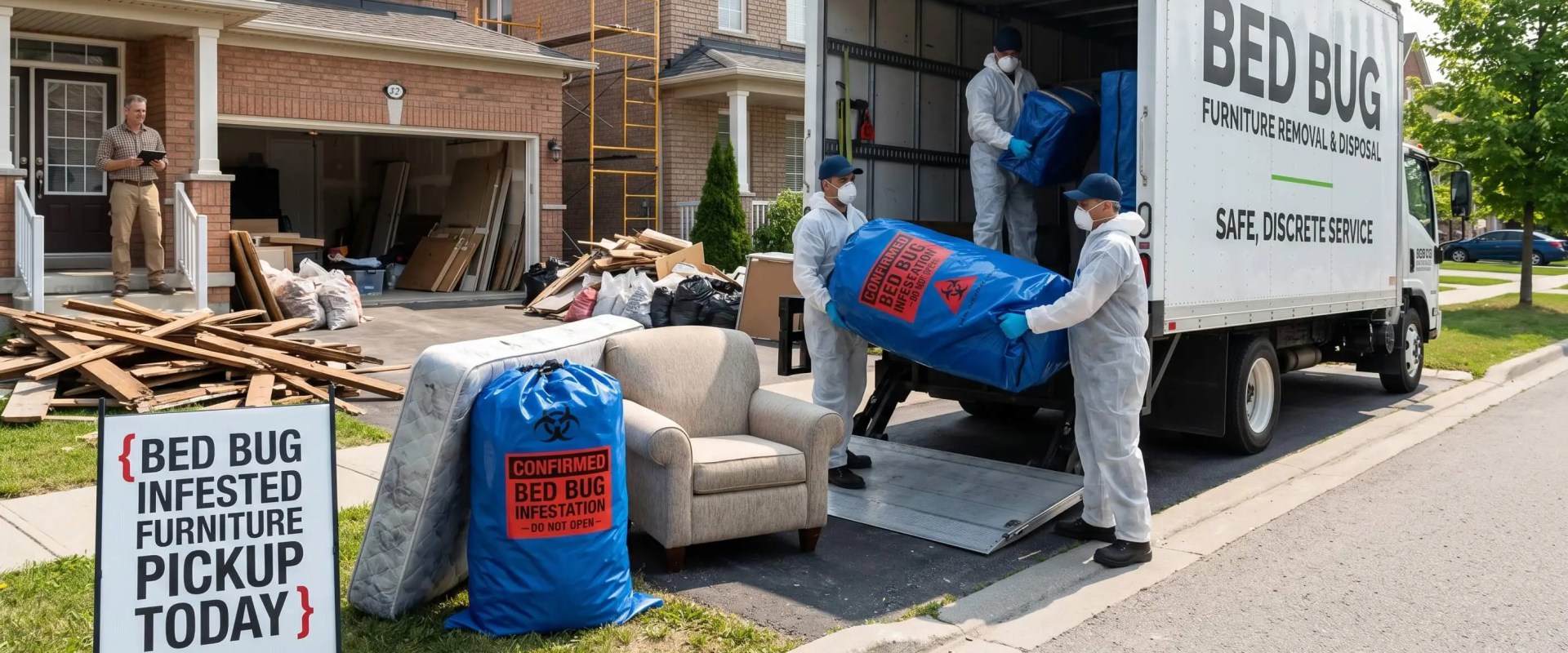
Anyone searching "companies that remove bed bug infested furniture" mid-project has already done the hard part: they've recognized that DIY heat treatment isn't compatible with a demolition timeline. The rest is execution. This guide covers identification, the exact sequence for moving infested pieces without contaminating clean rooms, what professional removal actually costs, and the verified federal and university resources worth bookmarking before the next demo day.
TL;DR Quick Answers
companies that remove bed bug infested furniture
Companies that remove bed bug infested furniture are licensed haul-away services that seal, transport, and dispose of contaminated pieces in compliance with local regulations. Most offer same-day or next-day pickup in major metros. Pricing runs $75 to $150 per item for standard removal, and $300 to $800 or more for multi-piece or whole-room jobs.
When professional removal beats DIY:
You have more than one infested piece.
The infestation involves soft furniture (mattress, box spring, upholstered sofa, fabric headboard).
You're in a multi-unit building where bugs travel through shared walls.
A renovation timeline can't absorb a week of trial-and-error treatment.
What they handle that DIY usually can't:
Airtight sealing during transport so bugs don't disperse mid-move.
Compliant disposal that meets municipal rules (some cities require marked or slashed pieces).
Liability coverage if bugs spread to adjacent units or contractor vehicles.
At $75 to $150 per item, professional removal almost always costs less than the $1,500 to $5,000 whole-home extermination bill that follows a botched DIY transport.
Top Takeaways
Demolition disperses bed bugs faster than normal household activity, so an infestation discovered mid-renovation needs containment within hours, not days.
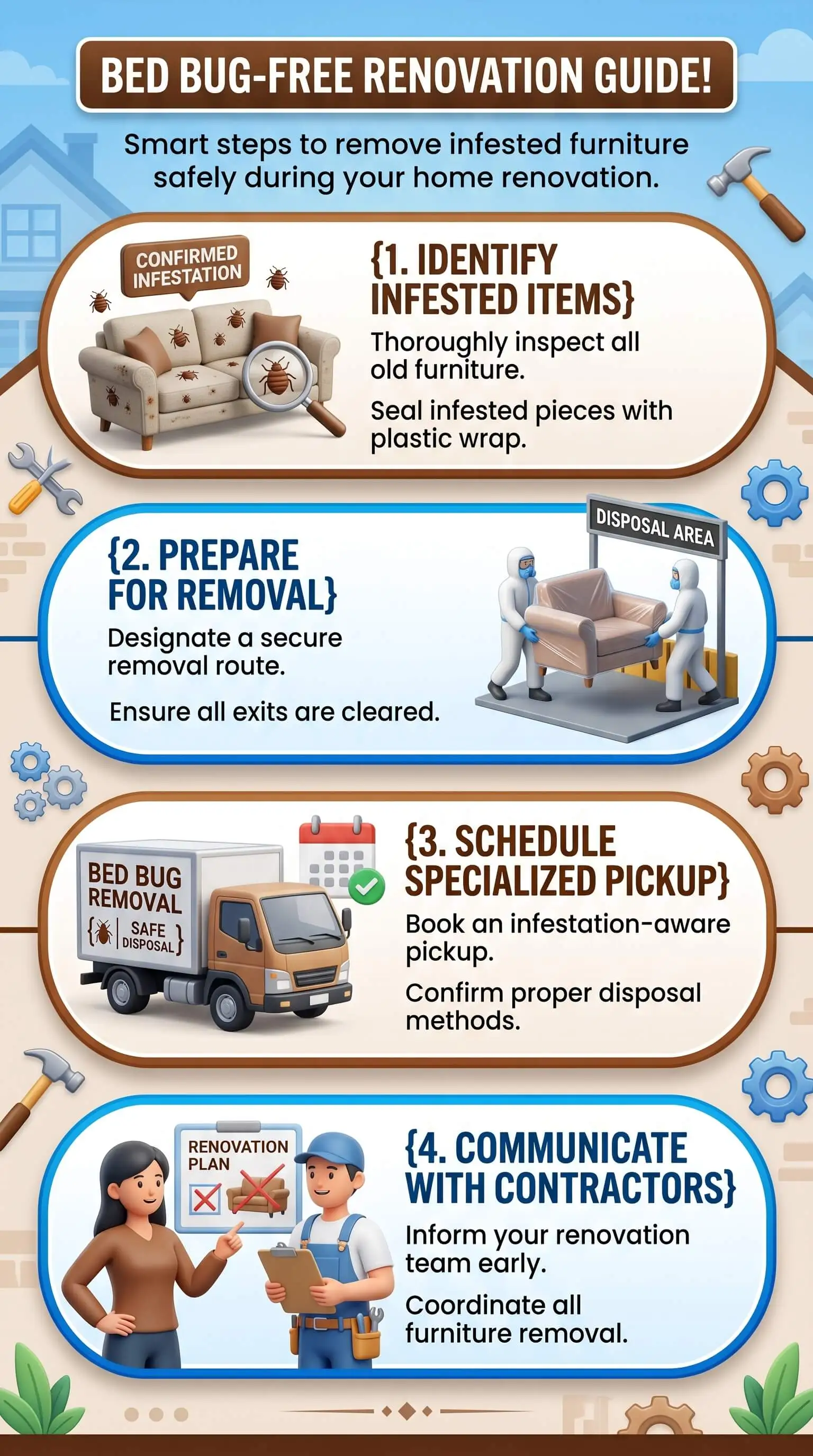
Identify infested pieces by checking seams, joints, and crevices for live bugs, dark fecal spots, shed skins, blood smears, and a sweet musty odor.
Seal the affected room’s doorway and HVAC vents before moving any furniture out.
Wrap and tape every infested piece in plastic before transport, and route through a single pre-cleared exit path.
Mark or slash discarded furniture to prevent scavenger pickup. Many cities require it by law.
Professional companies that remove bed bug infested furniture typically charge $75 to $150 per item and complete the job in a single visit.
Hard-surfaced furniture (metal frames, smooth wood dressers) is often salvageable with heat treatment. Soft and upholstered furniture usually isn’t.
Document everything for insurance, lease, and disclosure purposes before the room is rebuilt.
Why Renovations and Bed Bugs Are a Dangerous Combination
Bed bugs are very good at hiding, and that's the entire problem during a renovation. In a normal household, they wedge into mattress piping, dresser joints, baseboards, and the underside of upholstered furniture and stay there. Demolition changes the conditions. Vibrations push them deeper into wall voids. Saws and pry bars open new hiding places. Construction dust gets bagged and carried out, sometimes with fertilized eggs riding along.
The unique risk during a renovation is dispersal speed. A localized infestation in one guest bedroom can turn into a whole-floor problem inside 48 hours of active demo work. That's why “deal with it after the remodel” almost never works as a plan.
How to Identify Bed Bug Infested Furniture Before You Move It
Identification comes down to looking in the right places for the right signs. Live bugs are reddish-brown, flat, and roughly the size of an apple seed. Fecal spotting shows up as small dark dots, usually clustered along mattress piping or drawer joints. Shed exoskeletons look like translucent bug shells. Blood smears are rust-colored stains where a bug got crushed in a seam. Eggs are tiny pale ovals about a millimeter long, tucked into crevices.
The hiding places are predictable: mattress piping, box spring corners, headboard cracks, recliner seams, sofa cushion zippers, and dresser drawer joints. Use a flashlight and the edge of a credit card to scrape along the seams. Disturbed bugs run.
Should You DIY or Hire Companies That Remove Bed Bug Infested Furniture?
DIY removal works for one isolated piece. A guest bed you've already decided to discard, for example. It stops working the moment any of these are true: you have multiple infested pieces, your renovation timeline can’t pause, or you’re in a multi-unit building where bugs travel through shared walls.
Professional removal companies handle the parts DIY usually can’t: airtight sealing during transport, compliant disposal that meets local landfill rules, and liability coverage if bugs spread to adjacent units or contractor vehicles. They also work on same-day or next-day timelines, which matters when demolition crews are billing by the day.
When the renovation timeline can’t absorb a week of trial-and-error treatments, professional companies that remove bed bug infested furniture handle sealing, hauling, and compliant disposal in a single visit. That single visit is often the difference between a renovation that resumes Monday and one that drags into next month.
Step-by-Step: Safely Removing Infested Furniture During a Renovation
Stop demolition in the affected room. No further work until the infested pieces are out.
Seal the doorway and HVAC vents with 6-mil plastic sheeting and painter’s tape.
Bag all soft items (linens, pillows, curtains) in 6-mil contractor bags before moving anything.
Wrap larger pieces (mattresses, sofas, dressers) in plastic sheeting and tape every seam.
Slash, mark, or spray-paint "BED BUGS" on each piece before placing it curbside. Many cities legally require this to prevent scavenging.
Carry pieces along a single, pre-cleared exit path. Never route through clean rooms.
Vacuum the entire exit path immediately. Dispose of the vacuum bag in a sealed plastic bag in an outdoor trash bin.
Heat-treat or hot-wash any worker clothing exposed during removal, including your own.
The categories of furniture most commonly affected during a renovation are upholstered seating, mattresses, wooden bed frames, and dressers. These fall into what most household guides classify as soft and upholstered furniture. Soft pieces carry the highest risk. Smooth, hard-surfaced pieces with few crevices are sometimes salvageable through thorough heat treatment.
What Professional Bed Bug Furniture Removal Costs
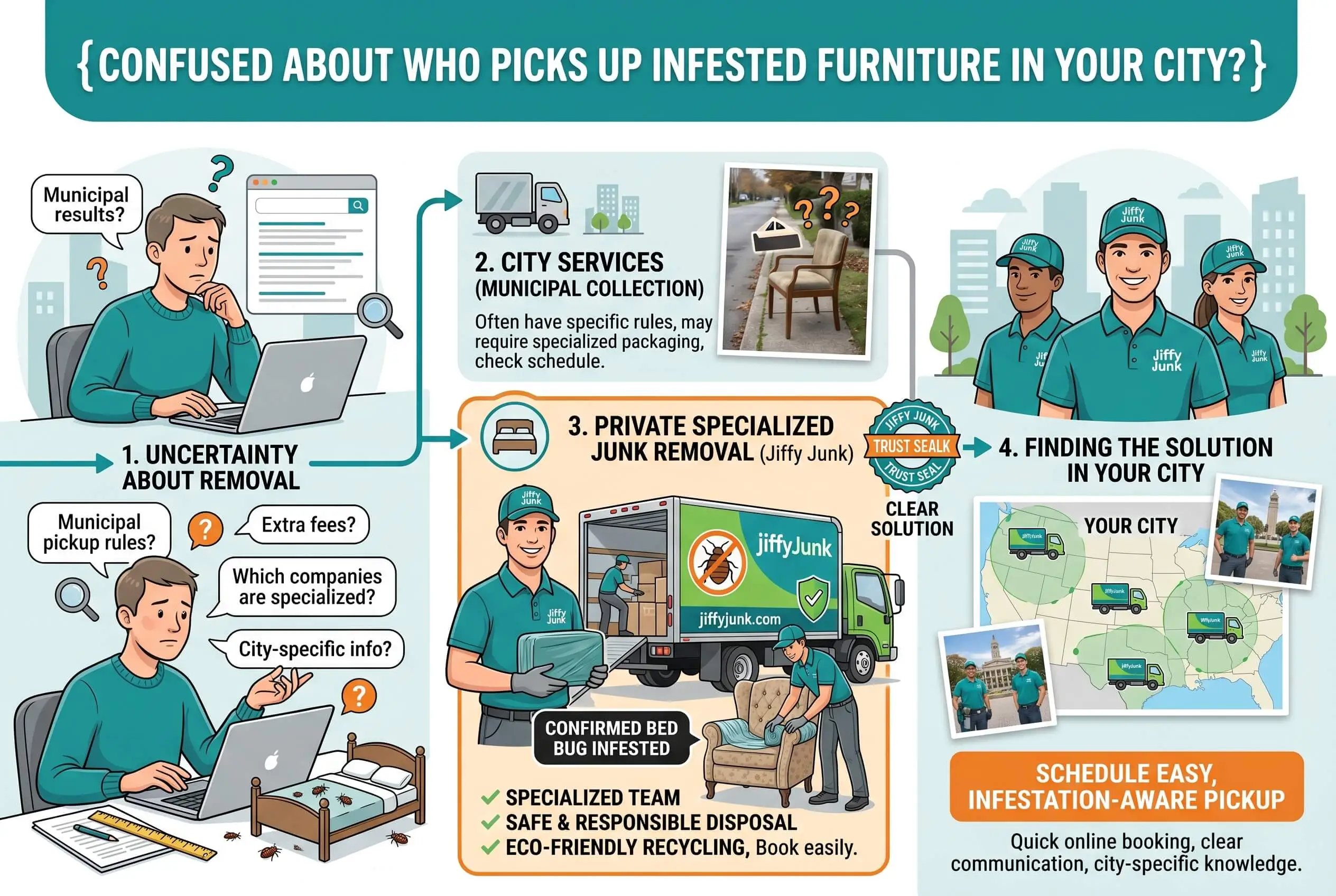
Professional bed bug furniture removal runs $75 to $150 per item for standard sealed haul-away. Whole-room or multi-piece pickups run $300 to $800 or more. Item count, building access (stairs vs. elevators), urgency, and whether the company also seals or pre-treats the pieces all push the price. Regional variation is real. Major metros run higher than mid-size cities, and high-rise pickups always carry an access surcharge.
“The biggest mistake we see homeowners make is treating bed bug furniture removal as a separate project from the renovation itself. It isn’t. The minute you find an infestation mid-demo, your project has changed: you’re now running a containment job that happens to also be a remodel. Every hour the infested furniture stays in the building, the cleanup gets harder and more expensive. The renovation crews who handle this best stop demolition in the affected room within the first hour, seal the doorway, and have a professional hauler on-site by the next morning. The ones who try to push through and ‘deal with it later’ usually pay for re-treatment of three rooms instead of one, plus a delayed timeline that costs more than the haul-away ever would have.”
7 Essential Resources
These are the federal, state, and university references we lean on most when covering bed bug remediation. Every link is verified at publication.
U.S. EPA Bed Bugs portal. Central guidance on treatment options, IPM principles, and pesticide registration from the U.S. Environmental Protection Agency. https://www.epa.gov/bedbugs
U.S. EPA: Top Ten Tips to Prevent or Control Bed Bugs. A concise checklist covering identification, vacuuming protocol, encasements, and how to choose a pest control professional. https://www.epa.gov/bedbugs/top-ten-tips-prevent-or-control-bed-bugs
U.S. EPA: Preparing for Treatment Against Bed Bugs. Step-by-step preparation guidance directly relevant to renovations, covering vacuum disposal, encasements, and clutter removal. https://www.epa.gov/bedbugs/preparing-treatment-against-bed-bugs
CDC: About Bed Bugs. The Centers for Disease Control and Prevention overview of bed bug biology, identification, bites, and public-health context. https://www.cdc.gov/bed-bugs/about/index.html
Purdue University Extension: Bed Bug Furniture Disposal Protocol. One of the most detailed academic guides on disposal, including how to render furniture unusable to stop scavenger pickup. Particularly useful during renovations. https://www.extension.entm.purdue.edu/bedbugs/furnitureDisposal.php
New York State Department of Health: Bed Bugs. A clear public-health guide covering identification, control, and tenant rights. Useful in multi-unit renovation contexts. https://www.health.ny.gov/environmental/pests/bedbugs.htm
NPMA Bed Bug Facts and Statistics. The National Pest Management Association’s data hub on infestation rates, hot spots, and industry trends, drawn from biennial Bugs Without Borders surveys. https://www.pestworld.org/all-things-bed-bugs/bed-bug-facts-statistics/
3 Statistics
Three numbers worth knowing before you decide what to keep, treat, or haul away:
1. 97% of pest professionals treated bed bugs in the past year.
97% of U.S. pest control professionals treated bed bugs within the past year, according to the National Pest Management Association’s 2018 Bugs Without Borders survey. That number has held steady for over a decade. For renovators, this means bed bugs are not a rare or regional problem you can plan to “probably avoid.” Source: NPMA / PestWorld.
2. 1 in 5 Americans has had a bed bug infestation, or knows someone who has.
One in five Americans has had a bed bug infestation at home or knows someone who has, per NPMA survey data. During a renovation, that probability cuts both ways. Your contractors, subcontractors, and delivery crews each carry the same exposure risk into your project site. Source: NPMA / PestWorld.
3. Professional whole-home treatment averages $1,500 to $5,000.
Whole-home bed bug extermination runs $1,500 to $5,000 on average, and severe infestations climb past $6,000. At $75 to $150 per item, professional furniture haul-away sits at the cheaper end of the response, and is often the move that prevents the bigger bill from arriving. Source: This Old House Bed Bug Exterminator Cost Guide.
Final Thoughts and Opinion
Bed bug discoveries during a renovation are rarely a small problem, and they almost never get smaller by waiting. The renovation context (open walls, active demolition, crews moving between rooms) is the worst possible environment for letting an infestation sit. It’s also the easiest moment to contain one if you act in the first hour rather than the first week.
Our position is direct: if the infestation involves more than one piece of furniture, or any soft furniture (mattress, box spring, upholstered sofa, fabric headboard), professional removal is almost always the right call. The math rarely favors DIY once you factor in the cost of a single failed treatment, the likelihood of dispersal during transport, and the risk that one missed egg cluster turns the renovation into a recurring pest problem six months later. The $75 to $150 per-item cost of a sealed haul-away is the lowest-friction insurance against a $2,500 to $5,000 whole-home extermination bill.
That said, hard-surfaced pieces with few crevices (a metal bed frame, a smooth wooden dresser with no upholstered drawer fronts) are often worth saving through professional heat treatment instead of disposal, especially when paired with proper cleaning and a careful look at different types of air purifiers for improving the surrounding indoor environment. Disposal should be the response to soft, riddled, or heavily infested pieces, not to every piece of furniture in the affected room. A reputable removal company will say so on the walkthrough.
Frequently Asked Questions
Can I keep bed bug infested furniture if it gets heat-treated?
Often yes, especially for hard-surfaced pieces like metal bed frames or smooth-finished wood dressers. Professional heat treatment that reaches and sustains 118°F throughout the piece works well. Soft, upholstered, or heavily infested furniture is usually cheaper to dispose of than to treat, especially when a renovation timeline is on the line.
Is it illegal to put bed bug furniture on the curb?
Many U.S. cities either ban it outright or regulate it heavily. Typical requirements include slashing or spray-painting “BED BUGS” on the piece, plus bagging or wrapping it before disposal. Check your municipal sanitation department’s specific rules. Fines for non-compliance are real, and the regulations exist to stop scavenger pickup that spreads infestations.
How quickly can a removal company haul away infested furniture?
Most companies offer same-day or next-day pickup in major metros. Urgency surcharges of $50 to $150 are common during active renovations, and usually worth paying. Every extra day of dispersal raises downstream remediation costs.
Will my renovation contractor refuse to keep working if there are bed bugs?
Many will, and they’re within their rights. Bed bugs travel on tools, clothing, and vehicles, which means a contractor working knowingly in an infested space risks carrying the problem to their next job site. Expect a pause until the infested furniture is out and the room has been inspected or treated. A clean, documented removal speeds the contractor’s return.
Does homeowners insurance cover bed bug furniture removal?
Standard homeowners and renters policies almost always exclude pest infestations, including bed bug remediation and furniture replacement. A handful of specialty policies and some commercial landlord policies offer limited coverage. Review your specific policy with your agent before assuming any portion will be reimbursed, and document every step of the removal in case coverage is available.
Ready to Clear the Room and Resume Your Renovation?
If your remodel has surfaced bed bug infested furniture, the right next step is a same-day call to a licensed haul-away company that handles sealed transport and compliant disposal in one visit. Get expert bed bug furniture removal pricing and scheduling here for service details, transparent pricing, and pickup availability across most U.S. metros. The sooner the infested furniture is out of the building, the sooner your renovation crew can resume.