A 10 yard dumpster is the most popular size for residential projects. Bathroom remodels, garage cleanouts, small roof jobs, single-room renovations. It's also where surprise fees do the most damage, because the base rate looks low enough that homeowners stop reading the fine print.
This guide covers the actual cost range, the real 10 yard dumpster size and weight specs, and the eight questions that turn an opaque transaction into a fair one. If you're booking a 10 yarder, this is the homework worth doing before you call.
Quick answer for the impatient: A 10 yard dumpster typically rents for $250 to $500 in most U.S. markets. It holds about 10 cubic yards of debris (roughly three pickup truck loads) and includes 2 to 3 tons of weight in the base price. Everything past that is where the surprises live.
TL;DR Quick Answers
10 yard dumpster size
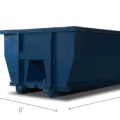
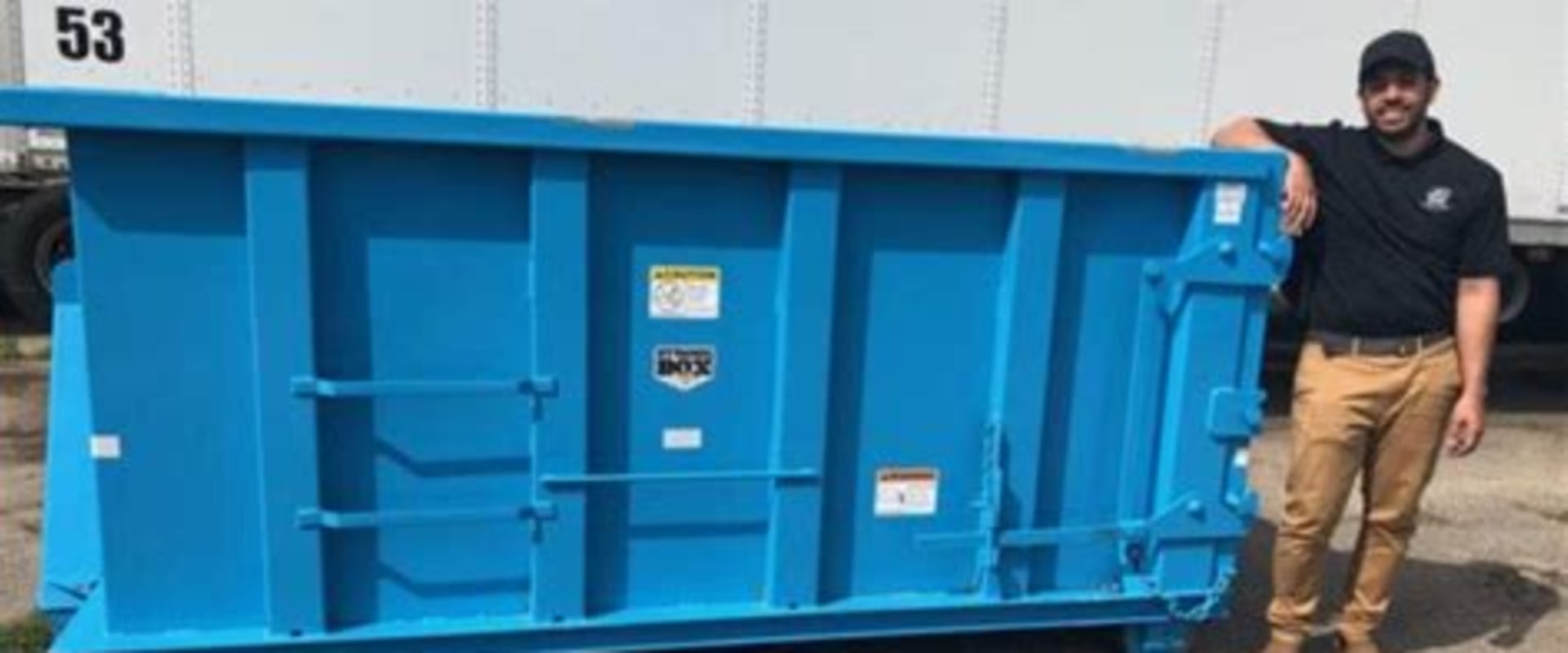
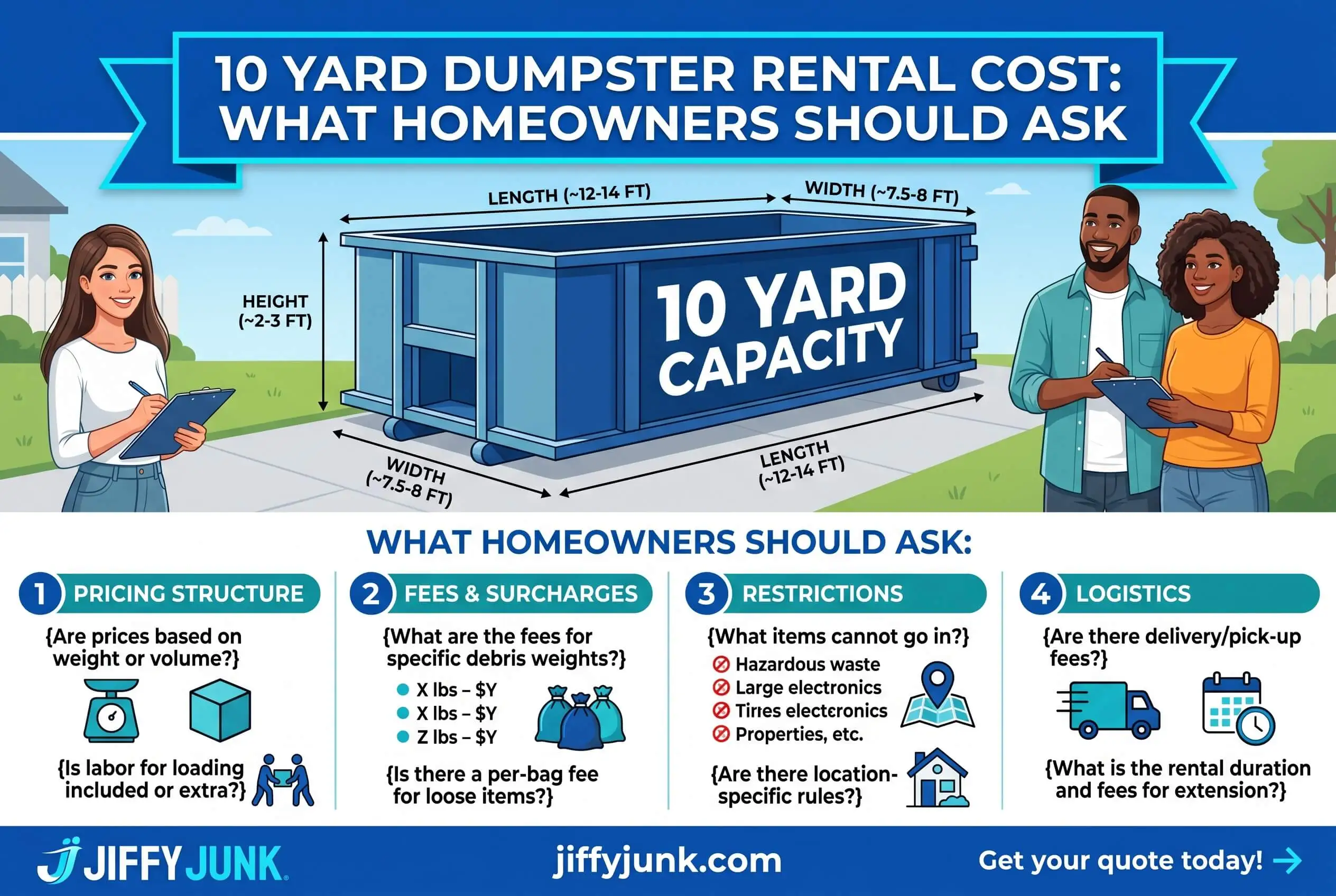
A 10 yard dumpster measures roughly 12 to 14 feet long, 8 feet wide, and 3.5 to 4 feet tall. It holds about 10 cubic yards of debris (roughly three pickup truck loads, or 50 to 60 standard 13-gallon trash bags).
Standard specs at a glance:
Length: 12 to 14 feet
Width: 8 feet
Height: 3.5 to 4 feet
Capacity: ~10 cubic yards
Weight included in base price: 2 to 3 tons (4,000 to 6,000 lbs)
It fits in most two-car driveways. Exact dimensions vary slightly by hauler, so confirm before delivery if clearance is tight.
Top Takeaways
A 10 yard dumpster typically costs $250 to $500 for a 7 to 10 day rental, with regional variation.
Standard dimensions: roughly 12 to 14 feet long, 8 feet wide, 3.5 to 4 feet tall. Fits most two-car driveways.
Weight capacity included is 2 to 3 tons (4,000 to 6,000 lbs). Overages run $40 to $100+ per ton.
The 10 yard size fits single-room remodels, garage cleanouts, and small roofing jobs. For whole-home work or large tear-offs, size up.
The eight pre-rental questions matter more than the base rate. Tonnage clarity, extension fees, and prohibited-material policy drive the final bill more than the quote itself.
If a hauler can't produce proof of insurance or a written contract, that's a walk-away signal.
What Is a 10 Yard Dumpster?
A 10 yard dumpster holds approximately 10 cubic yards of debris. That works out to about three pickup truck loads, or 50 to 60 standard 13-gallon trash bags. It's the smallest common residential roll-off size, and a hook-lift truck handles delivery and pickup. The word "dumpster" itself comes from the Dempster-Dumpster system trademarked by the Dempster Brothers in the 1930s. It became a generic term the same way "Kleenex" did.
Homeowners typically rent a 10 yarder for bathroom remodels, single-room cleanouts, small roofing jobs (under about 1,500 square feet), garage purges, or moderate yard waste removal.
Size & Dimensions
External dimensions vary slightly by hauler, but standard 10 yard roll-offs run roughly:
Length: 12 to 14 feet
Width: 8 feet
Height: 3.5 to 4 feet
That fits comfortably in most two-car driveways. Side clearance and overhead obstructions matter at delivery, though. Watch for low branches, power lines, and eaves. For a deeper visual breakdown of measurements and capacity by container type, this 10 cubic yard dumpster size and dimensions guide lays it out with diagrams.
Weight capacity is where most homeowners get caught. A 10 yarder typically includes 2 to 3 tons (4,000 to 6,000 lbs) in the base price. Overage fees run $40 to $100+ per ton over. Roofing shingles, dirt, concrete, and tile blow through that limit fast.
How Much Does a 10 Yard Dumpster Cost?
Expect $250 to $500 for a standard 7- to 10-day rental in most U.S. markets. Regional variation is real:
Northeast and West Coast: $350 to $550. Higher disposal fees and permit costs drive the spread.
South and Midwest: $250 to $400. Lower landfill tipping fees keep prices down in most states.
A typical quote covers delivery, pickup, the included tonnage, and the rental window. What it usually doesn't cover: weight overages, extra rental days, permits for street placement, prohibited-material surcharges, and driveway protection. Understanding those lines helps you get the best value from dumpster rental prices and see how a $300 quote can become a $550 invoice.
The 8 Questions Every Homeowner Should Ask
These are the questions that, in my experience, save homeowners money on the average rental. They also prevent the dispute calls that happen when expectations weren't set up front.
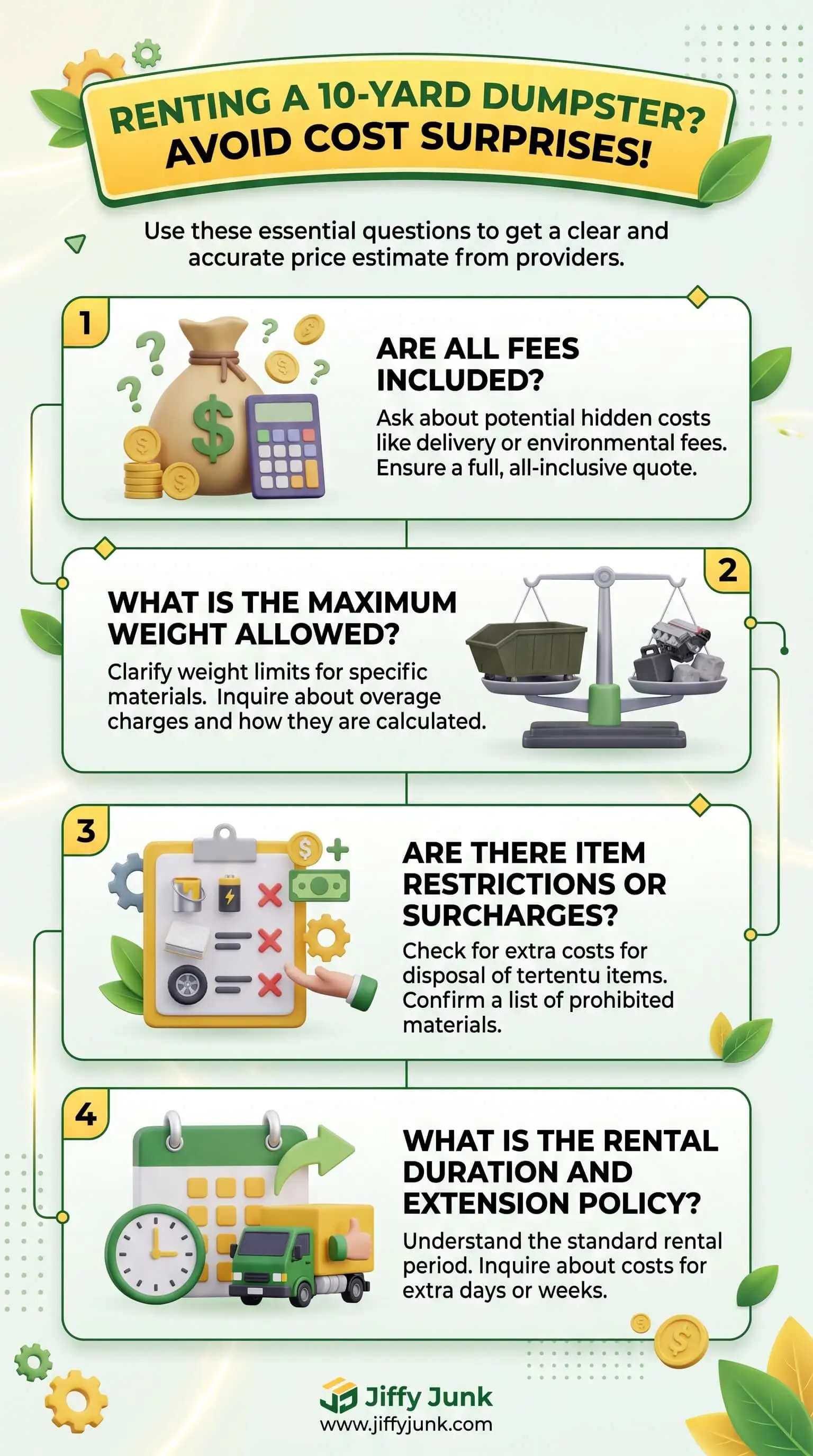
What's the included weight limit, and what's the per-ton overage fee?
How many rental days are included, and what does an extension cost per day? Standard windows run 7 to 10 days. Extensions usually run $5 to $15 per day.
What materials are prohibited, and what's the surcharge if I include them? Common surcharge items: mattresses, tires, appliances with refrigerant, electronics, paint.
Do I need a permit if I place it on the street? Permit fees vary by city, often $25 to $100. Driveway placement usually skips this.
Will the dumpster damage my driveway, and do you provide wood-board protection?
What's your cancellation and rescheduling policy?
Are you licensed and insured? Reputable haulers will email proof without hesitation.
What happens if I fill it past the fill line? Drivers often refuse above-rim debris at pickup or charge a second-haul fee.
When a 10 Yard Is the Wrong Size
A 10 yarder fits single-room remodels, garage cleanouts, small roofing jobs, and yard debris. It's the wrong call for whole-home cleanouts, multi-room renovations, large roof tear-offs, and estate cleanouts. Quick rule of thumb: if your debris pile already looks like more than three pickup loads, size up to a 15 or 20 yarder. Paying for a second haul costs more than booking the right size the first time.
"The mistake I see most often isn't homeowners overspending. It's homeowners renting the wrong size and then paying twice. A 10 yard dumpster sounds small until you stand next to three pickup loads of debris in your driveway, especially after a cleanout that includes old vents, filters, or air purifiers. The second mistake is treating the included tonnage as a footnote. For a bathroom remodel, you're fine. For a roofing job or anything with concrete, you'll be over by a thousand pounds before you finish. The cheapest rental is the one you size correctly the first time, with a hauler who shows you the math before you sign."
7 Essential Resources
The following resources come from federal agencies, industry standards bodies, and academic research centers. Bookmark them before you book. Reputable haulers cite the same sources when their pricing or practices get questioned.
National Overview: Facts and Figures on Materials, Wastes and Recycling (EPA). The federal benchmark on U.S. waste generation and recycling rates. Useful for context on where your debris ends up.
Sustainable Management of Construction and Demolition Materials (EPA). The authoritative federal page on C&D debris generation, recycling pathways, and disposal practices.
Construction and Demolition Debris: Material-Specific Data (EPA). Material-by-material breakdown of what's in the C&D waste stream: concrete, drywall, wood, asphalt.
State and Local C&D Materials Measurement Reports (EPA). State-by-state data on disposal and recycling rates. Useful for understanding why rental costs vary regionally.
2025 Infrastructure Report Card: Solid Waste (American Society of Civil Engineers). ASCE's assessment of U.S. waste infrastructure, covering industry size, employment, and tipping fee trends.
ANS Z245 Standards (National Waste & Recycling Association). The national industry standards governing waste container design, safety, and operations. The document trade-association-member haulers operate against.
Municipal Solid Waste Factsheet (University of Michigan Center for Sustainable Systems). Independent academic synthesis of EPA data with international comparisons and tipping-fee analysis.
3 Statistics
1. Americans generated 292.4 million tons of municipal solid waste in 2018, about 4.9 pounds per person per day.
Source: EPA National Overview: Facts and Figures.
Multiply 4.9 pounds by 365 days and you're looking at roughly 1,790 pounds of household waste per person per year. A family of four generates close to 7,000 pounds annually. The included tonnage on a 10 yard dumpster (4,000 to 6,000 pounds) starts to look a lot more relevant in that context.
2. The U.S. generated 600 million tons of construction and demolition (C&D) debris in 2018, more than twice the volume of municipal solid waste.
Source: EPA Construction and Demolition Debris page.
Demolition alone accounts for over 90% of C&D debris. If your project involves any meaningful demo (a kitchen tear-out, a roof tear-off, a deck removal), you're contributing to the heavier waste stream, and the dumpster's weight ticket will show it.
3. The U.S. waste and recycling industry was worth approximately $91 billion in 2022. The sector employs 135,000 workers and operates roughly 180,000 refuse trucks across North America.
Source: ASCE 2025 Infrastructure Report Card: Solid Waste.
Why that matters for your quote: this is a mature, scaled industry with established standards. A "company" that can't produce proof of insurance, a written contract, or a certified weight ticket isn't operating at industry baseline. Walk away.
Final Thoughts and Opinion
The thing nobody in the rental industry will say out loud: the base rate is the marketing number, not the cost number. Most homeowners I've watched go through this process focus on the wrong line. They shop the $250 versus $300 quote, then get surprised by a $150 weight overage that would have been the same regardless of which company they picked.
The shopping criteria that actually move the final bill, in order of impact:
Honesty included tonnage. This is the biggest variable cost driver, by a wide margin.
Clarity on the rental window and extension fees. Second biggest.
Transparent prohibited-material policy. Third, Surcharges here are sneaky.
Base rate. A distant fourth.
A hauler who quotes you $400 and walks you through realistic weight expectations will almost always cost less than a hauler who quotes you $250 and lets the weight ticket do the talking. That's the opinion I'd stake my own driveway on.
Frequently Asked Questions
How big is a 10 yard dumpster in feet?
Roughly 12 to 14 feet long, 8 feet wide, and 3.5 to 4 feet tall. Exact dimensions vary by hauler, so confirm specifics before delivery, especially if driveway clearance is tight.
How much weight can a 10 yard dumpster hold?
Most rentals include 2 to 3 tons (4,000 to 6,000 lbs) in the base price. You can typically fit more physically, but anything over the included weight triggers per-ton overage fees of $40 to $100+.
Can a 10 yard dumpster fit in my driveway?
Yes, in most two-car driveways. The container itself is about 8 feet wide, so you'll need at least 10 feet of clearance for the truck and roll-off motion. Watch for low branches, power lines, and eaves.
How long can I keep a 10 yard dumpster?
Standard rental windows are 7 to 10 days. Extensions usually cost $5 to $15 per day. Some haulers offer flexible "call when done" pickup. Ask during booking.
What's the difference between a 10 yard and 15 yard dumpster?
A 15 yarder holds 50% more debris and typically costs $100 to $200 more. The footprint is similar, but the container is taller. If your debris exceeds three pickup truck loads, the 15 yarder is almost always the better economic call.
Do I need to be home for delivery?
Usually not, as long as your placement instructions are clear and the area is accessible. Most haulers photo-document delivery and pickup.
What happens if I overload the dumpster?
Drivers often refuse above-fill-line debris at pickup or charge a second-haul fee. They won't transport overloaded containers. It's a DOT compliance issue, not just company policy.
CTA
Before you book, take five minutes with the eight-question checklist above and call two providers. The price differences and the honesty differences both show up fast. Reputable haulers will answer every question without hesitation, email a written contract before delivery, and walk you through realistic weight expectations for your specific project.
For a deeper dimensional reference with diagrams and capacity charts before you commit, the 10 cubic yard dumpster size and dimensions guide breaks down the size visually so you can compare against your project pile before placing the call.
Bottom line: the cheapest rental isn't the lowest quote. It's the right size from an honest hauler. Ask the questions, get it in writing, and your driveway will thank you.
Got a surprise dumpster fee story or a question we didn't cover? Drop it in the comments below. Homeowner experience is the best vetting tool the next reader has.