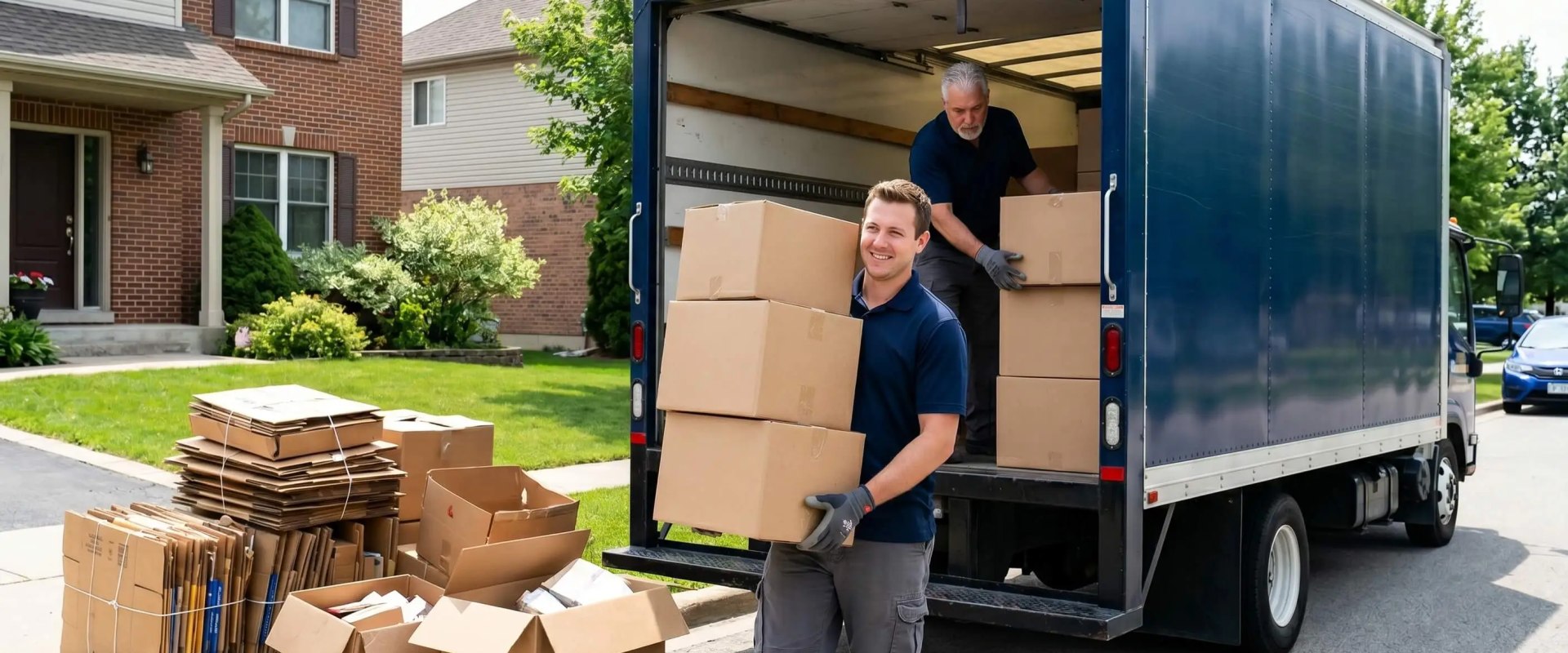
This guide covers what property managers actually need to know about handling bulk cardboard volume: when standard trash service stops working, how a dedicated cardboard pickup actually operates, what to look for when you're vetting a provider, and how to set up a system that doesn't fall apart the moment your move-in calendar gets busy. The goal is practical: keep your dumpsters clear, keep tenants from filing complaints, and keep your hauler from stacking surcharges on every invoice.
TL;DR Quick Answers
Cardboard Box Removal Service
A cardboard box removal service is a dedicated waste-hauling service that picks up bulk corrugated cardboard from properties, businesses, and event sites and routes it to a Materials Recovery Facility (MRF) for recycling rather than a landfill. The equipment is built for cardboard volume (box trucks, roll-offs, or baler-equipped vehicles), the load gets baled and sold to paper mills as Old Corrugated Containers (OCC), and most providers run scheduled, on-call, or hybrid models so the cadence can flex around actual volume.
Who typically uses it:
Multifamily property managers and HOA operators
Retail, restaurant, and warehouse operations
E-commerce facilities with high inbound packaging
Buildings subject to commercial recycling mandates like California AB 341
What it solves: overflowing dumpsters, hauler overage charges, contamination penalties, and code citations for visible exterior debris.
Top Takeaways
Cardboard fills volume faster than any other waste stream at multifamily properties because it's bulky but light.
Recurring hauler overages, boxes left beside the dumpster, and contamination flags are the clearest signs that standard trash service isn't enough.
Dedicated cardboard pickup services route loads to Materials Recovery Facilities and bale them as Old Corrugated Containers (OCC) for paper mills.
Vet providers on five things: licensing, equipment capacity, scheduling flexibility, recycling transparency, and pricing structure.
System fixes (staging area, tenant communication, service cadence) outperform enforcement every time.
Several states require multifamily properties to maintain commercial recycling programs, with cardboard at the top of the priority list.
Why Cardboard Volume Hits Property Managers Hardest
Cardboard is sneaky. A standard corrugated cardboard box is bulky but light, so it fills volume fast without ever triggering a weight-based alert from the hauler. By the time the bin is visibly overflowing, you've usually been generating extra volume for days without knowing it. E-commerce delivery patterns concentrate that volume on Mondays and Tuesdays. Move-in and move-out cycles concentrate it on the first and last weekends of every month. Holiday returns pile up in January and again in late summer.
And cardboard isn't a side category in your waste stream. Corrugated boxes are the single largest product category of municipal solid waste in the country by tonnage. Whatever waste system you've got at your property is going to get tested first by cardboard. If it falls short, cardboard is the first thing that becomes visible to tenants and visiting prospects.
When Standard Trash Service Stops Cutting It
A handful of warning signs tell you it's time to add a dedicated cardboard pickup to your service stack:
Your hauler is charging you for overages two or more months in a row
Tenants are leaving boxes beside the dumpster instead of inside it
Maintenance staff spends part of every shift breaking down cardboard
You're getting code citations or HOA notices for visible exterior debris
Your recycling load keeps getting flagged for contamination and rejected at the curb
Move-in weekends look like the morning after a moving sale
Even one of these signs is worth paying attention to. Two or more, and you're not dealing with a temporary surge anymore. You're under-equipped for your actual volume.
How a Cardboard Box Removal Service Actually Works
A dedicated cardboard box removal service does things your general trash hauler usually can't. The equipment is built for the material itself: box trucks, roll-offs, or baler-equipped vehicles that handle volume cleanly. Loads route to a Materials Recovery Facility instead of a transfer station, where the cardboard gets baled and sold to paper mills as Old Corrugated Containers (OCC). And the schedule flexes around your building's actual rhythm instead of locking you into a fixed weekly pickup whether you need it or not.
Providers usually offer a few service models, sometimes mixed. Scheduled service runs on a recurring weekly or biweekly cadence and works best when your volume is steady and predictable. On-call service triggers by request, which fits buildings with sharp surge events but a lower baseline volume. Most multifamily properties end up on a hybrid: a baseline schedule with on-demand surges built in for the months that actually need them.
On what gets accepted, the universal yes is clean, dry corrugated cardboard. The universal no is wax-coated boxes, packing peanuts, bubble wrap mixed in with the load, and food-contaminated boxes (with a recent EPA-confirmed exception for pizza boxes). Tape and labels usually go through fine without separation.
What to Look for in a Cardboard Box Removal Service
When you're vetting a provider, work through these before signing anything:
Licensing and insurance. Confirm general liability coverage and worker's compensation. Ask for proof of waste-hauler licensing in your municipality.
Volume capacity and equipment. A box truck handles a 50-unit building's weekly volume comfortably. A 200-unit property is going to need a roll-off or baler-equipped service.
Scheduling flexibility. Same-day and next-day availability for surge events matters more than most managers realize until they need it.
Recycling transparency. Ask where the cardboard is routed and request annual diversion reporting. LEED-certified properties need this documentation.
Pricing structure. Flat-rate per pickup, volume-based, and weight-based models all exist. Watch for fuel surcharges, contamination penalties, and long-haul fees buried in the contract.
If you'd rather skip the vetting work and start from a provider that already meets these criteria, you can compare bulk cardboard pickup pricing from a full-service operator built for property-scale volume.
Setting Up a System That Keeps Dumpsters Clear
Service alone doesn't solve the problem. Properties that stay clean almost always have three pieces working together: a staging area for cardboard, tenant communication that actually gets read, and a service cadence that matches the building's real rhythm. Get one wrong and the dumpster won't stay clear no matter how often the truck comes.
Staging matters more than people expect. Keep cardboard separate from general trash, and keep it covered if you can. Wet cardboard is non-recyclable in most streams, and a covered area is the cheapest insurance you'll buy all year. For tenant communication, signage with photos of acceptable items works better than text-heavy notices, and move-in welcome packets should mention the cardboard area before a tenant ever needs to use it. Cadence is the part that gets ignored most. Build your schedule around your actual move-in calendar instead of an arbitrary day of the week, and add on-demand pickups for the first weekend of each month and the Monday after major holidays.
Compliance and Recycling Considerations
Several states have commercial recycling rules that apply directly to multifamily properties. California's AB 341 requires multifamily buildings of five or more units that generate four or more cubic yards of waste per week to maintain a recycling program. Similar rules apply in Oregon, Washington, Vermont, and Connecticut. New York City has its own commercial recycling requirements under Local Law. Cardboard and paper fiber sit near the top of the mandated-recyclable list almost everywhere.
If your property is in one of these jurisdictions, a dedicated cardboard pickup isn't optional. It's the cleanest way to stay compliant and document your diversion volume for any audits or annual reporting requirements.
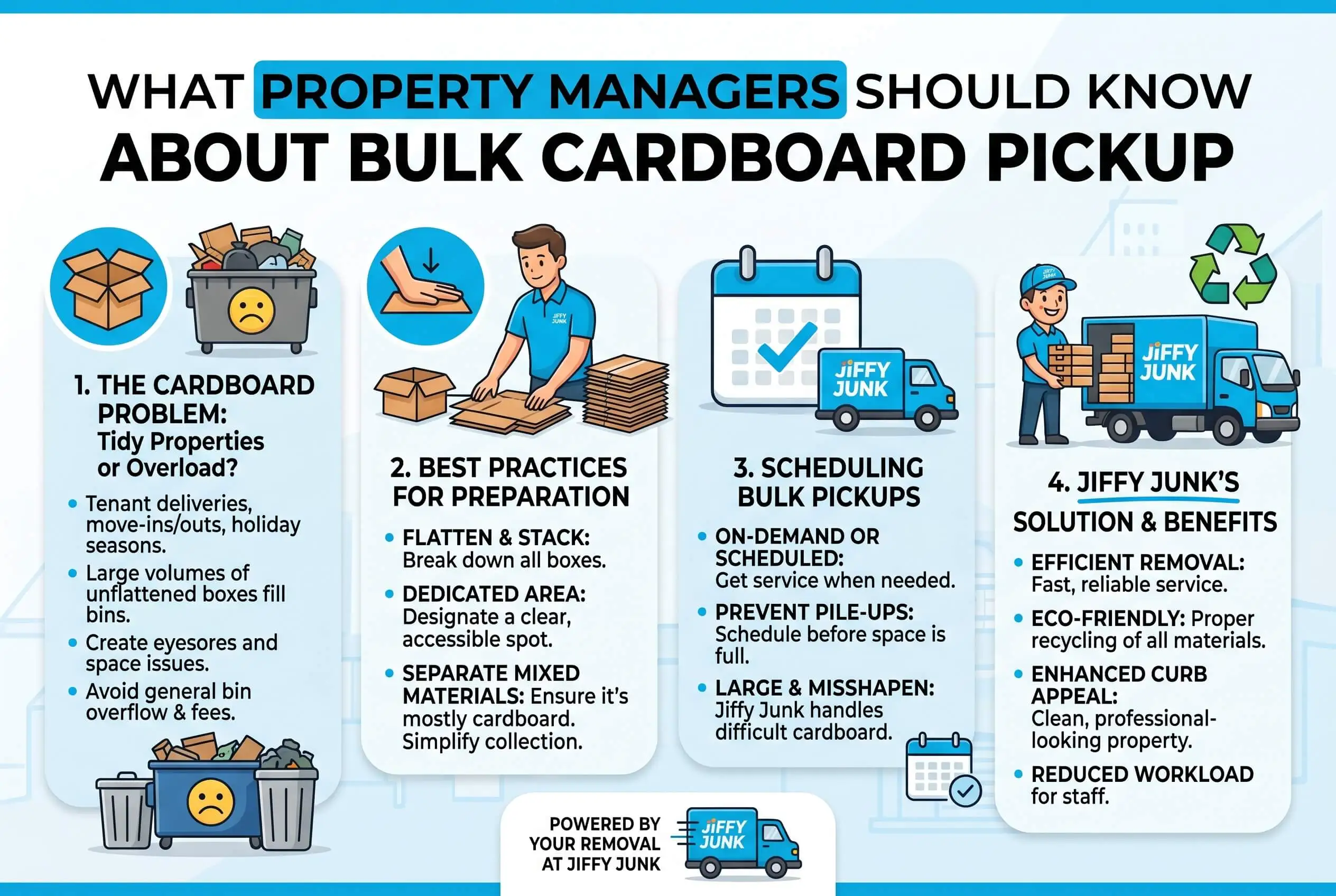
“In the buildings I've worked with most closely, cardboard is almost never a fixed problem. It's a rhythm problem. The properties that solve it aren't the ones with the biggest dumpsters or the most aggressive enforcement letters to tenants. They're the ones that mapped their volume against their move-in calendar, picked a service partner that could flex around it, and made the staging area so obvious that tenants didn't have to think about where the boxes go. When those things line up, the dumpster overflow stops being a recurring complaint and starts being a once-a-quarter exception.”
Essential Resources
These are the primary sources I rely on when researching commercial waste, cardboard recycling, and property-level compliance:
U.S. EPA: Containers and Packaging: Product-Specific Data. The federal source for corrugated box generation and recycling tonnages. View on EPA.gov
U.S. EPA: Paper and Paperboard: Material-Specific Data. Detailed national figures on paper and paperboard recycling, combustion, and landfilling. View on EPA.gov
U.S. EPA: Managing and Reducing Wastes: A Guide for Commercial Buildings. The clearest federal walkthrough for setting up a property-level waste reduction program, including waste audits and tenant engagement. View on EPA.gov
U.S. EPA: National Overview: Facts and Figures on Materials, Wastes, and Recycling. The big-picture summary that puts cardboard volume in context against the rest of the municipal solid waste stream. View on EPA.gov
CalRecycle: Mandatory Commercial Recycling FAQ. The plain-language source for California's AB 341 and SB 1383 requirements as they apply to multifamily properties. View on CalRecycle.ca.gov
U.S. EPA: Sustainable Materials Management. Background on the broader hierarchy of source reduction, reuse, recycling, and energy recovery, useful for framing your property's waste strategy. View on EPA.gov
U.S. EPA: Regulatory and Guidance Information by Topic: Waste. The federal index of waste regulations under the Resource Conservation and Recovery Act (RCRA), useful when you're working across state lines or need to confirm baseline federal requirements. View on EPA.gov
Statistics
Corrugated boxes were the largest single product category of municipal solid waste in the most recent EPA accounting, at 33.3 million tons generated, or 11.4 percent of total generation. Source: U.S. EPA, Containers and Packaging: Product-Specific Data
Approximately 32.1 million tons of corrugated boxes were recycled out of 33.9 million tons of total paper and paperboard recycling in the same EPA reporting year, which made corrugated cardboard the most recycled single product category by tonnage. Source: U.S. EPA, Containers and Packaging: Product-Specific Data
California's AB 341 requires multifamily residential dwellings of five units or more that generate four or more cubic yards of commercial solid waste per week to maintain a recycling program, with cardboard and paper fiber explicitly identified as priority recyclables. Source: CalRecycle, Mandatory Commercial Recycling FAQ
Final Thoughts and Opinion
Most cardboard problems at multifamily properties aren't actually cardboard problems. They're scheduling problems, communication problems, or contract problems wearing a cardboard costume. A 50-unit building generating four cubic yards of cardboard a week isn't going to get fixed by a sternly worded notice to tenants. The fix is structural: the right service at the right cadence, a staging area tenants can find without looking, and cardboard handled as its own line item instead of a sub-problem of general trash.
If you're staring at a recurring overflow situation right now, my recommendation is to stop reaching for enforcement and start reaching for infrastructure. Add the pickup, fix the staging, update the welcome packet, account for air purifiers and the boxes they arrive in, and the dumpster mostly takes care of itself.
Frequently Asked Questions
How often should a property manager schedule cardboard pickup?
Most multifamily properties do best on a weekly or biweekly recurring schedule, with on-demand pickups added during the first weekend of each month and after major holidays. Buildings with fewer than 50 units can sometimes manage with a biweekly baseline. Buildings over 100 units almost always need at least weekly service plus surge capacity.
What's the difference between cardboard recycling and general junk removal?
Cardboard recycling routes the material to a Materials Recovery Facility where workers bale it and sell it to paper mills as raw fiber. General junk removal can include cardboard, but it typically routes mixed loads to a transfer station or landfill. A dedicated cardboard service almost always produces better diversion documentation, which matters if your property has any compliance reporting obligations.
Do tenants need to break down boxes before disposal?
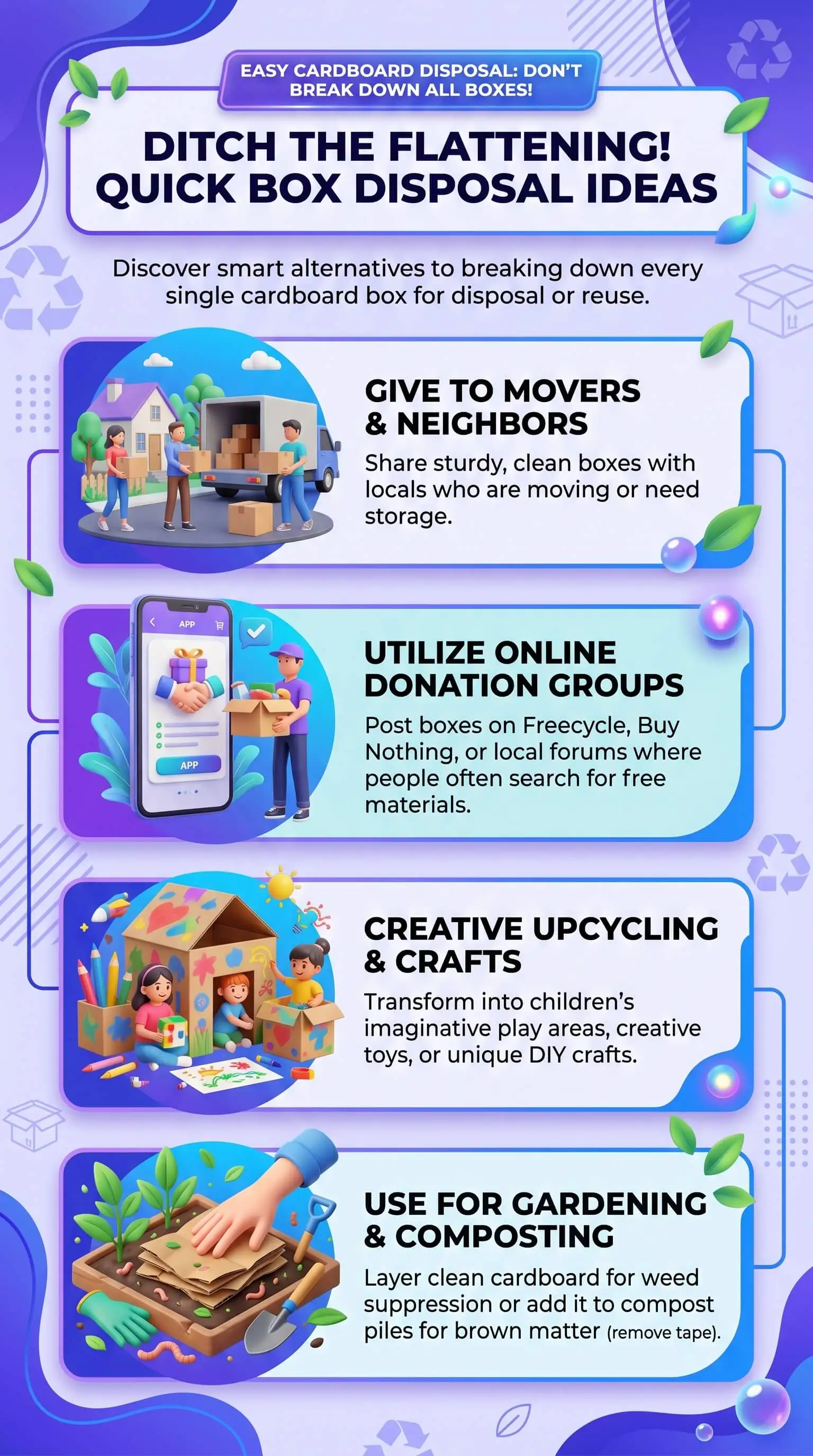
It depends on the service. Most commercial cardboard pickup providers prefer broken-down boxes because they pack denser into the truck, but most will accept whole boxes if your tenants won't reliably flatten them. The bigger issue is contamination. Tape, labels, and small staples are usually fine, but food residue, packing peanuts, and bubble wrap need to be separated out before the box goes into the cardboard stream.
How much does a cardboard box removal service cost for a multifamily property?
Pricing varies a lot by region, route density, and pickup frequency. Most providers structure pricing as either flat-rate per pickup, volume-based, or weight-based. A 50-unit building on weekly service typically falls in a predictable monthly range, though surge events and contamination penalties can move that figure up. The most useful thing you can do is get itemized quotes from two or three providers covering the same scope so you can compare cleanly.
Can a cardboard pickup service handle move-in surge volume?
The good ones can, but you have to ask up front. Confirm what surge capacity the provider has, what the lead time is for a same-day or next-day pickup, and whether surge pickups are billed at the standard rate or at a premium. Building a hybrid contract with a baseline schedule plus a known surge rate is usually the cleanest setup.
What happens to cardboard after a bulk pickup service hauls it away?
In most cases, the load goes to a Materials Recovery Facility (MRF), where workers sort it, bale it into dense bricks of Old Corrugated Containers, and sell it to paper mills. The mills pulp the fiber and use it to make new containerboard for new shipping boxes. A meaningful share of recycled paper fiber goes back into containerboard production, which is part of why the cardboard recycling loop runs faster than almost any other recycling stream.
Plan Smarter Service for Your Property
If your dumpsters are overflowing, your tenants are complaining, and your hauler is stacking surcharges on every monthly invoice, the move that actually fixes it is putting the right service in place at the right cadence. Schedule a professional cardboard box removal service built to handle property-scale volume, flex around your move-in calendar, and document the diversion you need for compliance reporting. Click or tap through to compare pricing and book a pickup that fits your building's actual rhythm.