That is exactly the problem with most air quality reports. They hand you a number and a color and assume you already know what either one means. Chicago air quality reports become far more useful once you know what the numbers represent. Here is the plain-language version of the terms that actually explain what is happening in the air over Chicago, so every report becomes a simple tool for planning your day with confidence instead of feeling like a riddle.
TL;DR Quick Answers
chicago air quality
Chicago's air quality shifts hour to hour, driven mainly by fine particulate matter (PM2.5) and ground-level ozone off Lake Michigan. We track it using the EPA's 0-500 Air Quality Index: readings under 100 are safe for most people, while anything higher means sensitive groups should cut back on outdoor time.
AQI 0-50 (Good): air is clean, no precautions needed.
AQI 51-100 (Moderate): fine for most people, sensitive groups should stay alert.
AQI 101-150 (Unhealthy for Sensitive Groups): limit prolonged outdoor exertion.
AQI 151+ (Unhealthy or worse): close windows and run a high-efficiency filter indoors.
Top Takeaways
AQI runs 0 to 500 across six color categories, and lower always means cleaner air.
PM2.5 and ground-level ozone drive most of Chicago's AQI swings.
Lake Michigan's temperature inversions can trap pollution close to the ground, especially in summer.
An Air Pollution Action Day means Orange or worse is expected across the Chicago area.
Chicago is the third-most-populous city in the United States, and it sits directly on Lake Michigan. That combination of heavy traffic corridors and lakefront weather patterns explains why the same handful of terms keep showing up in local air quality reports year after year.
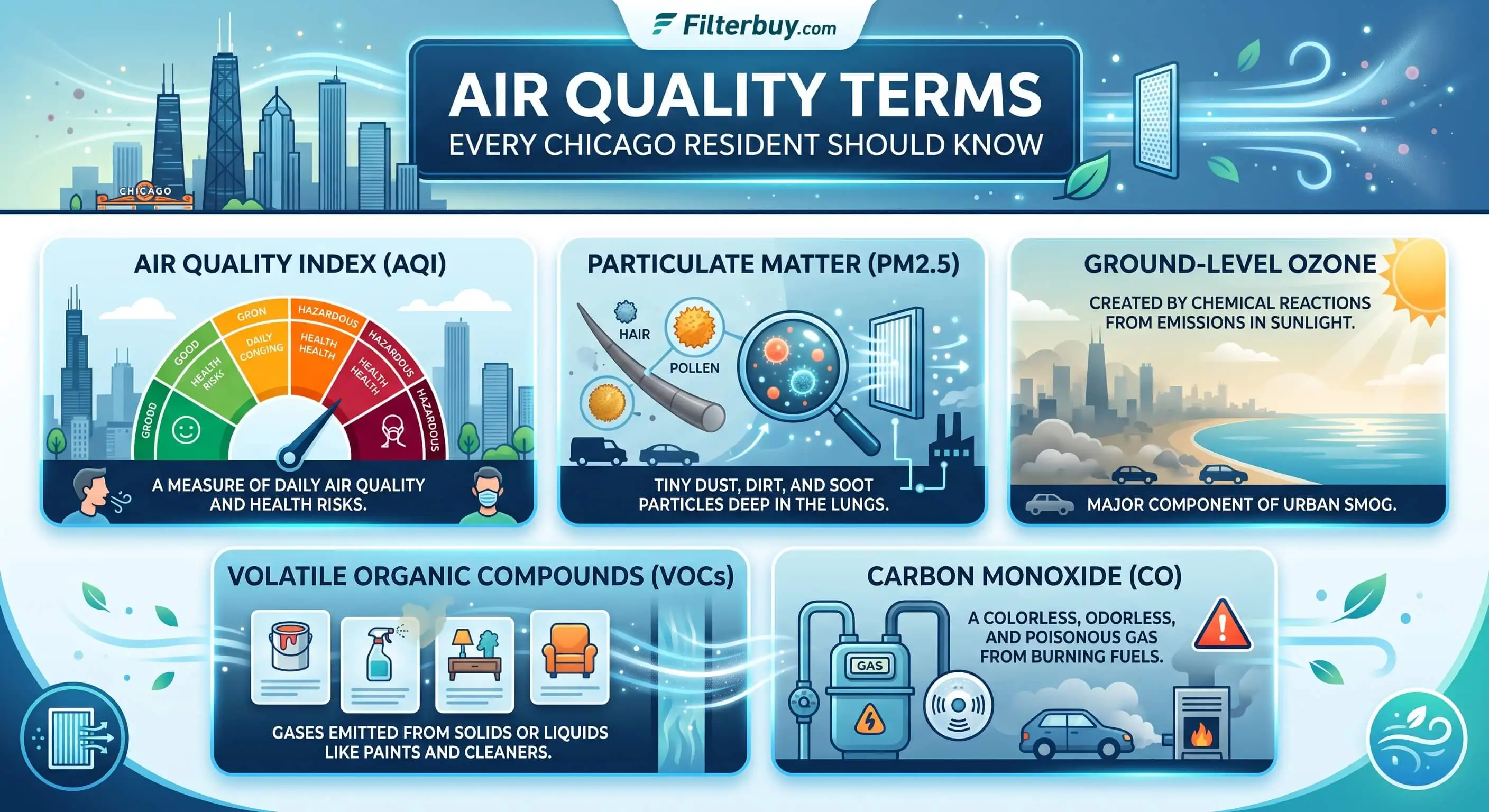
AQI (Air Quality Index)
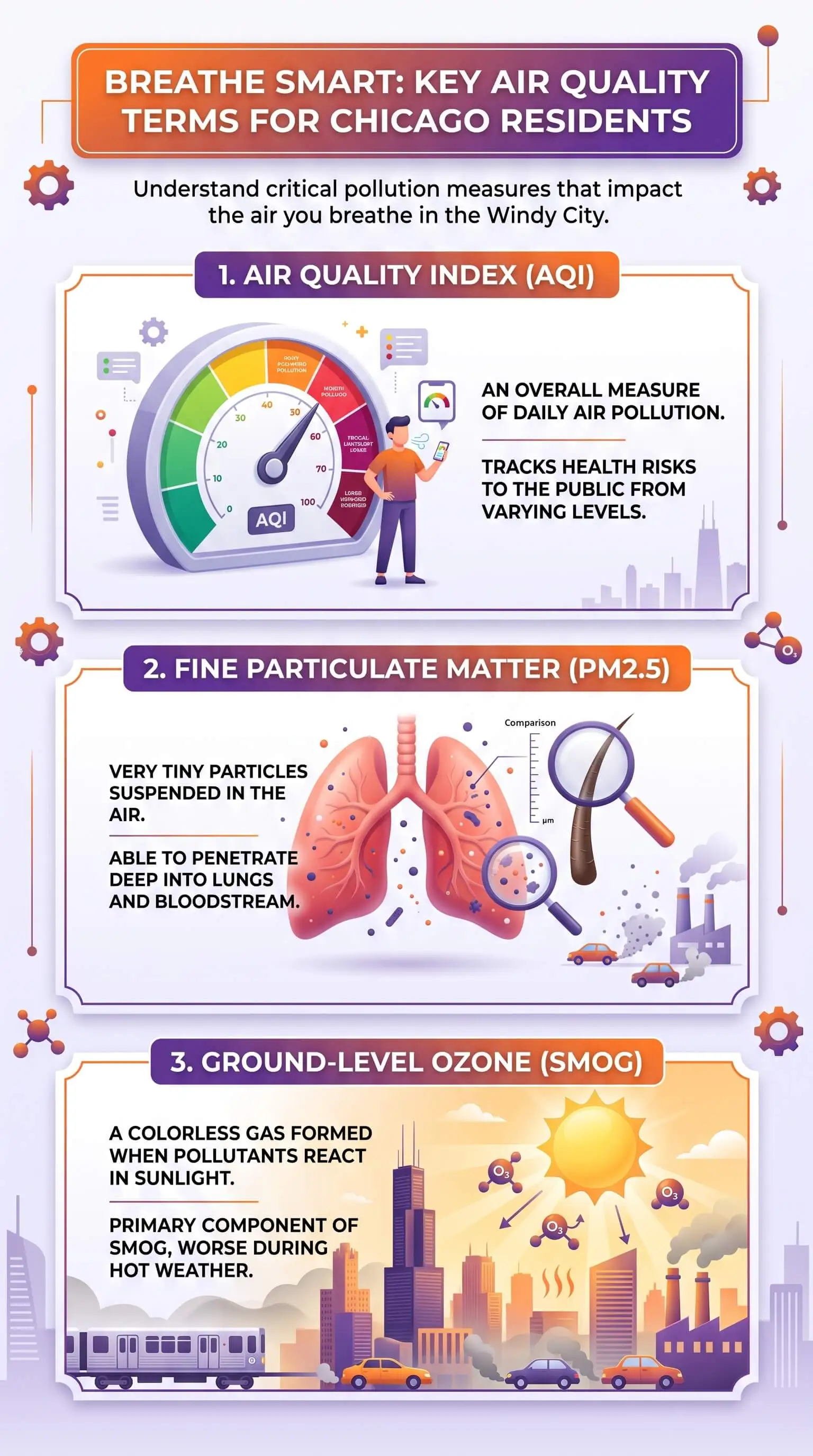
AQI is the master number. It runs from 0 to 500, and it always comes with a color: green, yellow, orange, red, purple, or maroon. Lower is better, every time, whether you're checking outdoor conditions or testing indoor air quality to create a healthier home environment.
PM2.5
PM2.5 refers to fine particles smaller than 2.5 micrometers. They slip past your nose and throat and settle deep in your lungs. On most Chicago days, PM2.5 is the pollutant actually driving the AQI number.
PM10
PM10 particles are larger, up to 10 micrometers. Dust, pollen, mold spores, and construction debris all fall into this category. They irritate the same way PM2.5 does, just higher up, in the nose and throat rather than deep in the lungs.
Ground-level ozone
Ground-level ozone has nothing to do with the protective ozone layer overhead — it forms at street level instead, when vehicle exhaust reacts with sunlight and heat. That is also why Chicago summer afternoons tend to post worse ozone readings than winter mornings do.
Main pollutant
The main pollutant is whichever one is pushing the AQI highest at that moment. In Chicago, that title almost always goes to PM2.5 or ground-level ozone.
Unhealthy for Sensitive Groups
This label covers the orange category, AQI 101 to 150. Kids, older adults, and anyone with asthma or a heart condition should be the first to scale back outdoor time.
Air Pollution Action Day
Illinois EPA calls one of these when the forecast points to Orange or worse across the Chicago area for a stretch of time. I treat that alert as my cue to switch the HVAC to recirculate and keep the windows shut.
Temperature inversion
A temperature inversion happens when warm air settles on top of cooler air near the ground, trapping pollution instead of letting it disperse. Chicago's lakefront setting makes inversions more common here than in a lot of inland cities, especially in summer.
“The day I learned what ‘main pollutant’ actually meant, the AQI number stopped being a mystery and started acting like a forecast I could plan around.”
7 Essential Resources
Check today's AQI in plain language
Check today's AQI in plain language AirNow's AQI Basics page lays out the 0-500 scale and all six color categories, and it is the fastest way to double-check what a local reading actually means.
Understand what PM2.5 is doing to your lungs
Understand what PM2.5 is doing to your lungs EPA's Particulate Matter Basics page explains why particles under 2.5 micrometers carry the greatest health risk of anything in the air.
See Chicago's own hyperlocal air sensor network
See Chicago's own hyperlocal air sensor network Open Air Chicago runs 277 sensors across the city, tracking PM2.5 and NO2 down to the neighborhood level, well beyond what federal monitors alone can capture.
Track Illinois' daily air quality forecasts
Track Illinois' daily air quality forecasts Illinois EPA posts daily forecasts for 14 sectors statewide and spells out exactly what triggers an Air Pollution Action Day.
Sign up for Cook County air quality alerts
Sign up for Cook County air quality alerts Cook County's Department of Environment and Sustainability explains how Air Quality Action Days get called and what residents should do once one hits.
Learn how air pollution affects asthma and heart health
Learn how air pollution affects asthma and heart health CDC connects the AQI directly to health guidance for anyone managing asthma or a heart condition.
Get ready before wildfire smoke reaches Illinois
Get ready before wildfire smoke reaches Illinois IDPH's wildfire smoke guidance covers what to do when Canadian wildfire smoke pushes PM2.5 higher here, which has turned into a near-yearly summer event.
These trusted resources help you monitor Chicago's air quality, understand changing pollution conditions, and decide when different types of air purifiers may help maintain cleaner indoor air during periods of elevated pollution or wildfire smoke.
3 Statistics
The Illinois Department of Public Health recommends keeping indoor PM2.5 under 35 micrograms per cubic meter and PM10 under 150 micrograms per cubic meter over any 24-hour period. (Source: Illinois Department of Public Health)
American Lung Association research links PM2.5 to more than 50,000 premature deaths in the United States every year. (Source: American Lung Association)
NASA estimates outdoor PM2.5 caused about 88,400 deaths nationwide in 2015, the fifth-highest mortality risk factor in the country that year. (Source: NASA)
These statistics show why reducing indoor particle exposure matters, especially when outdoor pollution levels rise, and why using a quality air filter can help support cleaner indoor air as part of a healthy home environment.
Final Thoughts and Opinion
I don't think most Chicago residents need to become air quality experts. I do think the AQI number deserves the same five seconds of attention we already give the weather forecast before walking out the door. Once you know that 142 means PM2.5 or ozone crossed into orange territory, the number stops being noise.
My own habit is simple: check the AQI the way I check the temperature, and let the color decide whether the windows stay open or the HVAC switches to recirculate. Keeping a 17.5x21x1 air filter on hand also helps me maintain cleaner indoor air whenever outdoor air quality takes a turn for the worse.
 Frequently Asked Questions
What is a good AQI number in Chicago?
Anything at or below 50 counts as Good. Once the number crosses 100, sensitive groups should start cutting back on outdoor time.
What is the difference between PM2.5 and PM10?
PM2.5 particles are smaller, at 2.5 micrometers or less, and they reach deeper into the lungs. PM10 particles run up to 10 micrometers and irritate the eyes, nose, and throat more than the lungs.
Why does Chicago's air quality get worse in summer?
Heat and sunlight drive ground-level ozone formation, and Lake Michigan's temperature inversions can trap that pollution near the surface instead of letting it disperse.
What does “Unhealthy for Sensitive Groups” actually mean for me?
It means the AQI has reached 101 to 150. Healthy adults can usually keep their normal routine. Anyone with asthma, a heart condition, or very young or older family members should shorten outdoor time that day.
Check Where Chicago's Air Stands Right Now
These terms are only useful once you put them next to today's actual number. Pull up Filterbuy's live Chicago AQI map and see the current reading for your own neighborhood, then decide from there whether the windows stay open and whether your home's MERV rating is appropriate for helping maintain cleaner indoor air when outdoor pollution levels increase.