Here's what we landed on. A family that washes frequently needs a mild soap made with plant-derived cleansers and glycerin, without sulfates, alcohol, antibacterial additives or added fragrance, and with every ingredient printed on the back. Moisturizer within a few minutes of each wash covers the rest. Washing less was never on the table.
If you're comparing options for the best all natural non toxic hand soap, check what a formula leaves out as closely as what it puts in. That one habit changed what we kept on our own counter.
TL;DR Quick Answers
Best All Natural Non Toxic Hand Soap
The best all natural non toxic hand soap is a plant-based formula made without alcohol, sulfates, parabens, synthetic fragrance or antibacterial additives, with every ingredient listed on the label. For a family that washes often, how gentle a soap is matters more than whether it says "natural."
What to look for:
Plant-derived cleansers such as coco-glucoside instead of sodium lauryl sulfate
Glycerin to hold moisture in the skin
Fragrance-free, essential oils included
No triclosan or other antibacterial actives, since the FDA says plain soap works just as well at home
Full ingredient disclosure, plus the USDA Organic seal if the label says "organic"
Our take as doctors and parents: use a gentle soap at the sink and a rinse-free, alcohol-free soap for the moments away from water, so hands get clean without another round of drying sanitizer. Then moisturize within minutes of every wash.
Top Takeaways
Keep washing, even when your hands are sore. The CDC credits handwashing education with 23 to 40% less diarrheal illness, so change the soap and the routine instead.
Choose gentle over "natural." Look for mild plant-derived cleansers and glycerin, and skip fragrance, alcohol and sulfates.
Leave antibacterial soap on the shelf. The FDA removed 19 antibacterial actives from consumer soaps in 2016 and still recommends plain soap and water.
Look for the USDA Organic seal before trusting the word "organic." "Natural" and "non-toxic" carry no legal definition at all.
Moisturize within minutes of every wash, as dermatologists recommend, and use a rinse-free, alcohol-free soap to cut down on wet-dry cycles away from the sink.
Why Frequent Handwashing Dries Out the Whole Family's Skin
Every wash takes some of your skin's natural oil with it. Those oils hold the outer barrier together, and when hands get washed ten or twenty times a day, the barrier never gets the chance to rebuild.
First the skin feels tight. Then it flakes, and eventually it cracks. The American Academy of Dermatology warns that those cracks let irritants and germs in more easily, which works against the whole reason you washed. Kids usually have it worse because they wash at school, at home and after every snack, and almost none of them reach for hand cream on their own. Anyone in the house with a history of eczema tends to feel it first. While air purifiers can help reduce certain airborne irritants at home, choosing a gentle hand soap is just as important for protecting sensitive skin from everyday irritation.
What the Best All-Natural, Non-Toxic Hand Soap Has in Common
We read a lot of soap labels while we were developing NOWATA. The formulas that hold up to all-day family use tend to share these traits:
Gentle cleansers. Plant-derived surfactants such as coco-glucoside or decyl glucoside strip less oil than sodium lauryl sulfate.
A humectant. Glycerin pulls water back into the skin between washes.
Little or no fragrance. Fragrance ranks among the most common skin irritants, and a plant source doesn't change that.
No antibacterial activities. According to the FDA, plain soap works just as well at home.
No alcohol, which dries skin that's already under strain.
Every ingredient is named. When a label says "fragrance" or "proprietary blend," you can't see what's touching your kids' hands.
An outside check. Search the product in EWG's Skin Deep database before it goes anywhere near your sink.
Natural Doesn't Always Mean Gentle
Most "best natural soap" roundups skip this, but a soap can be 100% plant-based and still be hard on hands that get washed all day.
Essential oils are the usual culprit. Lavender, tea tree and citrus oils smell clean, yet they can irritate skin or make it more sensitive over time. Traditional castile and bar soaps are simple and natural too, and plenty of frequent washers still find them drying because they're alkaline.
Our advice is to start unscented and change one product at a time. Give it a week, then look at everyone's hands, because that tells you more than anything printed on the bottle.
Reading the Label: "Natural," "Non-Toxic" and "Organic"
As scientists, this surprised us more than anything else we found. On cosmetics and soap, "natural" and "non-toxic" have no legal definition, so any brand can print them.
The word organic carries more weight when there's proof behind it. In the U.S., a personal care product can display the USDA Organic seal only after a USDA-accredited agent certifies its agricultural ingredients and its manufacturer. Without the seal, nobody has checked the claim.
So turn the bottle around. The ingredient list is the only part of the label you can hold a brand to.
Soap Types Compared for Families Who Wash Often
Here's how the main options stack up for a household that washes all day.
Conventional liquid soap with SLS lathers hard and lifts grease well, but it strips natural oils fast. Keep it for the occasional greasy job.
Antibacterial soap adds active ingredients without adding protection at home. The FDA pulled 19 of those actives, including triclosan, from consumer soaps in 2016, so we'd skip it.
Alcohol hand sanitizer kills many germs but leaves them sitting on the skin, and it struggles on visibly dirty hands. Used over and over, it dries skin quickly. It works best on clean hands when there's no sink.
Gentle plant-based liquid soap lifts germs and dirt with mild surfactants and goes easier on skin, especially in a fragrance-free version. This should be your everyday sink soap.
Rinse-free plant-based soap binds to dirt and germs so you can brush them off your hands, without alcohol or another soak-and-dry cycle. It fits the playground, the car, sports and travel.
The sanitizer point matters more than most parents expect, since kids' hands are rarely clean at the moment they need cleaning. We explain why sanitizer alone falls short on dirty hands in a separate guide.
A Hand-Care Routine That Works for Kids and Adults
The right soap gets you about halfway. This routine handles the rest:
Use lukewarm water. Hot water strips oil faster and doesn't clean any better.
Wash for at least 20 seconds, as the CDC recommends, covering the backs of hands, between fingers and under nails.
Pat dry. Rubbing with a towel adds friction to skin that's already stressed.
Moisturize within a few minutes, while skin is still a little damp. Dermatologists favor fragrance-free creams and ointments over thin pump lotions.
Treat cracks at bedtime with a thin layer of petroleum jelly.
Away from a sink, reach for a rinse-free, alcohol-free soap instead of another round of sanitizer.
If hands still crack, bleed or break out in a rash after a couple of weeks, see a board-certified dermatologist. Persistent dryness can be hand eczema, and that sometimes needs a prescription.
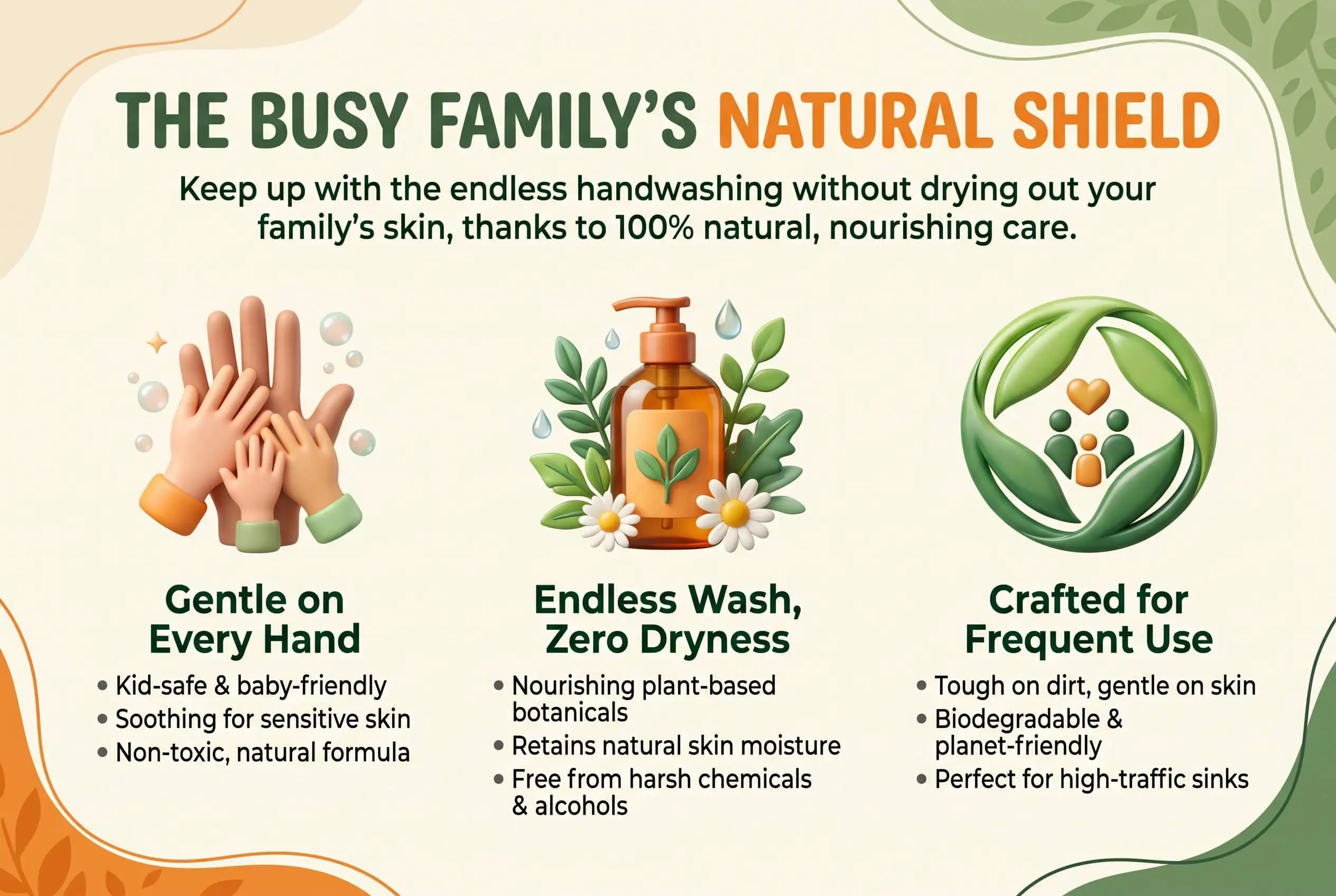
"We refused to rub alcohol and harsh chemicals on our own babies' hands, so before we formulated anything, we read the ingredient lists on the products we already owned. Much of what we found was there for lather, scent or a marketing claim, and very little of it had anything to do with clean hands. We spent two years building a plant-based formula without alcohol, sulfates, parabens or synthetic fragrance, and our kids used it before anyone else did. A family that washes all day won't get much from a stronger soap. What helps is a shorter label, with fewer ingredients the skin has to recover from."
7 Essential Resources
We leaned on these sources while developing NOWATA and while sorting out our own family's routine. Use them to check any soap you're considering, ours included.
1. Heal Dry Hands Without Washing Less
The American Academy of Dermatology walks through how to heal hands dried out by frequent washing, from when to moisturize to which ingredients to look for. It also explains when dryness needs a dermatologist.
Why we use it: it shows the answer is a better routine, and it names the moisturizer ingredients worth buying.
Source: American Academy of Dermatology: Dry skin relief from handwashing
2. See How Much Illness Handwashing Prevents
The CDC collects the data on how much illness clean hands prevent at home, at school and in the community.
Why we use it: on the days sore hands make skipping a wash tempting, these numbers are the reminder not to.
Source: CDC: Handwashing Facts
3. Skip Antibacterial Soap With Confidence
The FDA explains why it barred 19 antibacterial ingredients, triclosan among them, from consumer soaps in 2016 and why it still recommends plain soap and water.
Why we use it: it means one less harsh ingredient on a child's skin, with no protection lost.
Source: FDA: Skip the Antibacterial Soap; Use Plain Soap and Water
4. Find Out Which Label Claims Mean Anything
The FDA's cosmetics labeling page covers what brands have to disclose and which popular claims carry no legal definition.
Why we use it: it's the reason we list every ingredient and back our claims with third-party lab testing.
Source: FDA: Cosmetics Labeling Claims
5. Check What "Organic" Actually Requires
The USDA's National Organic Program spells out when a soap or other personal care product can legally carry the USDA Organic seal.
Why we use it: it separates certified products from bottles that only borrow the word.
Source: USDA Agricultural Marketing Service: Cosmetics, Body Care, and Personal Care Products
6. Spot When Dry Hands Become Hand Eczema
The National Eczema Association summarizes research tying frequent soap-and-water washing to hand eczema.
Why we use it: it helps parents recognize when a gentler soap isn't enough and a dermatologist should take a look.
Source: National Eczema Association: Hand Eczema Common Among Health Care Workers
7. Look Up Any Soap Before You Buy
The Environmental Working Group's Skin Deep database rates personal care products by ingredient hazard instead of marketing.
Why we use it: a two-minute search shows whether a "gentle" soap is hiding fragrance or another common irritant. Run ours through it too.
Source: EWG Skin Deep Cosmetics Database
3 Statistics
1. Handwashing Education Cuts Diarrheal Illness by 23 to 40%
According to the CDC, teaching people to wash their hands reduces diarrheal illness by 23 to 40% and respiratory illnesses such as colds by 16 to 21%.
What it means for your family: sore hands are a reason to change the soap and the routine, never a reason to wash less.
Source: CDC: Handwashing Facts
2. 31% of Frequent Washers Reported Hand Eczema Within a Year
Researchers surveyed 9,051 Swedish health care workers and found that 31% reported hand eczema over one year. The more often people washed with soap at work, the more likely they were to report it.
What it means for your family: a busy household can wash nearly as often as a clinic does, which is exactly why the formula and the moisturizer matter.
Source: National Eczema Association summary of the 2017 British Journal of Dermatology study
3. A Child Under Four at Home Was Linked to More Hand Eczema
In a Danish study published in Contact Dermatitis in 2012, 2,269 health care workers answered questions about hand eczema, and the researchers linked the condition to having a child younger than four in the household.
What it means for your family: as parents of young kids, we weren't surprised. Diapers, spills and sticky snack hands add up to a lot of washing for everyone in the house.
Source: Ibler, Jemec and Agner, Contact Dermatitis, 2012
Final Thoughts and Opinion
Our honest opinion is that "natural" is the least useful word on a soap bottle. Nobody regulates it, it says nothing about how gentle a formula is, and it can sit right beside an essential oil blend that leaves a child's knuckles red by the end of the week.
What protects a family that washes all day is far less exciting. You want fewer harsh ingredients and no fragrance you didn't ask for, without the antibacterial additives the FDA already says you can skip, plus moisturizer within minutes of every wash.
We also think most families are solving only half the problem. The sink gets all the attention, while the damage often piles up in the moments between: the playground, the car seat, the snack after soccer. That's when alcohol sanitizer goes onto hands that are already raw, again and again. Keeping a rinse-free, alcohol-free option for those moments lets skin recover without giving up clean hands.
The same thinking applies to the air in your home. You want to get rid of the problem instead of covering it up, which is how HEPA air purifiers remove contaminants rather than masking them.
We built our formula around that idea and tested it on our own kids first. Whatever you buy, decide with the ingredient list in your hand and a week of everyday use as the test.
Frequently Asked Questions
What makes a hand soap natural and non-toxic?
Neither word has a legal definition on soap, so the ingredient list has to do the work. We look for plant-derived cleansers, glycerin and full disclosure, and we skip alcohol, sulfates, parabens, synthetic fragrance and antibacterial additives. EWG Skin Deep is a quick way to double-check any product.
Which ingredients dry out hands with frequent washing?
The usual suspects are harsh sulfate cleansers like sodium lauryl sulfate, alcohol and fragrance, essential oils included. Hot water makes every one of them worse. For a family washing many times a day, removing even one of these often makes a visible difference.
Is natural soap as effective as antibacterial soap?
For everyday use at home, yes. The FDA has found no evidence that consumer antibacterial soaps prevent illness better than plain soap and water. Soap lifts germs and dirt off the skin so water can carry them away, and gentle plant-based soaps do that too.
Is natural hand soap safe for babies and kids?
A fragrance-free, alcohol-free, sulfate-free soap is a sensible place to start with kids. The word "natural" alone isn't enough, since essential oils can irritate young skin. We tested our own formula on our children before sharing it with anyone. If your child has eczema, check with your pediatrician or dermatologist before switching products.
How do I stop my family's hands from cracking without washing less?
Use lukewarm water, pat your hands dry and apply a fragrance-free moisturizer while skin is still slightly damp. At bedtime, put petroleum jelly on any cracked spots. When you're away from a sink, an alcohol-free, rinse-free soap spares already dry hands another round of sanitizer.
Is hand sanitizer gentler than soap for frequent use?
Usually not. Alcohol sanitizer can sting and dry out skin that's already cracked, and it doesn't remove dirt. It also works best on hands that already look clean. We cover sanitizer's limits against norovirus in another guide.
Give Your Family's Hands a Break
NOWATA started in our kitchen as a soap we'd feel good about putting on our own babies' hands. Our doctor-made formula is plant-based and rinse-free, made without alcohol, sulfates, parabens or synthetic fragrance, and in Swiss lab testing it physically removed over 99.9% of germs from skin.* Keep a bottle in the car, the backpack and the diaper bag for the moments when there's no sink nearby.
See the full ingredient list and how other families use it. Every order comes with a 30-day satisfaction guarantee.