
A clay tile roof can look perfect from State Street and still let water into the attic. On a lot of older Downtown homes, that's exactly what's happening, and nobody notices until a ceiling stain shows up.
I saw a good example last fall on a bungalow a block off State Street: three shades of red tile on one roof, a few tiles slipped out of line, and a strip of black patching along the ridge. Charming from the sidewalk. Much less so, I'd guess, from the attic.
So do older homes in Downtown Santa Barbara need specialized roof inspections? Most of them do. A roof inspection santa barbara homeowners can rely on documents what's happening under the tile, which is where these roofs usually start to fail. A quick look from a ladder won't tell you much about decades-old underlayment or the flat section hiding behind a parapet wall.
TL;DR Quick Answers
roof inspection santa barbara
Most older Downtown Santa Barbara homes need more than a glance from the street. Their 1920s-era clay tile usually holds up while the underlayment and flashing beneath it wear out, and historic-district rules shape how you can repair them. A roofer-led inspection with photos and written priorities shows you what needs fixing now and what can wait.
Tile usually outlasts the underlayment, so a good-looking roof can still leak.
Flat sections, parapets, scuppers and chimney flashing deserve a close look.
Inspect at least twice a year, plus before a sale and after big storms.
In El Pueblo Viejo, confirm repair requirements with the City first.
Top Takeaways
On older Santa Barbara homes, clay tile often outlives the underlayment that actually keeps water out.
Santa Barbara rebuilt much of Downtown after the 1925 earthquake, so many houses share the same tile and flat-roof weak spots.
The Historic Landmarks Commission reviews exterior changes in El Pueblo Viejo, which makes a documented inspection worth having before any work.
NRCA recommends inspections at least twice a year, ideally in spring and fall.
A good report tells you what to fix now and what you can simply monitor.
Why Older Downtown Santa Barbara Homes Age Differently
Every roof says something about when its house went up, and Downtown's roofs mostly point back to 1925. After the earthquake on June 29 of that year, the city was rebuilt in the Spanish Colonial Revival style. That choice is why red clay tile still covers so many rooftops between the Mission and the waterfront.
Clay tile lasts a very long time, but the layers under it rarely keep pace. The underlayment, wood battens and metal flashing do the real work of keeping water out, and on these houses they usually wear out well before the tile. So a roof can look fine from the street and still leak.
Older Downtown homes tend to share a few other traits:
Sloped tile paired with flat sections tucked behind parapet walls
Flashing and nails worn down by the marine layer and salt air
Decades of patches, mismatched replacement tiles and mortared ridges that make the roof's history hard to read
Chimneys, vents and skylights that owners added long after the original roof went on
What a Specialized Roof Inspection Checks on an Older Home
A specialized roof inspection for an older home is a documented, roofer-led evaluation of the hidden layers and transitions where older roofs fail, not only the tile you can see. This is especially important for roofing Santa Barbara homes with aging materials and complex roof structures.
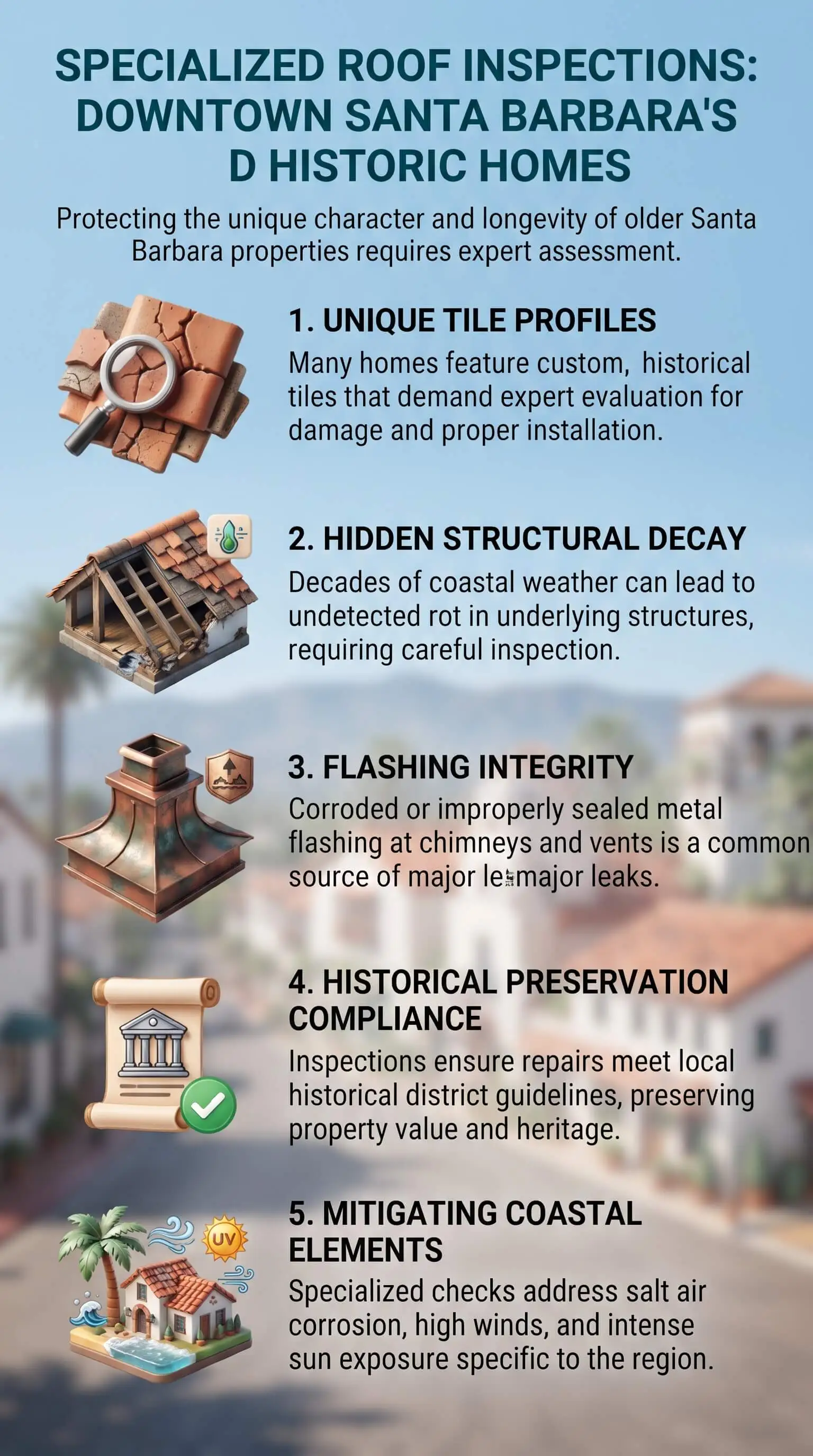
Clay Tile Condition and How It's Walked
The inspector looks for cracked, slipped, broken or missing tiles. How they move across the roof matters just as much. Old clay tile cracks when someone steps in the wrong spot, so an experienced tile roofer walks only where the tile has support underneath. On slopes nobody should walk at all, a drone can photograph the surface instead.
Underlayment Beneath the Tile
Most older tile roofs fail right here. Water stains on the roof deck and dark streaks on attic framing both point the same way, and so does brittle material showing through a broken tile. Once the underlayment gives out, the tile on top can't keep water out by itself.
Flat Sections, Parapets and Scuppers
On flat areas, the inspector checks seams, perimeter edges, cracked parapet caps and any spots where water sits after rain. Scuppers and drains matter more than most people expect. One outlet packed with leaves can push a winter storm's worth of water into a wall.
Chimneys, Flashing and Old Penetrations
Chimney flashing, wall flashing and the small crickets behind chimneys are classic leak points. Older houses also tend to have abandoned vents and skylights that someone sealed decades ago and nobody has looked at since. And once a slow leak soaks attic insulation, it can start to affect your home's indoor air quality too.
Prior Repairs and the Written Report
A useful inspection ends with photos and written findings in clear, practical language. The best reports separate immediate needs from items you can maintain or simply monitor. Not every finding means the roof needs to be replaced, and a good report shows you which ones do.
Historic District Rules and Why Documentation Matters
Many Downtown properties sit inside the El Pueblo Viejo Landmark District. The City's Historic Landmarks Commission reviews exterior alterations there, and any change has to fit the Spanish Colonial Revival tradition.
That's where a documented inspection earns its keep. With photos of every problem area, you can plan like-for-like repairs and find out early whether your roofer can save the original tile or needs to match it. What applies depends on your property and the scope of work, so check with the City's Planning Division before anyone starts.
Is a Home Inspector's Roof Check Enough for an Older Home?
A general home inspector looks at the visible roof covering, flashing, gutters and penetrations. That's a fair starting point. On a tile roof, or a house with both tile and flat sections, a roofer adds judgment about the underlayment and about which repairs can wait.
If I were buying an older Downtown home, I'd hire both. The home inspector covers the whole house. The roofer tells you what the roof will need over the next few years, and roughly in what order.
When to Schedule a Roof Inspection in Santa Barbara
The National Roofing Contractors Association recommends scheduled roof inspections at least twice a year, preferably in spring and fall. On an older Downtown home, some moments call for one no matter what the calendar says:
Before you buy or sell
Before the winter rains arrive
After a strong windstorm or a heavy downpour
When a ceiling stain shows up and nobody can find the source
Before solar panels go on
Before you plan exterior work in El Pueblo Viejo
Most residential inspections take about 60 to 90 minutes on site. Expect the written report, with photos, within two to three business days. The findings can also help you determine if roof replacement Santa Barbara services should be a priority.

"I used to judge an old tile roof by how it looked from the sidewalk. Then I learned how often the tile on a 1920s house is perfectly sound while everything underneath it has worn out. These days the tile is the last thing I trust, even though it's the first thing everyone checks."
7 Essential Resources
See what the Historic Landmarks Commission reviews The City explains how El Pueblo Viejo began in 1959 and confirms that the Commission reviews exterior alterations to properties inside the district.
Read the City's guidance on historic roofs and tile Chapter 2.5 of the Historic Resource Design Guidelines covers historic roof forms, roof materials, tile and chimneys.
Understand what makes a Spanish Colonial Revival roof historic This City guide points out the terra cotta tile and eave details that define the style. Worth a read before you price out a like-for-like repair.
Review the El Pueblo Viejo design standards The City's Historic Resources Ordinance sets the design review standards that keep district exteriors in line with the Spanish Colonial Revival tradition.
Learn how often roofs should be inspected In NRCA's Professional Roofing magazine, the association explains why scheduled inspections form the foundation of roof maintenance and when an extra check makes sense.
Discover why Downtown looks the way it does Downtown Santa Barbara's history page traces the line from the 1925 earthquake to the red tile roofs and white stucco walls the district is known for.
Verify a roofer's license before you hire The Contractors State License Board's free lookup shows a contractor's license status, classification and complaint history.
Together, these cover your roof's history, the rules around it and how to check who's working on it. If an inspection eventually leads to a tear-off, plan ahead for heavy debris like old clay tile, because it adds up fast by weight.
3 Statistics
About 23.6% of City of Santa Barbara parcels hold structures built before 1945: 1.5% before 1900, 9.8% between 1900 and 1924, and 12.3% between 1925 and 1944. (Source: City of Santa Barbara Historic Resources Year Built Map)
The National Roofing Contractors Association recommends scheduled roof inspections at least twice per year, preferably in spring and fall. (Source: Professional Roofing, NRCA)
The June 29, 1925 Santa Barbara earthquake caused an estimated $8 million in damage and 13 deaths, and the rebuild that followed gave Downtown its Spanish Colonial Revival look. (Source: Southern California Earthquake Data Center)
Roughly one parcel in four predates modern roofing materials, which is why routine checks matter so much here. NRCA even compares roof inspections to the service people already book for heating and cooling, much like yearly professional maintenance for a furnace.
Final Thoughts and Opinion
I don't think older Downtown homeowners need to lose sleep over their roofs. Clay tile earned its reputation, and plenty of these roofs have years of life left. I just don't trust the view from the sidewalk anymore.
If your house went up before about 1950, get the roof documented before you spend money on it. A paid inspection is a small cost next to paying for tile work twice because the first repair missed the real problem. More often than not, the report points to repairs or monitoring rather than a new roof.
Inside El Pueblo Viejo, I'd call it essential. A written record turns "I think the roof is old" into a plan you can hand to a roofer and, if it comes to that, bring it to the City.
Frequently Asked Questions
How often should an older Santa Barbara home get a roof inspection?
The National Roofing Contractors Association recommends at least twice a year, ideally in spring and fall. On an older Downtown home, I'd add one before buying or selling, one before the winter rains, and one after any storm strong enough to rattle the windows.
Can an inspector walk on a clay tile roof without breaking tiles?
Yes, as long as they know the tile. An experienced inspector steps only where the tiles have support and stays off fragile areas completely. On steep or delicate slopes, a drone can capture the roof's condition without anyone setting foot on it.
Does the underlayment on a tile roof wear out before the tile?
Usually, yes. Clay tile can last for generations, but the underlayment beneath it gives out much sooner. That's how an older tile roof can look perfectly fine from the street while water is already getting through underneath.
Do I need City approval to repair a roof in El Pueblo Viejo?
That depends on your property and the scope of the work. The Historic Landmarks Commission reviews exterior alterations in the district, so call the City's Planning Division before anything starts. A documented inspection in hand makes that call a lot easier.
Is a home inspector's roof check enough when buying an older Downtown home?
It's a good start, though often not enough by itself. A home inspector covers the whole house. A roofer adds trade-level judgment on tile, underlayment and flat sections, plus which repairs come first. In an older home, hiring both is the safer bet.
How much does a roof inspection in Santa Barbara cost?
The price depends on the property, the roof type, the reason for the inspection and any reporting deadline. Roofers usually charge for a formal inspection and quote it per property, with photos and a written report included. Many offer free estimates for repair work.
Know What's Under Your Downtown Tile Before the Rains
If nobody has looked past your tile in a few years, schedule an inspection before the rainy season starts. Choose a licensed local roofer who works on clay tile and flat roofs all the time, and ask for photos with written findings. You'll come away with clear next steps: what needs fixing now and what can safely wait.


